Why are eCOA studies still so challenging?

Despite having now implemented electronic clinical outcome assessments (eCOA) in clinical trials for decades, we continue to hit the same road blocks during operational set-up and implementation. This causes frustration for all stakeholders – sponsors, CROs, and eCOA providers alike.
Yet, many of these challenges are solvable, and the industry must take greater accountability for eliminating them. Addressing these issues will enable more efficient, effective use of eCOA and help realise its full potential to drive more productive clinical trials.
Following are some of the top challenges and solutions:
-
Licensing and translations
The COA licensing process remains a major bottleneck in clinical trial start-up and is one of the most frequently cited pain points in eCOA set-up and implementation. Key challenges include:
- Difficulty identifying the correct copyright holder
- Slow response times from licensors
- Lack of transparency around licensing terms, pricing, and included materials
- Lengthy contract review processes
- Delays caused by withholding the actual COA instrument until after license execution and payment
- Translation management inefficiencies
Essentially, there is no standard, which makes eCOA set-up and implementation difficult to navigate, often unpredictable, and a significant resource and time burden.
As mentioned, copyright owners often don’t provide sample copies of the measure, which means that sponsors and their partners lack all of the information needed to determine if the measure is appropriate for the study before purchasing the rights. This creates risks for protocol development, eCOA feasibility assessments, and system build timelines — especially when eCOA implementation often sits on the critical path to first patient in (FPI). Figure 1 shows industry averages and dependencies for many of the key activities in the licensing and translation process, and how that fits in with the eCOA build activities.
Suggested action? A few simple steps can significantly ease the complexity of licensing. The first is for copyright holders to provide clarity on pricing and deliverables up front. What is the study sponsor purchasing? What are the costs? What are the review/approval process requirements? In addition, availability of sample instruments would save significant time for sponsors and eCOA providers.
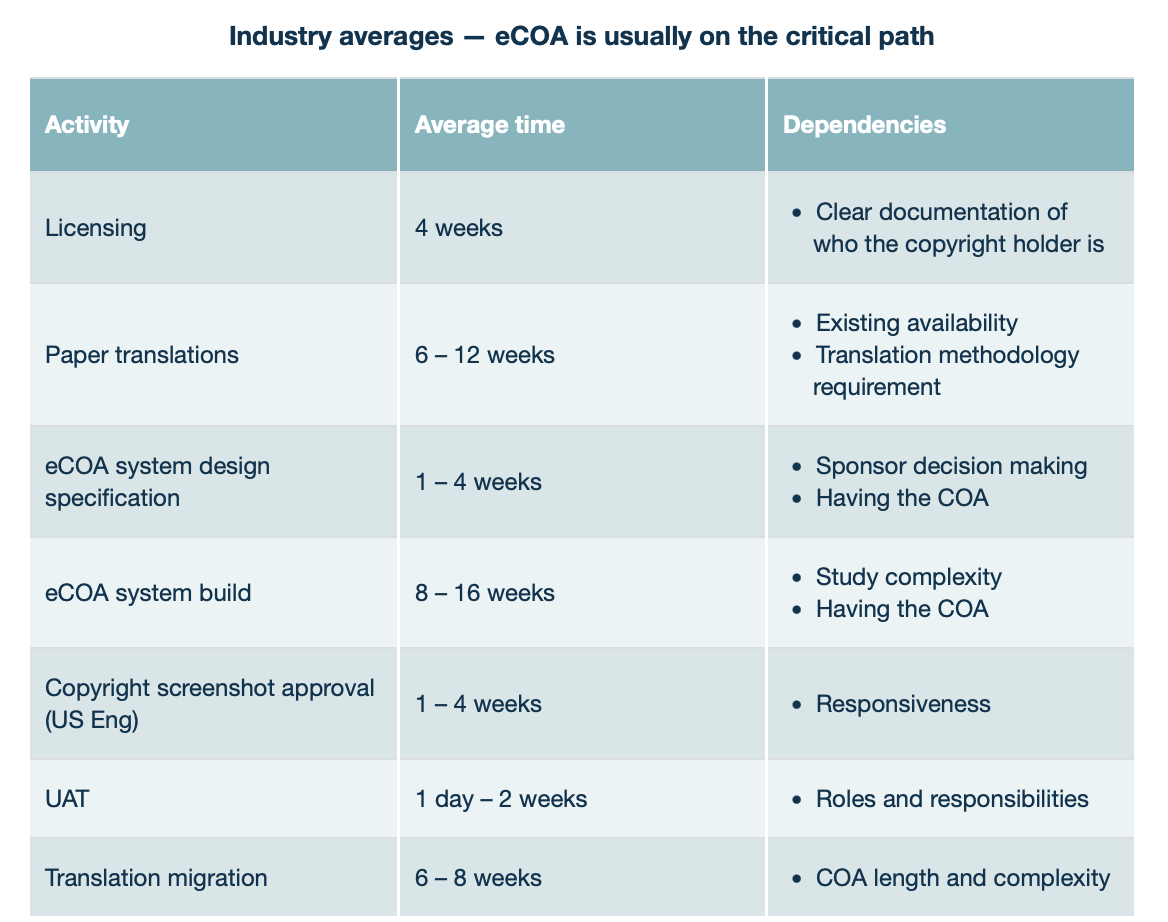
Figure 1. Industry averages and dependencies for many of the key activities in the eCOA build, licensing, and translation process.
-
Perceived need for eCOA screenshots for institutional review board (IRB)/ethics committee (EC) submission
Somewhere along the way, there became a perception, and subsequent ‘requirement’, that when a COA is implemented electronically, submitting the paper version will not suffice for institutional review board (IRB) or ethics committee (EC) review, and that both the paper format and the migrated electronic screenshots are required.
And, even when certain IRBs and ECs have publicly stated they are not required, many still feel it is too risky to not submit them ‘just in case’.
The primary goal of IRBs and ECs is to ensure that studies are conducted ethically and to protect the safety and wellbeing of participants. Migrating a paper format of a questionnaire to electronic format does not change the content or meaning of the COA or introduce any risks to participant safety or wellbeing.
Providing eCOA screenshots can significantly and needlessly delay time to study launch as eCOA design, build, and copyright holder review of screens, as well as translations, must all be completed prior to submission, for no additional value to ethics committee review.
Suggested action? All IRB/ECs should publicly document that they do not require screenshots. They should also continue to educate and reinforce this message by reminding sponsors and CROs that do submit screenshots that they are not required.
-
Fragmented stakeholder collaboration and lack of true partnership
Rigorous planning and open collaboration across multiple stakeholders — each bringing a unique skill set — is essential to a successful study launch and to successfully navigating complexities. For example, sponsors bring therapeutic area experience, CROs provide clinical operations expertise and resources, and technology providers bring critical knowledge of digital solutions, data capture and delivery, and participant and site journey experience.
Understanding these roles, and appreciating and orchestrating the value that each stakeholder can and should deliver to the study is vital, but often not prioritised. Too often we are seeing strictly transactional relationships. This can lead to silos and knowledge gaps that increase the risk of study delays, errors, and even compromised data quality.
Suggested action? Take a partnership approach. Recognise the opportunity to leverage the expertise that each stakeholder brings and pool the collective expertise – and cultivate it – to reach the best outcome.
To function as partners, who work together to create and find solutions to the inevitable challenges, requires an environment in which all parties (sponsor, CRO, and technology provider) can:
- Operate with trust, transparency, and respect
- Feel confident to take accountability and solve problems together
- Put agendas aside to support the success of the team
Setting up a strong governance framework, which prioritises transparency and open communication can go a long way toward creating a culture of collaboration.
All of the challenges described can impact:
- Timelines
- Efficiency
- Quality
- Site experience
- Participant experience
…and ultimately getting effective medications to those in need.
As an industry, we must move forward collaboratively to advance the productivity, quality, and efficiency of clinical trials. Patients and their families are depending on us. Modern technology, including eCOA, can and must play an important role in accelerating this journey. The positive news is that these challenges are all readily addressable through a spirit of collaboration, strong governance, education, and regulatory clarity. Let’s begin today.
About the author
 Florence Mowlem, PhD, is an expert eCOA scientist who has spent her career advising and guiding organisations on the electronic capture of clinical outcome assessments (COA) and the use of digital health technologies (DHTs) in clinical trials. She has a deep knowledge of clinical research, study design, and leveraging technology to support it, having worked at the intersection between science and technology to navigate for better solutions.