Trump order upturns federal childhood vaccines policy
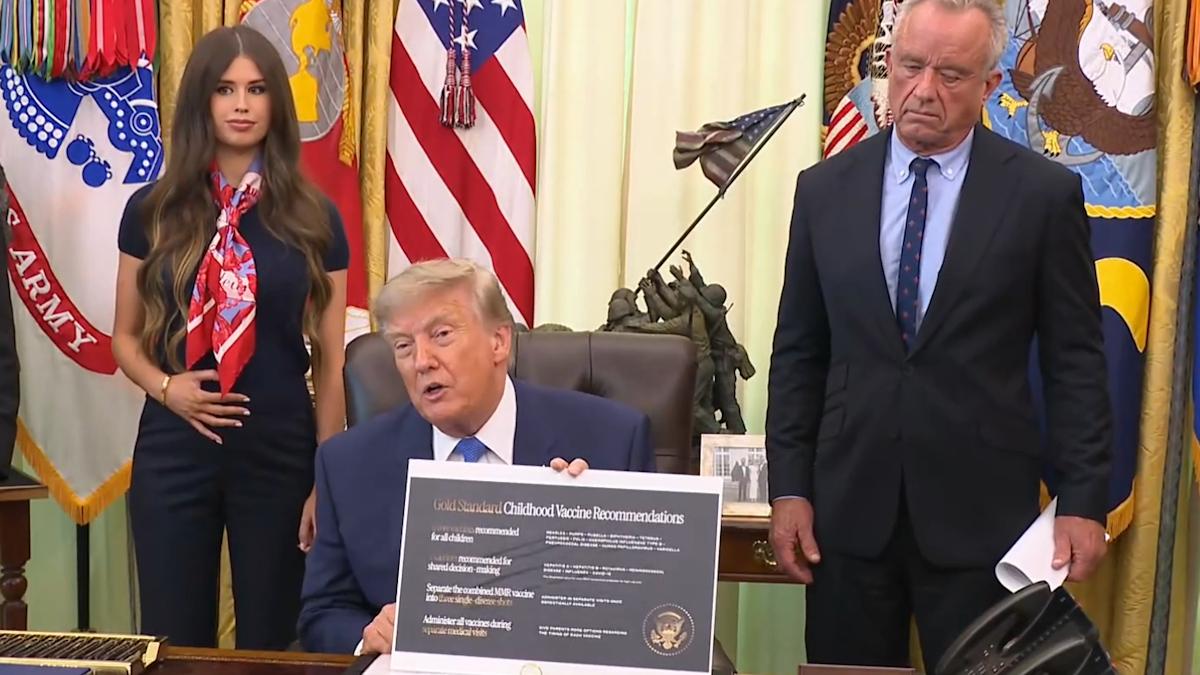
US President Donald Trump has signed an executive order that rips up the current US policy on childhood immunisations, limiting the schedule to 11 shots, a move that medical experts said will put "children's health at risk."
In amongst the detail of the order is the assertion that the measles, mumps and rubella (MMR) vaccine should be administered as three separate jabs – even though individual vaccines for each component are not available in the US and it could take years to get them developed, validated, and approved.
"As measles cases reach a 35-year high in the US, and with cold and flu season quickly approaching, today's executive order on vaccines is not only disheartening, but dangerous," said Andrew Racine, president of the American Academy of Pediatrics (AAP).
"Instead of ensuring every family can access life-saving vaccines for measles, influenza, RSV, and more, federal leaders are once again spreading misleading claims," he added. "There is no new evidence to justify significant changes to childhood immunisation guidance."
The broad sweeps of the order have been clearly signalled by HHS agencies under Secretary Robert F. Kennedy Jr, a well-established vaccine sceptic who has perpetuated the myth of a link between vaccines and autism.
Trump parroted that firmly debunked viewpoint at a press call to publicise the order at the White House, claiming that the change "finally aligns the United States with other advanced and developed nations around the world."
"Decades ago, children received only a small fraction of the vaccines required today. In those times […] the high rates of autism now observed did not exist," he said. "So, there's a reason for such epidemic rates of autism, and we're going to bring it back to where it was."
From there, reality soon evaporated, with the President claiming: "I've seen proof of it. Where they have a vaccination that looks like the size of a bottle of soda poured into a little child's body. And bad things happen in many cases, in too many cases, because this is an explosion. This is an epidemic."
A standard vaccine dose for a child is typically 0.5 ml, which is equivalent to just a few drops of liquid.
On the order to split the MMR dose, he added: "Together, there could be a possibility they're quite lethal, but separately it looks like they are not at all lethal, but just very effective."
MMR vaccine manufacturer MSD – known as Merck & Co in the US and Canada – said there was no evidence showing any benefit of splitting the shot into three parts, and suggested that could lead to missed doses and inadequate protection against the diseases.
Under Kennedy, the CDC has already slashed the US immunisation schedule to remove shots against six of 17 diseases, only to have the move blocked in federal court. Meanwhile, at least 28 states have already refused to accept changes to the childhood vaccine schedule introduced under his watch and are sticking to the earlier recommendations.
At the time the plan was announced, the PhRMA trade organisation's chief medical officer, Dr Mike Ybarra, said the changes were "not in the best interest of American families and add further confusion for parents and healthcare providers navigating an already complex system."
The executive order recommends measles, mumps, rubella, diphtheria, tetanus, pertussis, polio, Haemophilus influenzae type B, pneumococcal disease, human papillomavirus, and chickenpox shots for all children. RSV, hepatitis A, hepatitis B, meningococcal B, meningococcal ACWY, and dengue are recommended only for children and adolescents in high-risk populations.
Meanwhile, hepatitis A, hepatitis B, rotavirus, meningococcal disease, influenza, and COVID-19 should only be administered with "shared clinical decision-making" – a category that means patients need a sign-off from their healthcare provider before they can get them and which experts argue effectively downgrades and undermines their validity.
The order also states that vaccines should be administered at separate medical visits, adding to the number required and likely placing an additional logistical and financial strain on families.
Responding to the order, American Medical Association (AMA) president Dr Willie Underwood III said: "Vaccines are among the most thoroughly studied, effective tools we have to protect children from serious vaccine-preventable diseases. Altering a proven vaccination schedule without credible evidence risks weakening public confidence and putting children's health at risk."