GSK shares come under pressure from weaker vaccine sales
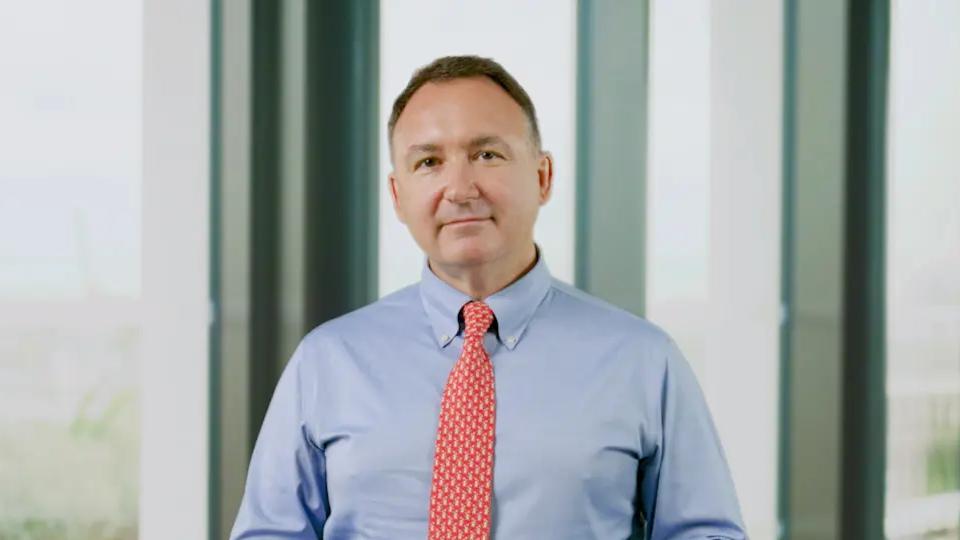
GSK's chief executive, Luke Miels.
Shares in GSK fell today on a 2% decline in vaccine sales in the third quarter, although demand for other medicines was strong and there are signs that the revamp of the business under new management is taking hold.
Vaccine sales came in at £2.6 billion, below analyst expectations and dragged down by a 5% decline for shingles vaccine Shingrix and a 22% fall for RSV shot Arexvy, while total group sales grew 5% to £8.9 billion on strong gains for its speciality medicines and HIV drugs.
The bright spot for the UK-headquartered company was a 15% gain for speciality drugs, with cancer therapies rising 23% to £622 million fuelled by strong growth for immunotherapy Jemperli (dostarlimab) and Ojjaara/Omjjara (momelotinib) for myelofibrosis.
Chief executive Luke Miels, who took over at the start of the year, said the results showed that GSK's key growth products and new launches are "performing well," and reiterated the group's commitment to "operational delivery, execution, and accelerating R&D."
That will be important if GSK is to weather an upcoming storm of patent expirations for four HIV medicines based on its integrase inhibitor dolutegravir, sold by its majority-owned HIV unit ViiV Healthcare, from 2028 onwards.
Dolutegravir-containing brands Tivicay, Dovato, Juluca, and Triumeq collectively contributed $1.45 billion to GSK's total HIV sales of £2.12 billion in the third quarter, and it is looking to new long-acting injectables based on cabotegravir, Apretude and Cabenuva, to compensate once generics enter the market. So far, the signs are good, with Apretude growing 21% to £143 million and Cabenuva up 35% to £478 million in the quarter.
Meanwhile, the company is facing a more challenging environment for vaccines in the US, which has seen recommendations for some shots scaled back under Kennedy and federal funding slashed for R&D projects, which has poured cold water on the sector. GSK is predicting that full-year sales of vaccines – which generate 28% of its total revenues – will be either flat or grow by a low single-digit percentage this year.
Miels highlighted three recent specialty medicine approvals that he thinks are key to GSK's future financial performance, namely chronic hepatitis B virus (HBV) therapy Hibsago (bepirovirsen), Jideytro (zidesamtinib) for non-small cell lung cancer (NSCLC), and Jemperli for a new rectal cancer indication.
He also said GSK is on track to start 22 phase 3 trials this year, with 18 already underway.
Some of the company's most keenly anticipated near-term prospects include two antibody-drug conjugates (ADCs) for cancer featured at the just-completed ESMO congress (ris-rez and mo-rez), ALK inhibitor neladalkib – which, like Jideytro, came from GSK's $10.6 billion Nuvalent takeover – and FGF21 analogue efimosfermin alfa for liver disorders.