ESMO26: 'Unprecedented' results from DeLLphi-305 in SCLC
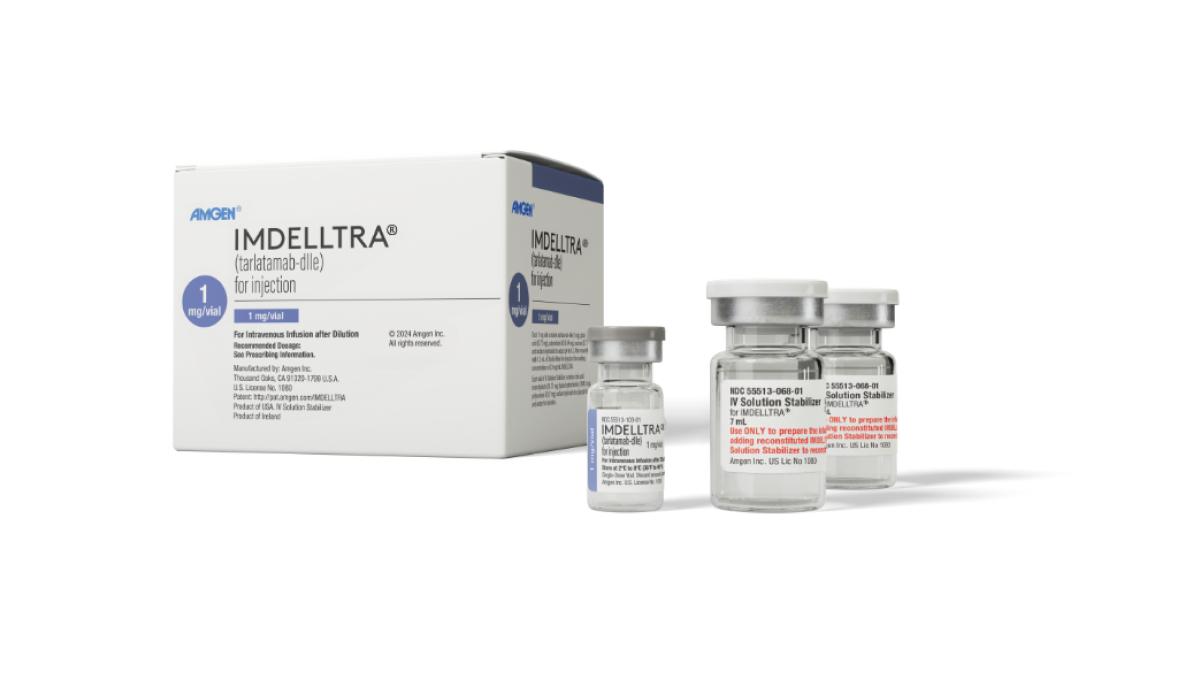
Amgen has revealed data that it hopes will move its DLL3-targeting T cell engager Imdelltra into the first-line setting in small cell lung cancer (SCLC) as a combination regimen with AstraZeneca's Imfinzi.
The full look at the results of the DeLLphi-305 study of Imdelltra (tarlatamab) and Imfinzi (durvalumab) as first-line maintenance therapy for extensive-stage SCLC (ES-SCLC) whose disease had not progressed after standard induction therapy revealed a 58% reduced risk of death, compared to Imfinzi alone, at 16 months' follow-up.
Median overall survival (OS) was extended by more than eight months to 21.1 months with the dual regimen, compared with 12.7 months with Imfinzi alone.
Amgen said that this is an "unprecedented" result in this form of cancer, with nearly 80% of patients still alive at one year compared to 53% of the control group, while progression-free survival (PFS) more than tripled to 7.9 months versus 1.9 months.
While SCLC can respond fairly well to initial chemotherapy, relapses are frequent, and the go-to second-line chemo – topotecan – has dismal efficacy, achieving OS rates of less than 10% over 12 months.
"For a disease where durable survival has remained extremely difficult to achieve, the magnitude and consistency of benefit in DeLLphi-305 are striking," said Jacob Sands, of the Dana-Farber Cancer Institute, who presented the results at ESMO. "Importantly, the benefit was seen across clinically relevant groups, including patients with brain metastases," he added.
That points to "the importance of effective treatment at the earliest possible opportunity," said Sands.
The result is even more impressive than that seen in the IMforte trial of Jazz Pharma/PharmaMar's Zepzelca (lurbinectedin) and Roche's PD-L1 inhibitor Tecentriq (atezolizumab) in a similar setting, which extended OS by 27% to 13.2 months from 10.6 months with Tecentriq alone. Zepzelca/Tecentriq has since been cleared for first-line maintenance of ES-SCLC.
Imdelltra has become a key growth product for Amgen since being approved as a treatment for ES-SCLC patients with disease progression on or after platinum-based chemotherapy, with sales reaching $627 million in 2025, its first full year on the market, and extending its label to include first-line maintenance could help that momentum build further.
For AZ, meanwhile, it offers the prospect of extending the label for Imfinzi from its current use in combination with chemotherapy as a first-line therapy for ES-SCLC and as a maintenance therapy for limited-stage SCLC (LS-SCLC) in patients whose disease has not progressed following concurrent platinum-based chemo and radiation therapy (cCRT).
ESMO commentator Dr Stephen Liu from Georgetown Lombardi Comprehensive Cancer Center said that the PFS improvement with the dual regimen is "profound," adding: "To keep this cancer from relapsing for that period is quite remarkable."
Liu also pointed to other therapies that have shown promise in ES-SCLC, including anti-B7-H3 antibody-drug conjugates (ADCs) from Roche/MediLink (tambotatug pelitecan) and GSK (risvutatug rezetecan) that could "provide important second-line options if tarlatamab moves successfully into the first-line space," as well as potential first-line agents in their own right.