The pre-commercial case for connecting data before acquiring more

Emerging biopharma companies (EBPs) are now bringing more of their own products to market instead of handing them to a larger partner. Of the 48 new drugs launched in the United States in 2024, EBP companies originated 41 and brought 26 of those to market themselves.1
They tend to work in specialty, oncology, and rare disease, where patient populations are small and spread across healthcare settings. Patients may be undiagnosed, which makes finding them a pre-launch task, rather than a post-launch one. A company in this position gets only one chance to launch, with far less room for error than an established company with products already on the market.
That one chance rests on a set of decisions about data and the systems that hold it. Those decisions are usually made quickly, and often in a fragmented way. They determine whether a team can find the right patients, reach the physicians treating them, and track the launch early enough to respond. Each choice is made on its own, and together they leave a disconnected data setup that is expensive and disruptive to fix, so it often goes unaddressed. Larger companies have departments and processes to manage data and systems, but a small commercial team does not.
Start with a data strategy, not a data shopping list
The first step toward bringing a product to market is defining success, not buying data. Launch requires a data strategy that starts with agreement on the key performance indicators (KPIs), and those depend on the therapeutic area. A company entering a crowded market may define success as the share it can win. A company treating an indication with a few thousand patients nationwide measures success by how many start treatment.
Only once those measures are set can companies decide what data to buy. Most need to acquire third-party data alongside the data they generate themselves, and that second data set is wider than it appears. Their own data may include patient services, specialty pharmacy, specialty distributor, and supply chain records, together with what sales representatives and medical science liaisons (MSLs) learn as engagement begins. Several of those streams build only after launch, as do customer relationship management and digital promotion data, so what a team needs at launch differs from what it will need once the product is in market.
Launch readiness comes from the strategy behind the purchases, not from the number of sources bought. A shopping list leaves a company with a collection of sources. An agreed set of measures turns those sources into something it can test against.
What disconnected data costs before launch
When those sources sit in separate systems with no shared way to connect them, three costs follow, and each one lands where a pre-launch team can least afford it. The first is limited visibility into launch performance, so problems are identified later than they need to be. The second is less precise targeting of healthcare professionals (HCPs), which can send a small field team toward physicians who are less likely to treat the condition, in a market where the right ones are hard to identify.
The third is less obvious, but over a launch year it often becomes larger than the other two. Reconciling data by hand is a staffing cost that is difficult to quantify. A senior director of commercial analytics who spends hours each week cleansing and integrating data is not driving strategy as they were hired to do. For a company counting every dollar, that time is as expensive as the data itself.
Connect the data before buying more of it
Companies may gain more value by connecting existing data sources than by acquiring additional ones. Two approaches are often discussed together and are worth separating. Data integration connects different sources to build a fuller set of data points about one subject, such as a physician or a patient. Data stacking supplies the same data point from several sources, then reconciles the versions into a single value, hoping to find more patients in the data. Stacking has its place and, in rare disease, where some manufacturers restrict how their data is shared, it may be the only way to get a comprehensive view. But three sources of the same type rarely produce three times the coverage, because they overlap heavily with one another.
The usefulness of additional data is narrow. If a source already covers most of the relevant population, adding 10% to 20% more patients may not be worth the procurement, cleanup, and onboarding costs.
One commercial team bought laboratory data to find patients whose disease was uncontrolled, then discovered that the claims data it already held identified the same patients. Asking whether an extra purchase will change a decision before the money is committed is the least expensive safeguard available.
Build the infrastructure in stages
Connecting existing sources does not require building everything at once. A practical foundation usually means linking sources through common identifiers like the HCP, the patient, and the payer. Linking compares different data sets against a large reference file to find overlaps, fill gaps, and correct quality problems.2 It is often good enough to launch on and avoids the specialist teams and ongoing expense of full master data management (MDM). Enterprise MDM remains the right goal as commercial needs grow, but a phased approach lets the infrastructure scale with the business, as Figure 1 shows.3
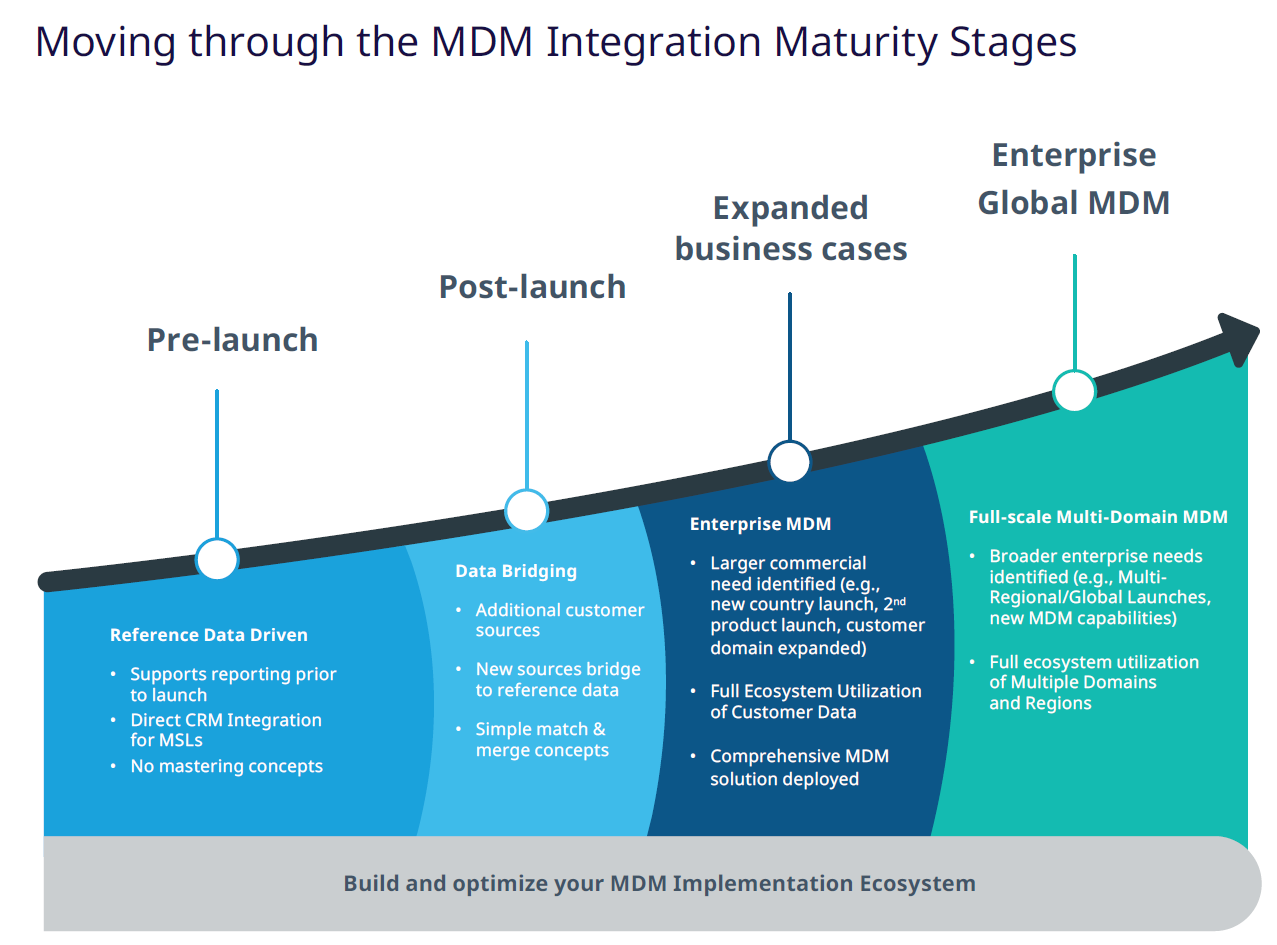
Figure 1: MDM approached in stages. A pre-launch organisation can work from reference data and linked sources, moving to enterprise MDM only as commercial needs expand.3
That linked foundation also makes finding patients possible. Predictive models depend on connecting electronic health records, genomics, claims, and registry sources to one another. In rare disease, patients often wait five to seven years for a diagnosis, even though health systems may already hold evidence of their condition.4 In one indication with no diagnosis code, a model built across claims, medical records, and web sources identified roughly three times the patients the company had forecast.
Those same models point to a wider issue. Artificial intelligence (AI) returns dependable answers only when the data beneath it is managed well and governed by clear rules so that the same question gets the same answer no matter who asks. A company whose data is still fragmented cannot put those tools to work, however much it invests in them.
Proving value without overbuilding
A right-sized data roadmap lets a pre-commercial company prove value early without overbuilding. Not every step requires owning the data. A team on a limited budget can often have analyses run against data it does not hold, answering the question without taking on a source to maintain. The first win is usually a quiet one, visible as less rework, fewer mismatches, and mistakes avoided.
The foundation also helps later on. A company that connects its data before launch reaches its commercial stage with a system it can build on. The harder questions of governance, vendor consolidation, and integration debt still need to be addressed, but they come up as planned choices instead of urgent problems. Getting the foundation right matters most when the margin for error is thin, which is exactly the position a first launch creates.
References
- IQVIA. Global R&D trends 2026. IQVIA Institute for Human Data Science Report. 2026 Mar 25.
- IQVIA. IQVIA data bridging. IQVIA Fact Sheet. 2023 Aug 16.
- IQVIA. Phased progress: data bridging as a strategic maturation approach to MDM. IQVIA Insight Brief. 2023 Sep 7.
- Ishman N. Start with the patient: why Next Best Patient is the launch engine emerging biopharma needs. IQVIA Blog. 2026 Jun 10.
About the author
 Stacey Pinel is VP and GM of emerging biopharma analytics at IQVIA. She has nearly 30 years of experience in the life sciences industry, including both consulting and client side experiences. She specialises in commercial operations, analytics, data, and technology. At IQVIA, her focus is on insight generation and commercial operations outsourcing in support of emerging biopharma clients.
About IQVIA

IQVIA (NYSE:IQV) is a leading global provider of clinical research services, commercial insights and healthcare intelligence to the life sciences and healthcare industries. IQVIA’s portfolio of solutions are powered by IQVIA Connected Intelligence to deliver actionable insights and services built on high-quality health data, Healthcare-grade AI, advanced analytics, the latest technologies and extensive domain expertise. IQVIA is committed to using AI responsibly, with AI-powered capabilities built on best-in-class approaches to privacy, regulatory compliance and patient safety, and delivering AI to the high standards of trust, scalability and precision demanded by the industry. With approximately 94,000 employees in over 100 countries, including experts in healthcare, life sciences, data science, technology and operational excellence, IQVIA is dedicated to accelerating the development and commercialization of innovative medical treatments to help improve patient outcomes and population health worldwide.
IQVIA is a global leader in protecting individual patient privacy. The company uses a wide variety of privacy-enhancing technologies and safeguards to protect individual privacy while generating and analyzing information on a scale that helps healthcare stakeholders identify disease patterns and correlate with the precise treatment path and therapy needed for better outcomes. IQVIA’s insights and execution capabilities help biotech, medical device and pharmaceutical companies, medical researchers, government agencies, payers and other healthcare stakeholders tap into a deeper understanding of diseases, human behaviors and scientific advances, in an effort to advance their path toward cures. To learn more, visit www.iqvia.com.