From first approval to lasting value: What sets successful emerging biopharma commercial strategies apart

Emerging biopharma (EBP) companies aren’t struggling to get to approval; they’re struggling with what comes next.
Today, EBPs account for 70% of all clinical-stage pipeline assets.1 They have also originated more than half of the 1,000-plus Novel Active Substances that reached the global market over the past two decades (Figure 1). In the past 10 years alone, EBPs have commercialised 197 novel drugs in the United States, and their share of launches continues to climb.2
Figure 1. Global Novel Active Substance (NAS) launches by originator company size, 2005-2024. EBP-originated NASs have grown from 66 in 2005-2009 to 189 in 2020-2024 (excluding China-only launches).
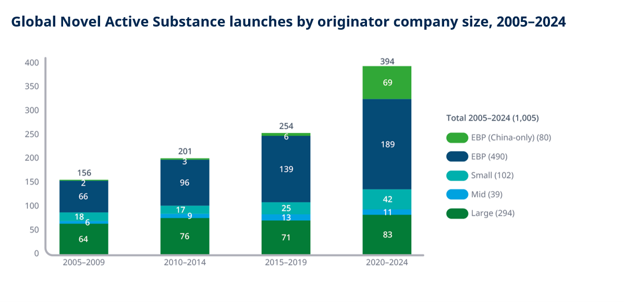
[Source: IQVIA Institute for Human Data Science. Expanding options for emerging biopharma in the U.S.: a decade of change. IQVIA Institute Report. 29 Oct 2025.]
Most EBP companies approach launch as a single moment in time. Those that build lasting value treat a launch as a sequence of distinct phases, each with its own unique demands and decision points. During the first few months, early-adopter physicians and the patients who have been waiting for a new option often help establish early credibility. Three to six months post-launch, after the initial patient cohort has started therapy and forecasts expand, is when real-world complexities set in. This is the moment when launch trajectories are either reinforced or quietly constrained. EBPs need to plan for the nine to 18 months that follow approval as deliberately as they plan for day one.
The organisations that sustain momentum beyond launch address several key imperatives early in their planning cycles.
Build evidence beyond approval
The FDA label remains the primary and essential foundation for any product launch. However, it is no longer the only evidence payers and physicians rely on to make real‑world decisions. Many EBPs approach launch with evidence designed to secure approval, assuming the label itself will carry the commercial story forward. Under time and budget pressure, clinical programmes are optimised for regulatory success instead of answering the broader questions that drive coverage, confidence, and sustained use.
Physicians and payers don’t usually infer what isn’t explicitly stated on a label. Approval language alone often leaves unanswered questions around comparative effectiveness, patient selection, durability, economic impact, or place in therapy. Teams that plan for complementary evidence designed to reinforce and extend the label are better positioned to translate approval into access and adoption.
The most effective organisations make these evidence decisions well before launch, often at the end of Phase II. When clinical differentiation is less clear, the commercial playbook shifts. Success then depends on access, pricing, and patient support more than on clinical messaging. Either path can succeed, but reaching FDA approval without a “day after” evidence strategy can create downstream challenges that can be hard to remediate.
Start making evidence decisions during Phase II or III, and the commercial story writes itself from a position of strength, rather than remediation.
Map demand across the full patient journey
Industry data shows that brands can lose up to 96% of generated demand between the first fill attempt and 12-month adherence. Yet, most organisations measure only the final stages of the patient journey, when the patient is already in active treatment.3 The visibility gap for EBP companies is both a risk and an opportunity, as they tend to operate in rare or specialty markets where the patient population is narrower and the cost of finding patients can have a significant effect.
What “good” looks like here is less about larger promotional investment and more about deeply understanding the patient journey and the realities of clinical practice. This means knowing from the start which patient subsets can benefit most, which physicians will treat them and, critically, whether those physicians are likely to routinely prescribe based on past behaviour. Even in rare cancers with no approved alternatives, some physicians default to familiar regimens, rather than adopt a new therapy. They are waiting to see how the clinical evidence translates to their unique patient populations, not waiting for more marketing information.
The commercial infrastructure required to support this level of granular understanding does not have to be resource-intensive, but it does have to be built before launch. Capabilities that showcase access, affordability, and adherence across the full treatment journey, rather than focusing narrowly on the final prescription fill, create durable value. These analytics pay for themselves by enabling faster learning, smarter intervention, and more sustainable utilisation in the months and years following launch.3
Build these capabilities before launch, and the learning curve compresses from months to weeks.
Design adherence into the launch model
Adherence requires its own approach, separate from generating initial demand. Finding prescribers is one concern; ensuring patient adherence over the 12 months that follow a first fill is another. For maintenance therapies, that post-fill window is where a meaningful share of commercial value is realised or forfeited. Few EBPs can fully scale patient support programmes, nurse education programmes, and affordability infrastructure while also funding a strong field team and medical science liaison (MSL) function; therefore, trade-offs are inevitable.
As a result, some organisations prioritise high‑touch patient support because adherence is inseparable from the product’s profile. This can be due to complex administration, prolonged titration, or significant caregiver involvement. Others take a less intensive services approach and invest heavily in their sales force, expecting physician confidence to sustain persistence. Both approaches can succeed when they are intentionally aligned to what patients need to stay on therapy.
The EBPs that get this right assess adherence risk before launch and build an infrastructure accordingly. They identify when patients tend to abandon therapy and whether the barriers are clinical or financial, and determine which issues require human interaction and which benefit from digital reminders. For example, a rare-disease therapy with complex administration may warrant advanced patient engagement services, while a simpler oral therapy may succeed with digital engagement backed by evidence that supports real-world persistence.
Assess adherence risk before launch, design infrastructure around what patients really need, and the post-fill window becomes a source of value, rather than attrition.
Establish operating cadence early
In theory, the tighter structure of an emerging biopharma organisation should be a competitive advantage. There are fewer people, fewer layers, and shorter distance between strategy and execution. In practice, that advantage does not always materialise.
EBP leadership teams are often assembled quickly, incorporating a mix of large-pharma veterans and specialty-market operators. When pressure intensifies, the absence of familiar workflows can slow down crucial decision-making. This type of cohesion is often the difference between executing or struggling when pressure intensifies.
Set up a clear governance model and shared planning framework early, and organisational agility becomes operational, rather than aspirational.
Preparing for the “launch after the launch”
For most EBP companies, the true test of commercialisation success does not occur during the months leading to approval. It happens during the nine-to-18-month period that follows.
The critical advantage lies in making fewer decisions under pressure. Companies that plan their evidence strategy during Phase III, mapping the full patient journey, designing for adherence, and establishing an operating cadence early, don’t just execute better at launch — they adapt faster when the market responds in unexpected ways.
Approval may validate the science, but it does not secure commercial success. That outcome is determined by the decisions made before launch and the readiness of organisations to execute for what comes next.
References
- Gores M, Baker T, Rink C, Sanvoisin M. Seizing the moment: biotech’s golden opportunity for self-commercialisation. IQVIA White Paper. 23 Feb 2026.
- IQVIA Institute for Human Data Science. Expanding options for emerging biopharma in the U.S.: a decade of change. IQVIA Institute Report. 29 Oct 2025.
- Kitlas S. Navigating a brave new world: strategies for emerging biopharma. IQVIA Insight Brief. 3 Sep 2025.
About the author
 Celine Rossignol is VP, Global Large Biotech & EBP Segment, at IQVIA. She has over 25 years of global healthcare and industry experience at the C-suite level, with deep expertise in asset development and commercialisation. She joined the IQVIA US EBP team and led a team focused on incorporating deep expertise in commercialisation and launch to support the development, enablement, and execution of strategies to support the clients’ asset lifecycle.
About IQVIA

IQVIA (NYSE:IQV) is a leading global provider of clinical research services, commercial insights and healthcare intelligence to the life sciences and healthcare industries. IQVIA’s portfolio of solutions are powered by IQVIA Connected Intelligence™ to deliver actionable insights and services built on high-quality health data, Healthcare-grade AI®, advanced analytics, the latest technologies and extensive domain expertise. IQVIA is committed to using AI responsibly, with AI-powered capabilities built on best-in-class approaches to privacy, regulatory compliance and patient safety, and delivering AI to the high standards of trust, scalability and precision demanded by the industry. With approximately 94,000 employees in over 100 countries, including experts in healthcare, life sciences, data science, technology and operational excellence, IQVIA is dedicated to accelerating the development and commercialization of innovative medical treatments to help improve patient outcomes and population health worldwide.
IQVIA is a global leader in protecting individual patient privacy. The company uses a wide variety of privacy-enhancing technologies and safeguards to protect individual privacy while generating and analyzing information on a scale that helps healthcare stakeholders identify disease patterns and correlate with the precise treatment path and therapy needed for better outcomes. IQVIA’s insights and execution capabilities help biotech, medical device and pharmaceutical companies, medical researchers, government agencies, payers and other healthcare stakeholders tap into a deeper understanding of diseases, human behaviors and scientific advances, in an effort to advance their path toward cures. To learn more, visit www.iqvia.com.