Women – and pharma – in AI: Where are we now?
Late last year, we reported on the Women in AI Healthcare event – hosted by Real Chemistry in collaboration with Pharma Brands – which brought together a dynamic group of female leaders to discuss the transformative role of artificial intelligence (AI) in life sciences. The event was not just a showcase of innovation, but a call to action: to ensure women are not only present, but pivotal in shaping the future of AI in healthcare.
This June marked the third such Women in AI event, taking place at a time when AI in medicine has progressed from pilot to infrastructure. Guest female speakers included: Dr Anushka Patchava, chief clinical & innovation officer, Cignpost; Nora Lamoudi-Sutcliffe, senior commercial manager, Microsoft; and Eleanor Barr, AI product manager, GSK.
Pharma Brands’ intention, as stated by the event’s director, Kate Eversole, is still to upskill women in life sciences in AI, yet, the onus in June was somewhat less on that determined female placement in and working with AI – and instead concentrated more on AI’s overall positioning within the sector as a whole, both in terms of machine in lieu and machine alongside human. In this way, Women in AI became a platform for female leaders to discuss and learn more about AI in their field today.
AI making waves in the clinical setting
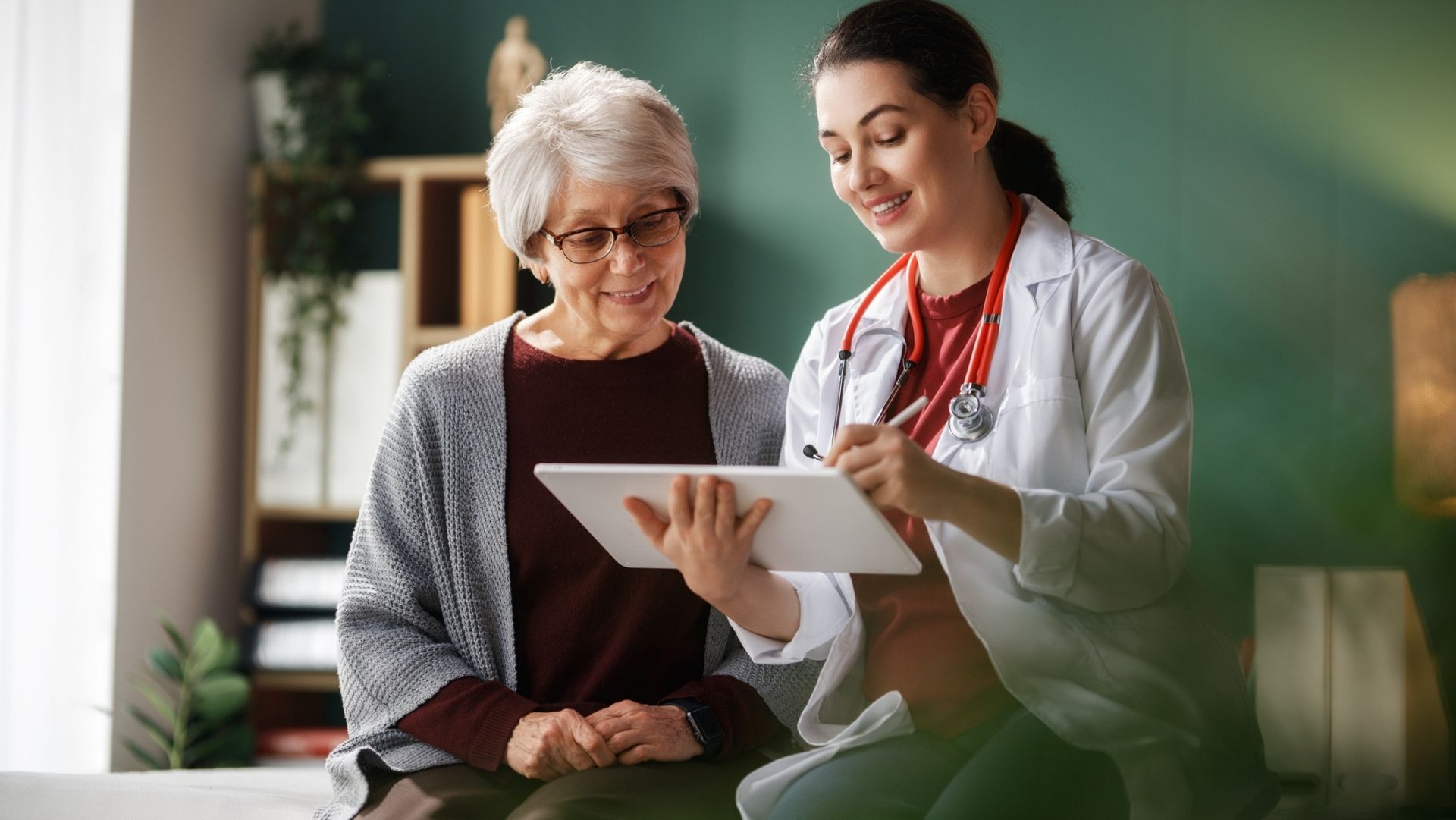
Celine Parmentier, EVP and head of global med comms at Real Chemistry, opened the event with the facts as they currently stand.
Referencing the US openness to AI and that, as of 2026, the FDA has authorised over 1,350 AI-enabled medical devices, across diagnostics, imaging, and clinical decision support – Parmentier also spoke to the example of OpenEvidence, the AI-powered medical information platform geared toward doctors. Now well established in the US, with over 40% usage in consultations in the clinical setting, OpenEvidence was valued at over $12 billion at the start of the year, with backers including Thrive Capital, DST, Sequoia, Nvidia, Kleiner Perkins, Blackstone, Bond, Craft Ventures, Mayo Clinic, and others.
Additionally, Parmentier mentioned new research conducted by Imperial College London earlier this year, using Google AI to match or exceed radiologists in detecting cancer in breast scans. Also involved were the universities of Cambridge and Surrey, NHS Trusts at Cambridge University Hospitals, Imperial College Healthcare, the Royal Marsden, the Royal Surrey and St George’s University Hospitals, and the AIMS public engagement group.
The study involved 175,000 women – the largest NHS study to date – and Google AI “detected more cases of invasive cancer, more cases overall, had fewer false positives, and recalled fewer women having their first scan than humans did.” At a time when there is a 29% shortfall of clinical radiologists – predicted to rise to 39% by 2029 – such results are positive indeed, particularly in the ongoing conversations on and implementation of AI in early detection screening. The study’s findings are published in two linked papers in Nature Cancer.
Tech giants and LLMs in health
Then, of course, there’s Anthropic’s work, with Claude Fable 5 being much discussed at the time Women in AI took place, with Claude Science officially released not many weeks later. But that’s not forgetting, as Parmentier mentioned, Google Research’s Articulate Medical Intelligence Explorer (AMIE), a research AI system based on an LLM and optimised for diagnostic medical reasoning and conversations.
Trained on real-world datasets comprising medical reasoning, medical summarisation, and real-world clinical conversations – AMIE (and let’s not gloss over the female acronym here) uses a novel self-play based simulated dialogue learning environment to improve the quality of diagnostic dialogue across a multitude of disease conditions, specialities, and patient contexts.
Though Google Research itself admits no current LLM can replace a human physician, Parmentier’s mention of AMIE segued to discussion of Big Tech’s moveen masse into the health product market: “The Tech Giants moved in, and they moved in fast,” she commented, caveating that “it is Tech driving this. Pharma doesn’t really have a seat at the table.”
Parmentier referenced also not just Amazon’s One Medical, but OpenAI’s ChatGPT Health, designed to securely connect users' health information and ChatGPT's intelligence to provide informed and personalised health conversations. Users are able to connect their medical records and wellness apps, such as Apple Health and MyFitnessPal, to ground conversations in their health information, making responses more relevant and useful.
Mentioned as well, of course, was Eli Lilly’s partnership with Nvidia, announced in October 2025, intended to build the ‘most powerful’ supercomputer to manage the entire AI lifecycle, from data acquisition and training to fine-tuning and high-volume inference. Since the June Women in AI event, though, Bristol Myers Squibb has gone one further and said it is the first life sciences company to buy a new AI supercomputing infrastructure blueprint from NVIDIA. The DGX SuperPOD is based on the chip giant's Vera Rubin NVL72 system – a next-generation AI and supercomputing platform, specifically designed for complex and autonomous agentic AI workflows and scientific computing.
And in terms of legal frameworks for all this, as of 2nd August 2026, the EU AI Act (Regulation (EU) 2024/1689) has come fully into force for high-risk AI systems deployed, imported, or distributed across the European Union. With this around the corner in June, Parmentier noted the contrasting stance to the US when it comes to AI openness, it must be said with an air of frustration.

Where is medical AI or health AI in all this?
Despite all the above, frustratingly indeed, women are still underrepresented in Phase I studies; bizarrely, especially in diseases that kill them most. Although the National Institutes of Health (NIH) established the Revitalization Act nearly thirty years ago, “requiring women and members of racial and ethnic minority groups to be included in NIH-funded clinical research”, a recent study published in Ethics & Human Research noted that “women are still poorly represented in industry-sponsored research and in early phases of clinical research, especially Phase I studies.”
Parmentier’s point? That historic biases must end as we enter the Age of AI, so that they are not further ingrained and inequality deepened in technology – particularly as AI becomes utilised more and more in drug discovery and development.

The importance of mindset shift & a woman’s intuition
One woman definitely attempting to set industry biases firmly in the past is Cignpost’s Dr Anushka Patchava, also an advisor at the World Economic Forum, the first guest speaker of the evening. She discussed how leadership – especially female leadership – in AI in pharma currently stands, and where it can evolve to next.
Presenting a chart of emotional qualities in AI leadership and adamantly describing AI’s role as being one of augmentation, Patchava admitted the challenge of maintaining a balance between control and experimentation, and between authority and integrity – even as a woman…
For Patchava, it’s about separating the signal from the noise, or “measuring the ROI.” And women, she noted, are better at judging where embedded AI is actually leading and influencing decisions that men are. Why? Intuition. The magical ingredient. By following that intuition, women can challenge the AI.
In a world where the options are passive adopter, reactive responder, or conscious architect, Patchava encouraged that women be the conscious architect for the future.

Administration in the (healthcare) workplace and at home
Microsoft’s Nora Lamoudi-Sutcliffe represented tech, of course, but she terms herself a “sales leader, rather than a techie.”
Lamoudi-Sutcliffe mentioned the landmark deal with NHS England only days before, NHS England intending to accelerate AI adoption across healthcare services by providing 505,000 clinicians and support staff with access to Microsoft 365 Copilot in order to “streamline administrative processes, improving capacity across NHS England Trusts, reducing costs, and providing more time for patient care.”
She also highlighted, though, that only 17% of AI is being built by women. Furthermore, the gender pay gap is growing year over year, the gap ever larger the more senior the position. Added to this, women are often the most time-poor. But to this last point, it is here, Lamoudi-Sutcliffe insists, that AI can help most – giving back time, visibility, mental load, and the ability for women to duly, expertly influence in the workplace.
Microsoft’s CoPilot CoWork sends emails, schedules meetings, creates documents, posts in Teams, searches your organisation, manages files, conducts deep research, prepares briefings and summaries, drafts communications, schedules prompts… The list potentially goes on, as it is available not just as a work account, but also a school account, and there is a personal version, too.
The secret is in the prompt, though. And to this end, Lamoudi-Sutcliffe came up with the ‘GCSE of a great prompt’: Goal, Context, Source & Style, and Expectations.An A* in AI education, indeed.
Multimodal AI for biomarker prediction: A case study in NSCLC
GSK’s Eleanor Barr, by contrast, brought us firmly back into industry’s direct concern with AI. She ran through multimodal AI for biomarker prediction, specifically in targeted cancer therapy, explaining current AI usage for computational pathology.
Her case study was of a novel surface-expressed ligand in non-small cell lung cancer (NSCLC), building an AI-ML-based pipeline for digital Tumour Proportion Score (TPS) computation and characterised the tumour microenvironment (TME).
It was found that spatial omics data can link the tumour to its microenvironment to reveal new biology. Indeed, said Barr, deep learning makes morphology measurable and interpretable. Spatial omics zooms in on cell-to-cell interactions in the TME and reveals new targetable immuno-oncological mechanisms. In this way, AI can help scientists get ahead of disease – at every stage of the pipeline.
Nonetheless, as ever, regulatory pathways lag behind such technological developments. Indeed, Barr commented, the infrastructure itself is fragmented, adding that “even pathology itself is not standardised – how can a tool then be built to harmonise?”
Pharma needs, she said, to decide what to build first, and what to adapt and align institutionally around it. Additionally, it mustn’t be forgotten that the outcomes sought are, at the end of the day, for patients. As GSK urged at London Tech Week: “Be ambitious for patients.”

Ethics and the responsibility that comes with AI
As Women in AI came to a close – questions flitting across sustainability and the ethical concerns that yet exist, discursively moving over issues of transparency and trust, and general methods for championing implementation within the life sciences workplace – Patchava insisted that “AI is a capability, not a tool.” And with the ability to do something comes a responsibility.
To this end, although AI agents make fewer errors than humans, nevertheless, as been reiterated time and again in the life sciences, a human must ever be in the loop where AI is operating. Healthcare – ‘people care’ – demands it.
Patchava also cautioned: “AI is augmented intelligence, not artificial intelligence. AI will make stupid people stupider. Use your brain. Don’t just trust the AI […] AI use becomes part of your signature. It’s your responsibility.”

About the author
Nicole Raleigh is pharmaphorum’s web editor. Transitioning to the healthcare sector in the last few years, she is an experienced media and communications professional who has worked in print and digital for over 20 years.
Supercharge your pharma insights: Sign up to pharmaphorum's newsletter for daily updates, weekly roundups, and in-depth analysis across all industry sectors.
Want to go deeper?
Continue your journey with these related reads from across pharmaphorum


On the future of AI in life sciences, with women at the helm
Is women’s health reaching an inflection point?
12 Questions With Marie Teil
Women leading the AI revolution in life sciences


Click on either of the images below for more articles from this edition of Deep Dive: AI 2026