Women leading the AI revolution in life sciences
In a room notably absent of men, the Women in AI Healthcare event – hosted by Real Chemistry in collaboration with Pharma Brands – brought together a dynamic group of female leaders to discuss the transformative role of artificial intelligence in life sciences.
The event was not just a showcase of innovation, but a call to action: to ensure women are not only present, but pivotal in shaping the future of AI in healthcare.
As Kate Eversole, Pharma Brands’ event director, reflected, “We all don’t know what we’re doing with this,” highlighting the shared uncertainty and opportunity that AI presents. Indeed, it was due to women expressing their discomfort with AI to her after a previous event that sparked a deeper inquiry into gender representation in tech. With women accounting for just 22% of AI professionals in the UK, the urgency to address this imbalance is clear. If AI models are trained predominantly on male data, the resulting systems risk perpetuating gender bias – an issue that could have profound implications in healthcare.
Celine Parmentier, EVP and head of global med comms at Real Chemistry, emphasised that, “If we’re not in the room when AI is designed, tested, and deployed, there will be gaps.” The evening’s speakers – each a trailblazer in her own right – demonstrated how women are already shaping, challenging, and advocating for AI in life sciences.

Curiosity, capability, and the call to action
Bobby Dhaliwal, innovation and business excellence director, UK, at AstraZeneca, opened with a powerful assertion: “AI is the biggest transformation to the workplace in the last 25 years.” Dhaliwal’s journey – from a self-confessed ‘rubbish’ chemist to a leader in commercial operations – underscored the value of curiosity and adaptability in navigating technological change.
In her current role, Dhaliwal oversees commercial operations, insights, analytics, and digital engagement. She’s spearheading a company-wide AI capability uplift programme, launched in June, with 60% of staff already trained. Her approach is intentional, aiming to inspire, champion change, and ensure no one is left behind.
AI’s potential in life sciences is vast: from content generation and learning avatars to patient treatment optimisation and healthcare system support. Yet, Dhaliwal warned of ethical pitfalls: “An AI model used to detect skin cancer only worked on Caucasian samples,” she noted, illustrating the dangers of biased data.
Her key message? Stay curious. “Use your voice, embrace new ideas, and never stop asking questions.” Dhaliwal’s leadership exemplifies how women can drive responsible, inclusive AI adoption in pharma.
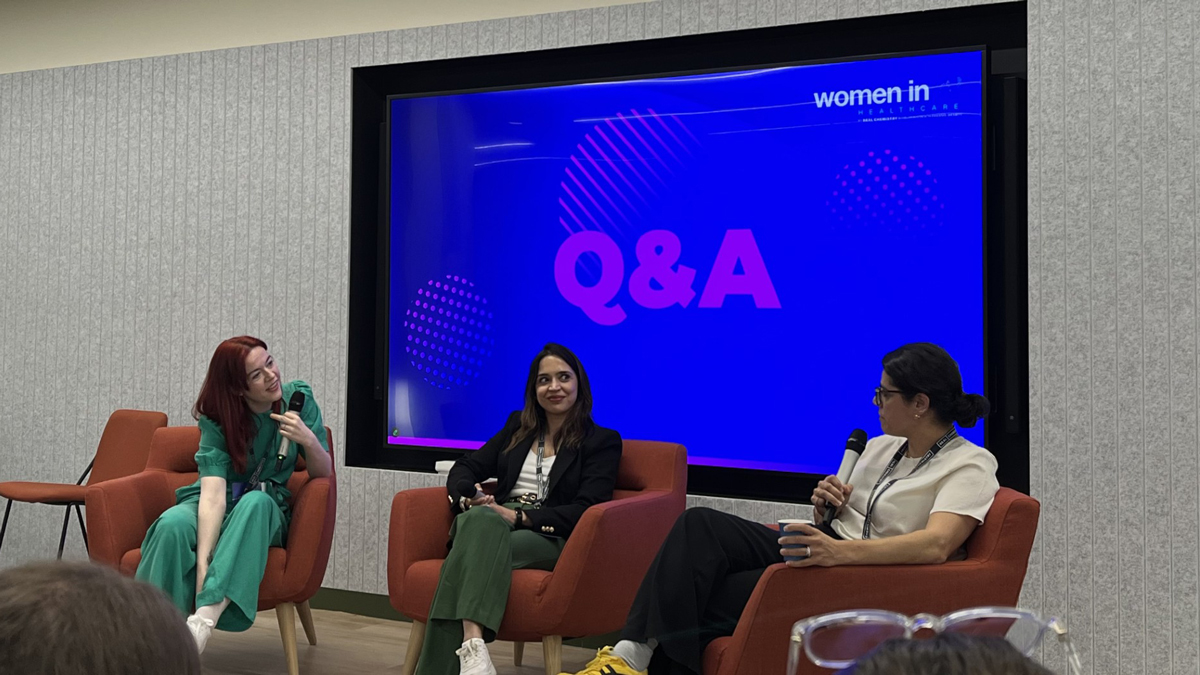
. Pictured: Heather Murray (left), Bobby Dhaliwal (centre), and Dr Samin Saeed (right). Photo by Nicole Raleigh
Demystifying AI for ‘non-techies’
Heather Murray, founder and CEO of AI for Non-Techies, brought clarity to the often overwhelming world of AI, breaking down the technology into six practical categories: content, research, coding, data analysis, thinking, and automation. The main thread, though, was a reminder that AI is not new, but its accessibility is.
“Every single year, more data is created than ever before in civilisation,” Murray said. “But what’s the point unless we can derive insights from it?” Her discovery of ChatGPT in November 2022 catalysed her business, and she now advocates for AI as a communication tool, rather than a technical challenge.
Murray highlighted the risks of ‘Shadow AI’ – unregulated personal use of AI tools outside organisational oversight – and stressed the importance of clear prompts and critical thinking. “A prompt can only be written by someone who can do the task manually,” she noted, underscoring the need for foundational skills.
She too addressed the gender gap in AI adoption, advocating for safe spaces where women can experiment without pressure and for elevating female AI adopters within organisations, suggesting a reframing of the technology and the creation of “intentional rooms for women to learn and lead.”

Strategic integration of AI in Medical Affairs
Dr Samin Saeed, VP of early medical pipeline, specialty care, at GSK, offered a strategic lens on AI’s role in transforming Medical Affairs. Since 2007, the function has evolved from a support role to a strategic partner, with AI poised to accelerate this shift.
“[Providing] insights from many sources, evidence generation, shaping clinical narratives – AI can help with all of it,” she explained. But she cautioned against overreliance, especially in systematic literature reviews, and emphasised the need for human oversight.
Saeed’s team is exploring AI for adverse event detection, predictive modelling, and treatment pattern analysis. Yet, GenAI is not fully mature. Data access remains a barrier, requiring partnerships and licensing. And as for ‘human in the loop’? That will always be necessary.
Saeed also addressed the evolving role of agencies. With AI enabling in-house content creation, agencies may shift toward crafting early scientific narratives. “Medical Affairs needs to provide the ‘So what?’ context,” she said, suggesting a strategic repositioning for external partners.
Personal productivity was her most successful AI use, though. From white papers to job descriptions, AI is helping her team work smarter. But she remains cautious: “Until we’re ready to be judged by robots in a court of law, AI cannot decide if a drug is safe.”

Audience insights and open questions
The event’s interactive format allowed for rich dialogue, and questions ranged from AI adoption rates to ethical guardrails, environmental impact, and the future of human roles.
As for real-world adoption, Dhaliwal posited that uptake was higher than expected, though finance teams remained sceptical. “We need peers to share use cases,” she said, emphasising the importance of relatable examples.
Concerns were raised about ChatGPT’s limitations, also. Here, tool diversity is key. Whilst compliance is still on a learning curve, according to Dhaliwal: “We’re catching up as we go,” she admitted, highlighting the need for flexible governance.
Environmental concerns are, of course, a very real consideration. For example, Murray compared AI’s energy use to fast fashion and junk food: “One GenAI image uses the energy of half a smartphone battery,” she explained, urging mindful usage.
The conversation also touched on language bias, with English dominating scientific discourse. It was suggested that AI could eventually democratise access to non-English content.

Women must be at the table
As the event drew to a close, the central theme emerged clearly: women must be at the table – not just as users of AI, but as designers, testers, and decision-makers. The speakers demonstrated that AI is not a distant future, but a present reality, one that demands intentional inclusion and ethical vigilance.
Parmentier’s closing remarks brought the discussion full circle: “Do we need intentional spaces for women in AI?” The answer, echoed by the room, was a resounding yes. Gender-specific sessions, diverse representation, and proactive upskilling are not just beneficial – they’re essential.
Overall, what is most critical is to learn how to prompt. In a world increasingly shaped by algorithms, the ability to ask the right questions – and to do so with confidence – is a skill that will define the future of work.
As AI continues to evolve, the life sciences industry must ensure that its transformation is inclusive, ethical, and driven by diverse voices. The women at this event are not just participants in that journey – they are leading it.

About the author
Nicole Raleigh is pharmaphorum’s web editor. Transitioning to the healthcare sector in the last few years, she is an experienced media and communications professional who has worked in print and digital for over 20 years.
Supercharge your pharma insights: Sign up to pharmaphorum's newsletter for daily updates, weekly roundups, and in-depth analysis across all industry sectors.
Want to go deeper?
Continue your journey with these related reads from across pharmaphorum


NHS cleared to use digital cardiac rehab programmes

From prostate cancer to breast cancer: In conversation with Christine Roth

Mind the gap: The need for gender-specific outcome measurement

Gates Foundation puts $2.5bn into 'ignored' women's health


Click on either of the images below for more articles from this edition of Deep Dive: AI 2025