Reimagining the role of medical science liaisons in the age of AI
AI is rapidly disrupting every part of the pharma industry. However, some functions within pharma are being disrupted faster than others. When it comes to medical affairs, and in particular medical science liaisons (MSLs), progress has been slower. But AI is already making big changes in how some MSLs do their jobs, and it’s likely that a larger wave of change is on the horizon, according to experts in AI technology for MSLs.
“I think pharma companies, when they talk about generative AI, they have a much larger remit,” Kelly Malloy, SVP of customer engagement, augmented intelligence, and artificial intelligence at Inizio Medical, told Deep Dive. “They're not necessarily focused on medical. It's actually quite a tricky use case because it's so heavily regulated. That ends up falling to the bottom of our client organisations’ IT priority list.”
Malloy says pharma AI efforts are more likely to be focused on internal efficiencies in areas like IT and finance.
“If they are dipping a toe into medical, it's more around content generation, but content generation for very low-risk use cases,” she said.
Ariel Katz, CEO of H1, a technology firm focused on helping life sciences companies find and connect with physicians, agrees.
“There's technology disruption changes, but there's not been enough disruption within pharma for them to be forced to implement AI in any meaningful way,” he said. “They're using it today for insights gathering. They're taking all the MSL insights that are written down and they're synthesising them via AI. That's really the extent to which it's being used. Compared to other industries, that’s a very small percentage.”
Katz believes that could all change in a hurry, however, thanks to current political headwinds – namely President Donald Trump’s Most Favoured Nations drug pricing initiative.
“If Trump does what's in his executive order, pharma companies can lose 25% of their profit overnight,” Katz said. “I don't think they're just going to eat losing 25% of their profit. I think they're going to offset that with cost savings.”
Pharma companies are going to be looking for ways to increase efficiency and reduce headcount, and it’s going to force them to look in areas they’ve hitherto overlooked, Katz predicts.
While they wait for pharma to come to the table, a few technology firms like Inizio and H1 are already building next generation tools for the current generation of MSLs. And there’s a lot AI can do to help the field.
How AI can help MSLs do their jobs faster
The job of a medical science liaison is in some ways tailor-made for AI support: it’s a job all about managing massive amounts of information. That includes the always-changing scientific information about which they must be an expert, as well as information about the physicians they work with and how to best reach and engage them.
“My first MSL role, it took so much work to do some background research on the KOLs that we were interacting with,” Tiffanie Stewart, MSL field director at Inizio Engage, told Deep Dive. “We did it all. We were our own little detectives doing it manually, looking them up on PubMed, trying to collate information about them, understanding what they're interested in. We'd have spreadsheets and spreadsheets and spreadsheets.”
There are three major areas where rapidly advancing AI technology could massively increase efficiency for MSLs, according to the experts Deep Dive spoke with: content generation, administrative support, and training.
Content generation: The low-hanging fruit
Medical affairs teams spend a lot of their time generating different kinds of content, including regulatory writing, educational materials, and conference presentations. Although this content certainly needs to be reviewed by humans for accuracy, AI can be, and in many cases already is being, used to speed up the process of content generation.
“If someone today is a medical writer at Pfizer and they're drafting peer-reviewed publications for Pfizer's phase 3 clinical trials, the drafting of that publication is a total waste of time,” Katz said. “AI could draft that publication quicker, faster, better, and the person should be a reviewer instead of an author, basically. Their function changes. That's a good example. Another example is someone that's creating a poster for ASCO. Why are you formatting this thing? AI can create a much prettier poster in 10 seconds than you can ever create, and you should edit it instead of author it.”
MSLs themselves also need to generate a lot of content to do their work connecting with HCPs.
“Generating content is a large part of what we do,” said Malloy. “Patient lay summaries, manuscripts, you name it. We are trying to augment their capability to do exactly what they've been doing for years.”
Administrative support: A huge opportunity
Stewart mentioned that her early career as an MSL involved a lot of spreadsheets and detective work. But increasingly, that work can be done by AI systems.
“It's cut the administrative work down significantly, and we're able to do things much faster and be more agile with that work,” Stewart said. “I mean, of course, what I'm finding is there's always a need to validate the information that's given to us when it's generated through an AI model, but it's such a time saver. We're able to get way more done with fewer people on the team than we were when I first started.”
But administrative support goes beyond insights generation. AI can also help MSLs manage their schedules and responsibilities more efficiently.
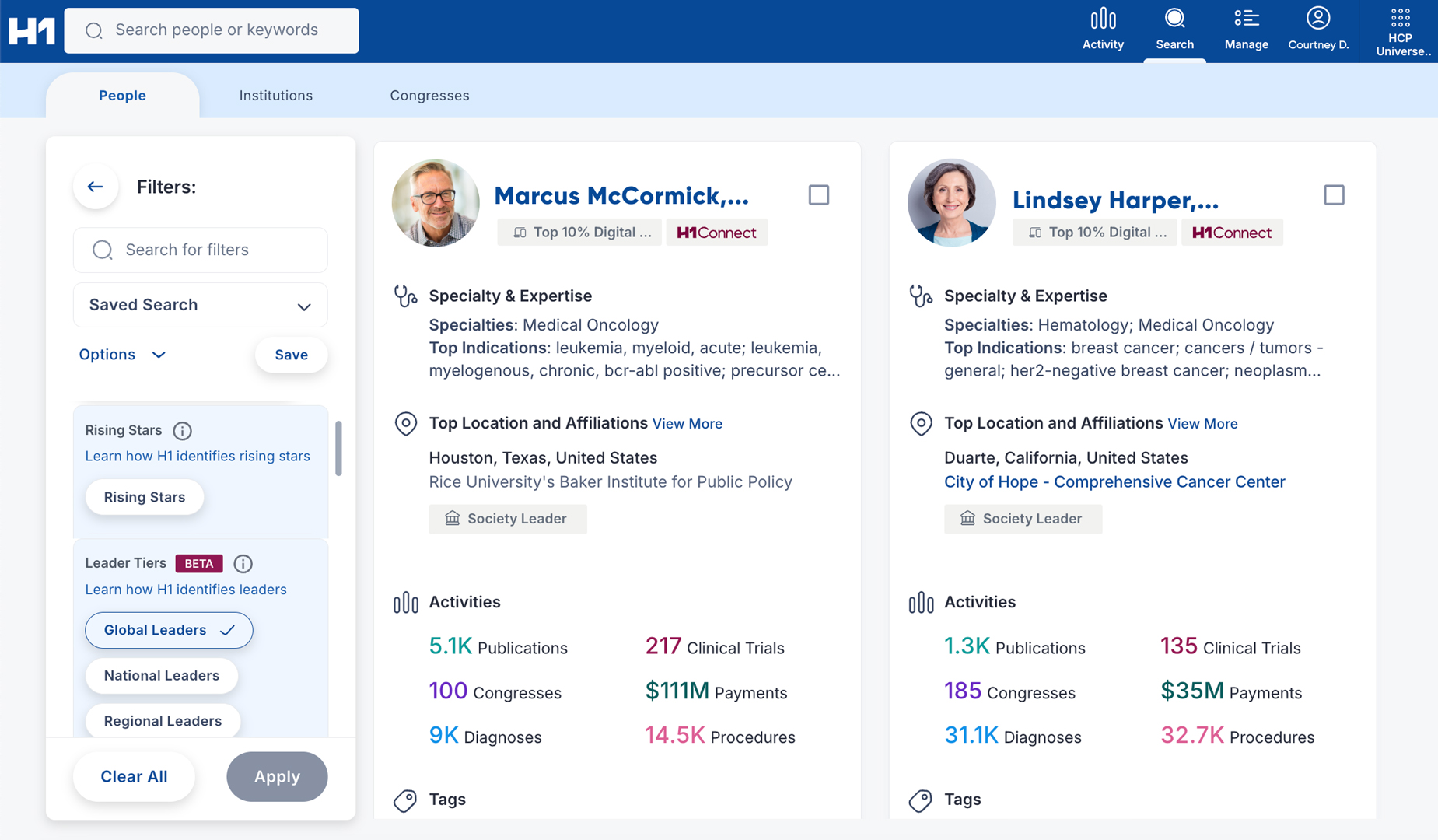
Image courtesy of H1
H1’s whole business is built around creating a database that makes it easier for MSLs to find out everything they need to know about healthcare providers, from their areas of expertise to what conferences they’re planning to attend. Now they are building AI agents that sit on top of that database.
“For BioMarin, we created a digital MSL who basically every day monitors the latest HCP's information, recommends what you should do with that HCP, it predicts what that HCP will do,” Katz said. “It can then automate all your emails that you want to send them, do follow-up meetings, monitor the latest scientific literature. You can have it draft or automatically send the emails. It just reduces everything that an MSL needs to do. It sits on top of an MSL. Each MSL is paired with a digital MSL, and boom, that's what they do for you.”
Training: Improving MSL soft skills
While information management is a huge part of an MSL’s job, equally important are the soft skills of connecting to healthcare providers, gaining their trust, and building a rapport. This is the part of the job where the human element is the most important. But AI can still be helpful.
“Because they are so well-versed and they do that constant upkeep and research into their field, MSLs have an understanding of the science that's really very solid,” Malloy said. “But it's in that relationship management, conversational skill building that we noticed a real gap. That's where the MSL Interact tool really comes into play. It's filling that gap, that need for MSLs to feel confident.”
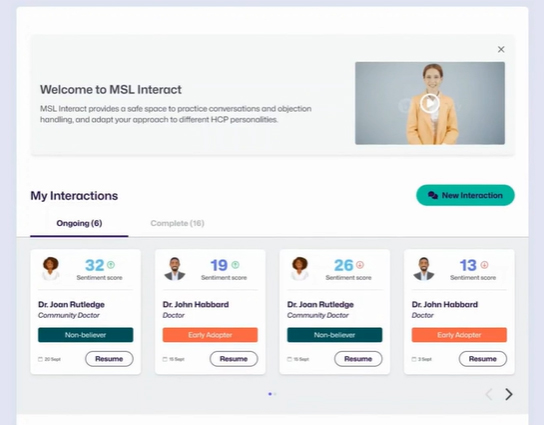
Image courtesy of Inizio
MSL Interact is a training platform developed by Inizio that leverages the ability of large language models to take on different personas as they interact with users.
“What we're doing is taking generative AI, training it, giving it a persona, ingesting information that is both publicly available and that is client-specific. We're targeting different therapeutic areas. We're engaging clients. They're giving us their specific information,” Malloy explained. “We're able to create this HCP persona that maps to different types of doctors or healthcare providers that these MSLs may be meeting in the field. Then the MSLs can come into the tool and actually have a practice conversation.
Could AI replace MSLs?
If AI can do so much of the workload of MSLs, should they be concerned for their jobs as the technology improves? On that question, Katz, Malloy, and Stewart all agreed: the human touch is too essential a part of an MSL’s work for AI to be an existential threat any time soon.
“I think physicians value that peer-to-peer communication,” Katz said. “But the administrative burden that an MSL faces, scheduling follow-up, scheduling emails? These are doctors, these are PharmDs. They're not good at that stuff. That will go away and get better over time. I feel confident in that going away. I don't think you're going to see less MSLs. You're just going to see them doing different things.”
Malloy feels similarly.
“There is a significant trust built between an MSL and an HCP over time. Really nothing can replace that as far as I'm concerned,” she said. “An AI MSL might be great to consult for specific questions that you need an answer to. But again, I think that that insight, sharing that back-and-forth bi-directional exchange of information is something that we're going to need humans for.”
It's not the quality of the AI at question, Stewart says, but the willingness of HCPs to accept an AI in the role of MSL.
“It depends on whether a human will want to I have a relationship with a non-human, a robot in my mind,” she said. “I don't think that's the case yet. I think we still value that human connection. We're wired for connection.”
About the interviewees

Kelly Malloy is the senior vice president of customer engagement, AI & augmented intelligence at Inizio Medical. With over 20 years of experience in medical communications, medical affairs, and technology, she has led product strategy, innovation, and client success at organisations including Complete Healthcare Communication, ApotheCom, and Anju Software.

Tiffanie Stewart has nearly 14+ years in clinical research and medical affairs. Her expertise spans various therapeutic areas and industries, including FDA-regulated drugs and laboratory-developed tests. Leading MSL and Medical Affairs teams, she pioneers innovative solutions for enhanced MSL excellence at Inizio Engage, based in New Jersey.

Ariel Katz is the CEO and co-founder of H1, the leading healthcare platform that connects the world to the right doctors. With extensive experience in healthcare technology and data, he helps pharma and healthcare companies accelerate drug development, advance clinical research, help patients find care, and improve patient outcomes.

About the author
Jonah Comstock is the editor-in-chief of pharmaphorum. A veteran healthcare journalist, he has spent more than a decade covering pharma, biotech, health tech, and digital health for publications including Psychology Today, MobiHealthNews, Healthcare IT News, and Healthcare Finance News.
Supercharge your pharma insights: Sign up to pharmaphorum's newsletter for daily updates, weekly roundups, and in-depth analysis across all industry sectors.
Want to go deeper?
Continue your journey with these related reads from across pharmaphorum


Compliance baked into the design core: On AI in life sciences with Florian Schnappauf

Smarter learning and better outcomes: How AI can provide an advantage in medical education

Smarter learning and better outcomes: How AI can provide an advantage in medical education
Optimising customer experience in global medical information installations: Part One


Click on either of the images below for more articles from this edition of Deep Dive: AI 2025