From the White House to AI drug discovery: Dr Rahul Gupta on tackling America’s opioid crisis
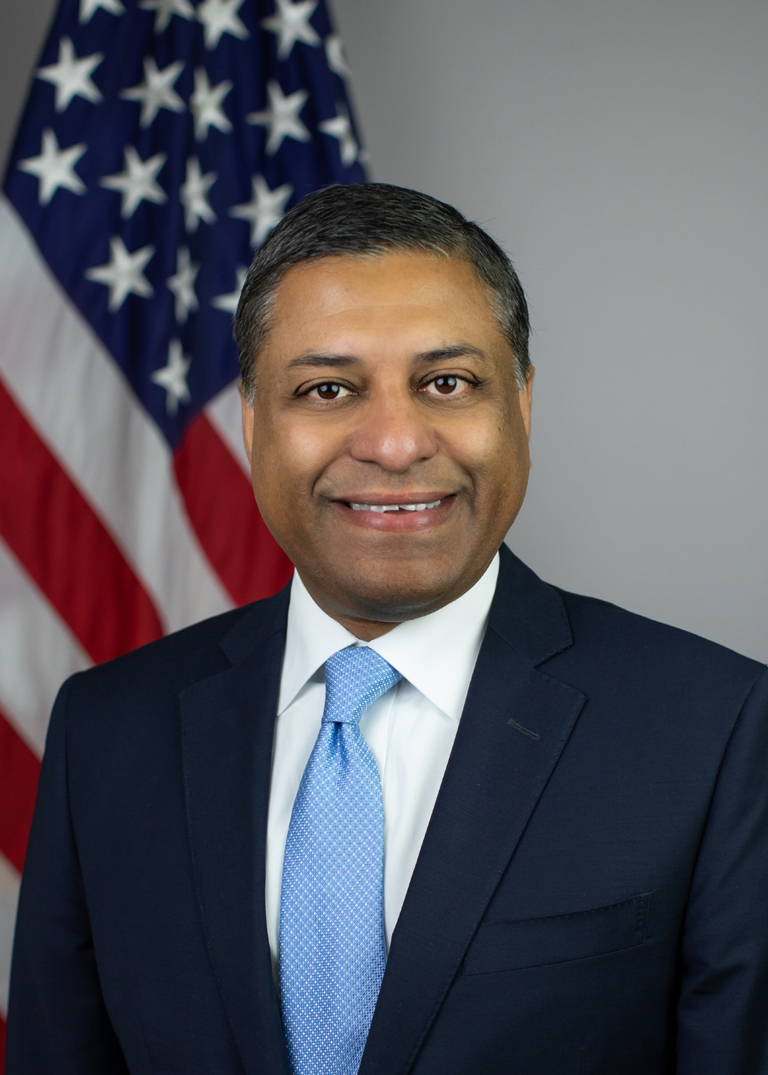
As the first physician to serve as US Director of National Drug Control Policy, Dr Rahul Gupta has seen the devastating impact of opioid addiction up close. In this interview, he discusses the lessons learned in government, the progress that has been made, and the urgent need to harness new technologies to fight back.
Eloise McLennan:
Can you help us understand the scope of what we're facing in terms of trying to combat opioid use disorder?
Dr Rahul Gupta:
There's always been an issue of drugs and the policy around drugs in this country [the US] – for at least half a century. Yet, what we have seen – despite extraordinary efforts – is a rise in the deaths since the 1970s and '80s.
It has consumed about one million American lives in the last couple of decades. That adds to the fact that there are 49 million Americans today, one in seven, who have an addiction disorder. That's the first piece that's important. In addition to the lowest birth rate on record, we have a crisis that's become the number one killer for working-age individuals.
The second fact of this is that, every day, there are about 2 million people in custody across jails and prisons in America. Two-thirds of them are there because of an addiction. As a result, we found, in our analysis and data, when I was at the White House, that about 25% of the 100,000-plus people who die a year are those who are just coming out of prison. Because they were untreated for their primary disease – that is, addiction – they get on the street, and they overdose and die within the first few days or weeks.
We have clearly more work to do because even a single death is very meaningful, and we want to avoid that. The fact is that we have been heading on a historic track, but it's meaningful to so many families and people across the country.
When I went into the White House, we said, if we continue the same policies of the past, we will see 165,000 deaths by the end of 2025. However, if we apply everything we have to offer in terms of policy and resources, we will cut that figure in half to about 80,000 deaths. By the end of 2024, we were able to get down to around 80,000 deaths, saving tens of thousands of lives.
What do you think people still misunderstand about the long-term impact of opioid use disorder?

Deaths are only the tip of the iceberg. For every person who dies, there are about 15 people who have non-fatal overdose, which were not being captured. Below that is the level of people who have opioid use disorder or addiction through opioids, which is about nine million Americans.
That means that, when I did the assessment, we were providing treatment to 5% of those people. We increased to about 25%. We got rid of the extra barrier for providers to get an extra license. For example, I have a DEA license, so I can write opioids [prescriptions] all day long. However, if somebody comes to me and says, "Doc, I have an addiction now to that opioid," I have to get an extra license to even treat them with a lower-scheduled drug like Suboxone.
We enacted an act of Congress, President Biden signed it into law, and we removed that extra license. That changed the dynamics from 129,000 providers in the country to 1.8 million. We increased the number of providers who can write treatment for opioids overnight by changing policy that way. We made overdose reversal drug Naloxone available over the counter, and we made a reduction in price from $120 for a two-dose pack to now $24, which [California] Governor [Gavin] Newsom did: a mass contract of $3 million with a generics company and [he] was able to get the price lowered to $24 for a two-pack.
You stepped into the role of US Director of the Office of National Drug Control Policy when the opioid crisis had already devastated countless communities. When you took that role, did you think it was realistic that you would be able to bring those numbers down?

In West Virginia, number one in overdose deaths, I commissioned a social autopsy study. We took 100% of the people who died in one year from overdose, and looked at everything around their life in a CSI manner – family, medical record, education, work. Learn from the dead so you can help the living.
We enacted policies as a result of our learning and, by the time I left, we were providing technical assistance to over 25 states. At the federal level, I emphasised that supply and demand are two sides of the same coin, because the administration takes an approach that it is either a supply-side problem or a demand-side problem.
Just catching cartel leaders hasn’t worked. It’s a business model. What we figured was that the middle-level people – the brokers, the real estate agents, the lawyers – those are the people where knowledge and effectiveness lie in these cartels and transnational criminal organisations.
Then, when you left office earlier this year, what attracted you to the AI drug discovery space?

I wanted to continue to have an impact in this space, particularly. When I look at it from a public health perspective, then the largest expense in our $3, $4, $5 trillion ever-growing healthcare budget at one of the lower quality levels in the world, number one, is hospital system expenses, but number two is pharma expenses and those costs.
We were there during the Inflation Reduction Act, where Medicare was able to negotiate prices down, but those prices, even negotiated prices, were nowhere compared to what European countries are getting for the same product. It became important for me to find a way to work where we are using technology and the most innovative cutting-edge science and artificial intelligence to not only get drugs out faster, but also cheaper.
For example, stimulant use disorder kills about 35,000 to 37,000 Americans a year. Yet, there is no medical treatment. Industry often moves forward with an agent where they see financial profit. Because of the financing system, it doesn’t often make sense to have drugs for addiction available. That’s why we have had the same three types of medications for opioid use disorder for decades.
When I talked to GATC Health and found out that the first of the prime drugs is for opioid use disorder, and the way they’re discovering this is turning the system upside down, using in silico platforms – it clearly impressed me. They are also working on stimulant use disorder, PTSD, and brain cancer. It showed me there is a way to disrupt the decades-long system of drug discovery that costs billions of dollars.
Having worked inside federal drug policy and now working from the other side, what changes do you think you'd like to see in how regulators evaluate and approve AI-designed treatments, especially for urgent public health crises like OUD?

There’s so much knowledge that rests in the private sector. The regulatory bodies rest in the public sector. It’s going to be very important that the public sector quickly gets on board.
People will continue to die, and the regulatory process can be slow, difficult, and old, analogue. There will be competition, whether it’s China or others, that will take over if we don’t understand our regulatory process.
I proposed that the FDA considers creating a subcentre or taskforce to bring industry and academia together. Ninety percent of molecules never make it to clinical because they fail. We now have validated technology that can predict a molecule's success with 91% specificity and 86% sensitivity before going through $800 million of preclinical work.
We have this ability now. This is the reason we've been asked by Lloyd's of London Syndicate to become the insurance underwriters. They're looking at clinical trial outcomes insurance. Regulatory agencies must understand that you can encourage predictive modelling of compounds, fix them before studies, and accelerate the process.
The same goes for NIH. NIH invests taxpayer dollars into initial target recognition, biomarkers, and clinical trials. There is nothing stopping NIH from utilising this technology to validate targets and tie funding to validated targets.
I'm more concerned with the adaptation of current technology than with retrospectively criticising what was done in the past. It's time to adapt quickly because we have competition in the world.
Were you satisfied with what you achieved in office, or would you have liked to do more?
I was not satisfied because, as a physician, one death is too many. I wish I had urged people to move faster, broken more china, because every day that passed meant more deaths.
You always feel, when there are still 80,000 deaths, could you have done more? My hope is that the current administration understands this is not only a political issue, it's a real people issue. We cannot afford to reverse the progress that has been made.
What gives you hope that we might be turning the tide on the opioid epidemic?
For the first time, we're seeing progress. It is universally accepted that this is not just a COVID spike. We know now what works and what doesn't.
What gives me hope is that we begin to adopt the policies and programmes on the ground that have been demonstrated to save lives – treatment expansion and naloxone access. I've seen mothers ask what more they could have done, and I've seen a granddaughter save her grandmother's life with naloxone. Those stories remind me what's at stake.

About the author
Eloise McLennan is the editor for pharmaphorum’s Deep Dive magazine. She has been a journalist and editor in the healthcare field for more than five years and has worked at several leading publications in the UK.
Supercharge your pharma insights: Sign up to pharmaphorum's newsletter for daily updates, weekly roundups, and in-depth analysis across all industry sectors.
Want to go deeper?
Continue your journey with these related reads from across pharmaphorum


Non-opioid painkillers: Another tool to fight the opioid epidemic

OTC Narcan will arrive next week, at $45 per pack

Purdue and Sacklers agree new $7.4bn opioid settlement
Rethinking pharmaceutical pain management beyond opioids – the pharmaphorum podcast


Click on either of the images below for more articles from this edition of Deep Dive: AI 2025