Lilly trumpets strong result for Jaypirca in CLL at EHA
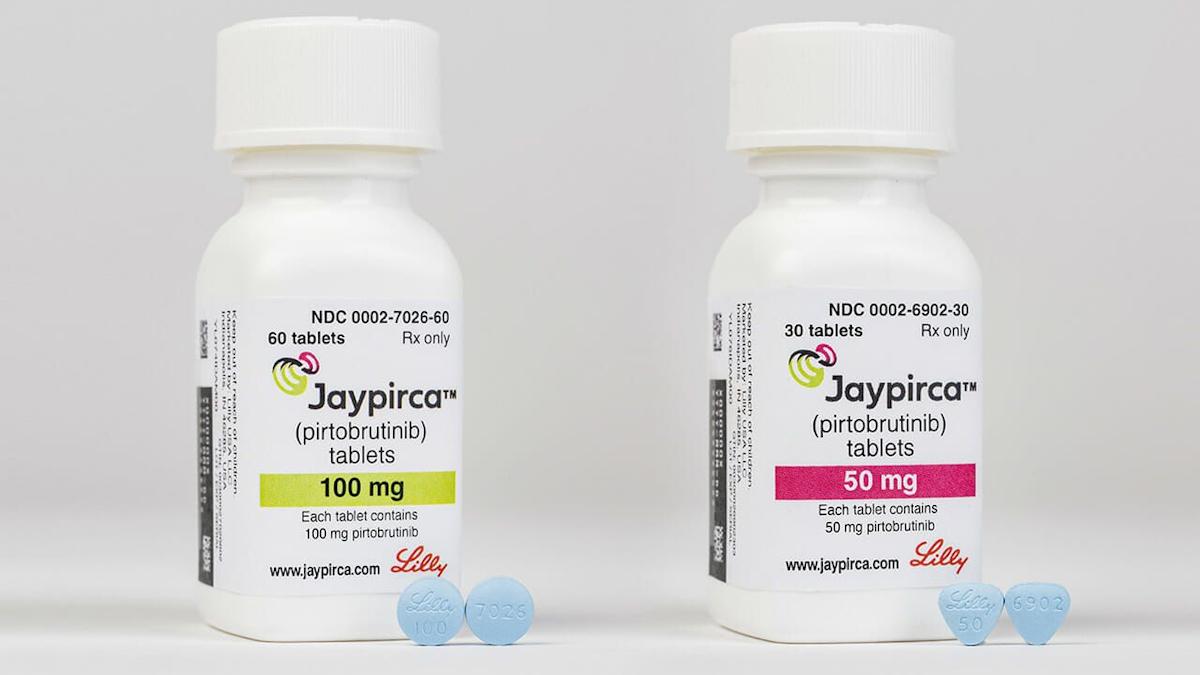
New data with Eli Lilly's Jaypirca has cemented its place as a therapy for chronic lymphocytic leukaemia (CLL) in patients whose cancer has returned or stopped responding to treatment.
The results of the BRUIN CLL-322 trial, reported at the EHA congress, showed that adding the non-covalent BTK inhibitor to the standard, second-line regimen of AbbVie/Roche's Venclexta (venetoclax) and rituximab reduced the risk of disease progression or death by 45%.
After two years of follow-up, 86.9% of patients on the Jaypirca (pirtobrutinib) regimen were still alive without disease progression, compared to 71.8% of those on Venclexta/rituximab alone. In addition, peripheral blood undetectable minimal residual disease (MRD) rates at the end of treatment were higher, coming in at 86% and 61%, respectively.
Crucially, four out of five of the subjects enrolled on the trial had previously been treated with older, covalent BTK inhibitors like AbbVie/Johnson & Johnson's Imbruvica (ibrutinib), AstraZeneca's Calquence (acalabrutinib), and BeiGene's Brukinsa (zanubrutinib), with some showing resistance to them.
Lead investigator Matthew Davids of Dana-Farber Cancer Institute said that this reflected current clinical practice in relapsed or refractory CLL.
Meanwhile, the addition of Jaypirca to the standard treatment kept the cancer under control for longer "without adding much toxicity," according to Davids, who told delegates that this suggests the triplet can benefit a wide range of patients, "including older patients with other medical co-morbidities."
"When pirtobrutinib is added to the standard venetoclax-rituximab regimen, we see a substantial improvement in progression-free survival, even better than we hypothesised," he added. "That speaks to the power of the triplet-based therapy over the doublet and supports consideration of the triplet as a new standard of care option for relapsed/refractory CLL," he added.
The readout of BRUIN CLL-322 comes just a few months after Jaypirca was approved by the FDA as a single-agent therapy for patients with relapsed/refractory CLL who had been previously treated with a covalent BTK inhibitor, based on the results of the BRUIN CLL-321 study. Lilly said it intends to submit the new results to global regulatory authorities to see if the label for Jaypirca can be extended.
That could ramp up the sales potential for the drug, which brought in $506 million in global sales last year after claiming its first approval as a third-line or later therapy for CLL after a BTK drug and Venclexta in 2023.
Analysts at Leerink have suggested the drug could make revenues of $1.8 billion in 2030, if the triplet regimen is approved for marketing, while GlobalData thinks it could go as high as $2.5 billion in the same year.
Lilly recently also reported encouraging data with the drug in the first-line setting, outperforming chemoimmunotherapy (CIT) in previously untreated CLL patients without 17p deletions in the BRUIN CLL-313 study.