Solution Spotlight: BrandPRO Biopharma

A strong strategy on paper can unravel when priorities collide. BrandPRO Biopharma gives pharmaceutical teams a place to put their decisions to the test. In approximately three hours, participants manage competing prescription brands, weigh commercial and patient-focused trade-offs, and see the business consequences of their choices. It turns training into a shared challenge: agree on a strategy, commit to it, and learn from what happens next.
What problem or status quo deficiency are you solving?
A polished brand plan does not tell you how a team will respond when its assumptions are challenged. Will colleagues agree on where to invest? Can they explain why one opportunity deserves priority over another? Too often, training ends before those questions become uncomfortable. BrandPRO Biopharma gives teams a practical setting in which to confront them. Participants have to move from discussing strategy to making decisions together. The challenge is to develop the judgement behind a plan: how to interpret information, defend a choice, recognise a weak assumption, and adapt when the results demand it.
What has made this problem challenging to address in the past?
The workplace offers little room to rehearse a consequential commercial decision. Once resources are committed, changing direction may be costly. Yet, a presentation or case discussion can let participants settle for a convincing explanation without testing whether their choices work together. Training also needs to make room for disagreement. Colleagues may use the same word, such as value, while prioritising very different outcomes. A shared decision exercise can surface those differences. It gives a team something concrete to examine: what we chose, why we chose it, and what we would reconsider.
What new innovations does your solution bring to bear on these challenges?
BrandPRO Biopharma brings prescription-brand strategy into an experiential learning format. Participants explore tensions such as treatment efficacy versus affordability and innovation investment versus profitability. Those tensions create a starting point for deeper questions: whose needs are we prioritising, what evidence supports our position, and what are we giving up? The distinctive learning opportunity is to make a choice and then revisit its logic in light of the outcome. An attractive proposition must hold together as a business strategy. That creates a more demanding conversation than asking participants whether they understand the concepts.
How does your solution work?
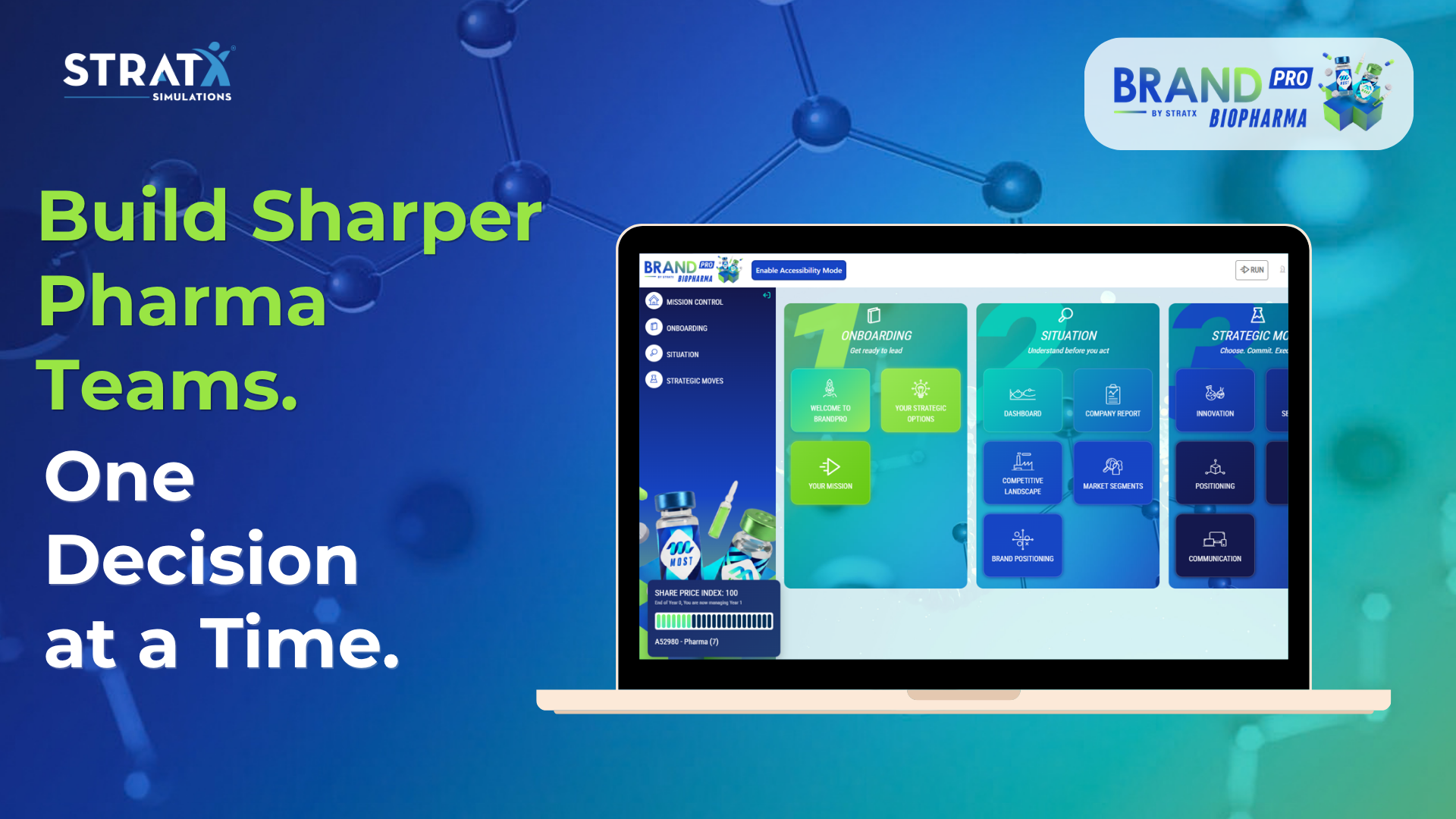
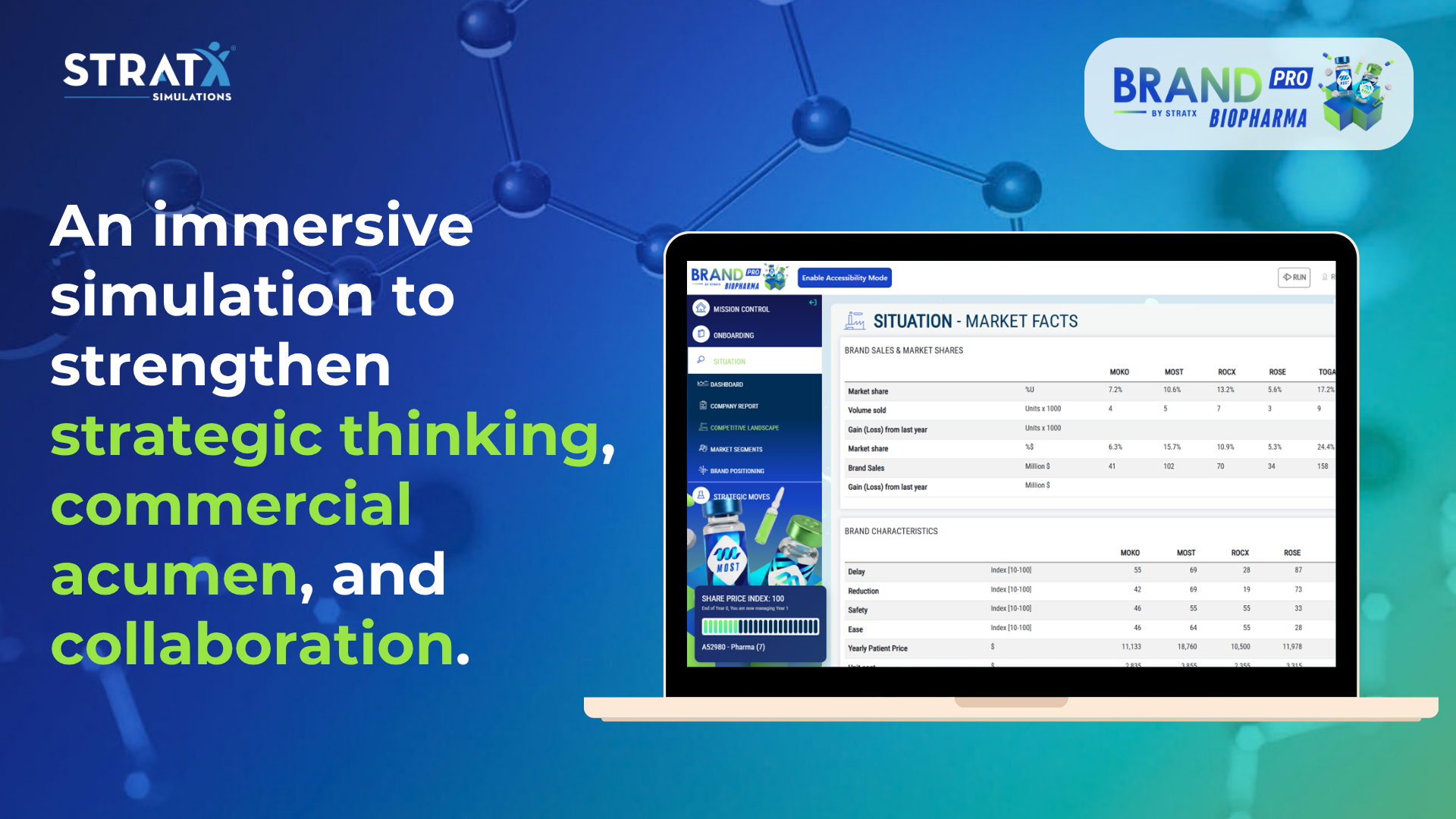
Teams run BrandPRO-M, a biopharma affiliate competing in a market for a chronic autoimmune disease. Over five simulated years, they manage two prescription brands, MOST and MOKO. They analyse information, make decisions about pricing, brand resources, research and development, sales and distribution, and advertising, then review performance. The simulation takes approximately three hours. Each round gives participants a reason to challenge their previous thinking: did the decision deliver what we expected, and what should we change? Success requires a coherent strategy that teams can explain and refine as the exercise progresses.
What makes your solution stand out in the market?
It makes the quality of a strategy a shared question. Participants cannot stop at proposing an initiative for their own area; they have to consider how it supports the wider business. A team might agree that a brand needs stronger differentiation, for example, then discover that it disagrees about the investment required or the return it expects. Those disagreements are useful learning material. Built on StratX’s experience with Markstrat, BrandPRO Biopharma is designed for pharmaceutical marketing, commercial excellence, market access, and brand strategy programmes. It gives facilitators a concrete experience around which to build discussion.
What concrete outcomes and KPI benefits does your solution deliver?
Participants examine simulated revenues, market share, and profitability and contribution, with overall value creation measured through the Share Price Index (SPI). The learning objectives include strategic thinking, commercial understanding, and stronger alignment across functions. For a training team, useful evaluation questions go beyond the final score: can participants explain the financial implications of a choice, identify the assumptions behind it, and agree on priorities? These can be assessed through decision rationales and debriefs. A follow-up can explore how participants apply their learning at work; simulated results should not be presented as evidence of real-world ROI.
How does your solution improve the experience for the end user?
Participants have a stake in the discussion because they own the choices. A difference of opinion becomes a decision to resolve; a disappointing result becomes an assumption to investigate. That gives the learning a clear purpose and provides colleagues with a shared experience they can refer to afterward. BrandPRO Biopharma supports online, face-to-face, and blended delivery. A facilitator can use the debrief to ask a practical closing question: what will you do differently in your next brand-planning conversation? The goal is to leave participants with specific actions, alongside a clearer understanding of their strategic reasoning.
What do your customers have to say about this solution?
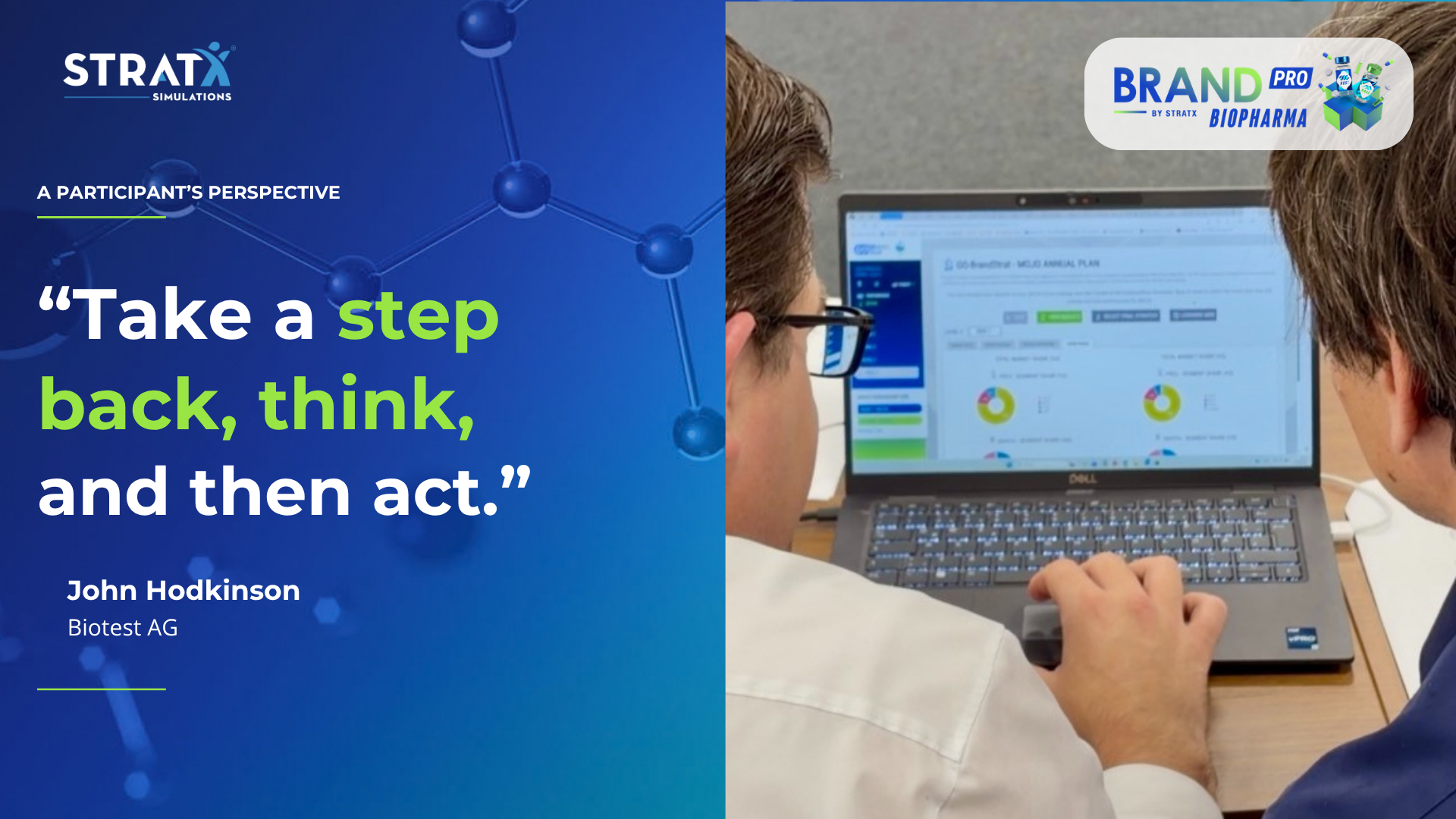
At a recent StratX programme in Frankfurt with Biotest AG, a leading supplier of serum in the biotech industry, 16 participants worked in teams using a simulation during a one-day Reverse Marketing seminar. Reflecting on the experience, John Hodkinson said:
“What I liked about today was it pushed us to take a step back, think, and then act.” - John Hodkinson, Biotest
The takeaway connects directly to the learning challenge: creating space to analyse a situation before committing to action. This is an example of StratX’s simulation-based learning in a pharmaceutical organisation.
Before your teams commit to their next brand plan, give them a chance to rehearse. Explore BrandPRO Biopharma and request a demonstration.
About StratX Simulations

StratX Simulations helps organizations develop business skills through hands-on, simulation-based learning. For pharmaceutical and biopharma teams, its simulations and facilitated workshops build strategic thinking, commercial acumen and cross-functional collaboration. By making decisions and exploring the consequences in a risk-free setting, participants build skills and confidence they can bring back to the workplace. Founded by INSEAD Professor Emeritus Jean-Claude Larréché, StratX has offices in Paris and Boston. Learn more at www.stratxsim.com.