ESMO26: Moderna, MSD reveal cancer jab data early after leak
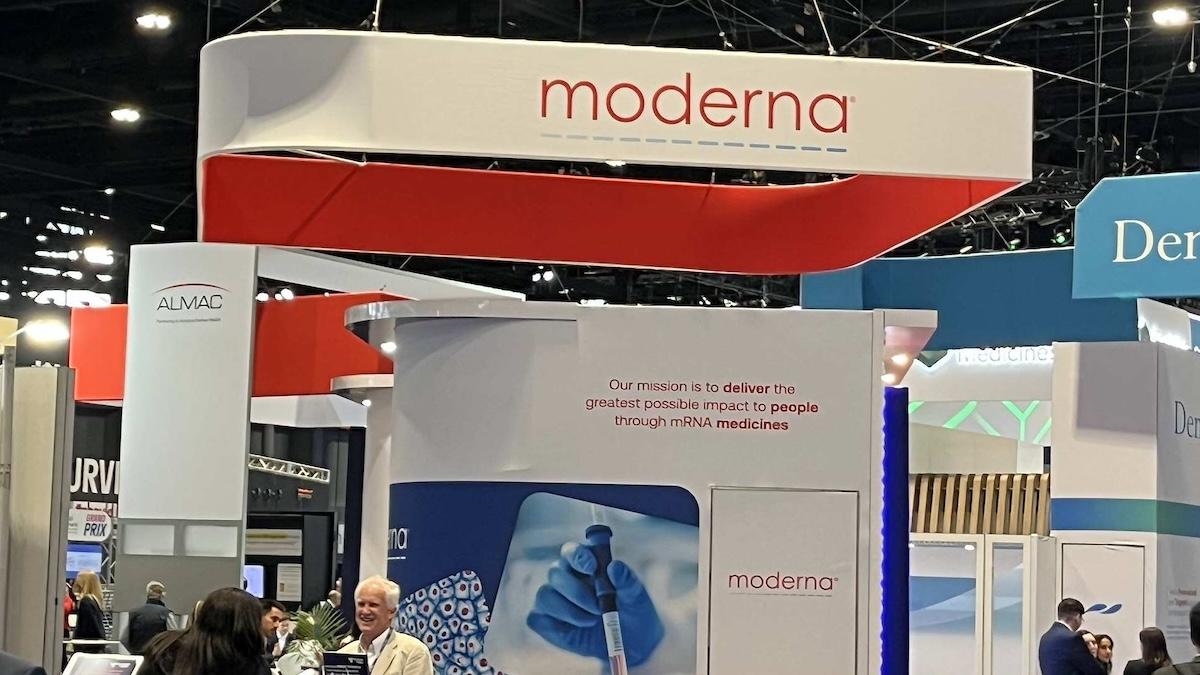
Photo by Jonah Comstock
Moderna and MSD have shared keenly anticipated results for their melanoma cancer vaccine, ahead of a presentation at ESMO tomorrow, after a data embargo breach.
The INTerpath-001 in patients with completely resected stage IIB-IV melanoma had been billed as one of the highlights of ESMO, which starts today in Madrid, Spain, and the headline result has not disappointed.
The combination of the personalised intismeran autogene vaccine with MSD's immunotherapy Keytruda (pembrolizumab) cut the risk of recurrence or death by 42% compared to Keytruda alone at 24 months, a hazard ratio of 0.58 that largely met expectations as a clinically meaningful result. Recurrence-free survival (RFS) at that timepoint came in at 82.2% with the combination and 70.0% for the control group.
That was backed up by a 38% improvement in distant metastasis-free survival (DMFS) at two years, an endpoint reached by 88.5% in the Keytruda/vaccine group and 80.2% in patients receiving Keytruda alone.
Crucially, the benefits were seen consistently across the different patient groups included in the study, and were accompanied by safety data that was consistent with earlier studies.
In the wake of the leak – which was first reported by STAT and has since been confirmed by the ESMO secretariat – shares in Moderna fell almost 18%, while MSD (known as Merck & Co in the US and Canada) also dipped slightly.
That was likely in part because the overall RFS and DMFS results were a little lower than was seen in mid-stage trials, failing to meet inflated expectations, and also as a correction to the strong gains in the stock after MSD and Moderna teased the outcome in August.
Both stocks had started to regain some of the lost ground at the time of writing, which could reflect that the gains in both RFS and DMFS with the vaccine are being delivered on the back of an already highly-effective treatment.
Breach investigated
ESMO said it has launched an investigation into the leak and "may have identified the source," adding: "Appropriate measures are being taken, and, should the findings warrant it, we will consider all available options."
"INTerpath-001 is the first phase 3 study to demonstrate a clinically meaningful improvement in RFS and DMFS over standard-of-care Keytruda in patients with resected melanoma," said MSD's head of R&D, Dean Li.
The results set "a new benchmark in the adjuvant setting and [represent] one of the most significant advances in melanoma treatment since the advent of immunotherapy," he added.
Analysts have suggested that, if approved, intismeran autogene could generate billions of dollars in sales in its own right, but may also pave the way for Moderna's broader mRNA-based cancer vaccine pipeline, which also has trials running in lung, kidney, and bladder cancer.
The vaccine is made by sampling a patient's tumour to determine its unique mutational signature and identifying up to 34 cancer neoantigens – which appear on tumour cells, but not on healthy cells – that can be used to prime the immune system to attack the cancer.
"From the beginning, we believed mRNA technology could make it possible to develop cancer treatments uniquely matched to each patient's tumour," said Moderna's chief executive, Stéphane Bancel.
"The INTerpath-001 results mark a defining moment for that vision and show what's possible when we rethink how medicines are made."
Moderna and MSD are now looking at preparing marketing applications for intismeran autogene, which could set up potential approvals next year.