Datroway is first TROP2 drug for frontline breast cancer
AstraZeneca and Daiichi Sankyo's Datroway has been approved by the FDA for some previously untreated patients with metastatic triple-negative breast cancer (TNBC), the first drug in the class to move into the first-line setting in the US.
The green light – which comes on the back of the TROPION-Breast02 trial and after a priority review – makes the TROP2-targeting antibody-drug conjugate (ADC) a treatment option for patients who are not eligible for frontline immunotherapy with PD-1/PD-L1 inhibitors.
The news has been celebrated by the Triple Negative Breast Cancer Foundation, whose executive director, Arlene Bothers, noted that seven out of 10 patients with metastatic TNBC are not candidates for immunotherapy, with chemotherapy the only treatment option.
"Today's approval of Datroway means that for the first time, these patients will have a new standard of care beyond traditional chemotherapy at the outset of their treatment," she added.
Datroway (datopotamab deruxtecan) was approved by the FDA last year for previously treated HR-positive, HER2-negative breast cancer, and EGFR-mutated non-small cell lung cancer (NSCLC), and has seen its sales start to accelerate, bringing in $218 million last year for AZ and Daiichi Sankyo and another $102 million in the first three months of 2026.
Approval in first-line TNBC gives the two companies another growth driver for a product that AZ has predicted could eventually reach $5 billion in peak annual sales across all its indications.
In TROPION-Breast02, treatment with Datroway led to a statistically significant five-month improvement in median overall survival (OS) and a 43% reduction in patients' risk of disease progression or death compared to chemotherapy, becoming the first drug in the TROP2 class to improve OS in first-line TNBC patients. The trial showed an "unprecedented" median OS of approximately two years.
TNBC is the most aggressive type of breast cancer, accounting for 15% of all breast cancer cases, and has one of the worst prognoses, with a median OS of just 12 to 18 months.
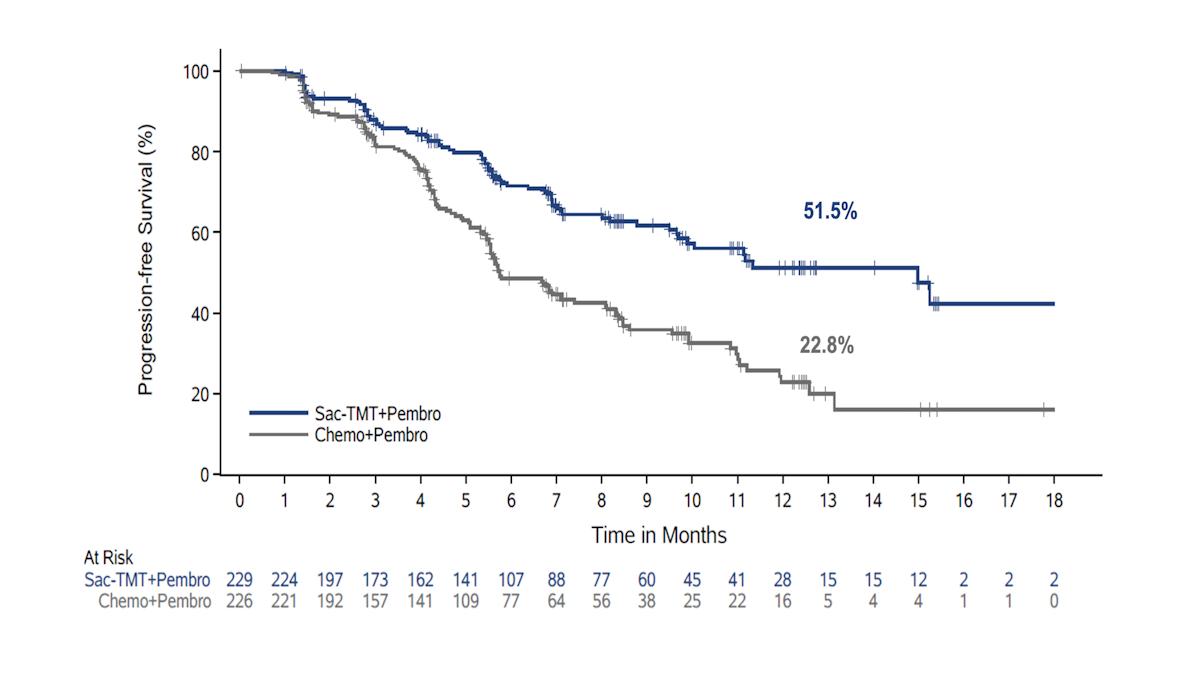
Gilead Sciences' rival TROP2 ADC Trodelvy (sacituzumab govitecan), which is also approved for previously treated TNBC, has positive progression-free survival data in the first-line setting from the ASCENT-03 study, but so far has not been able to show an OS benefit.
The company is drawing on the accompanying ASCENT-04 trial of Trodelvy in combination MSD's PD-1 inhibitor Keytruda (pembrolizumab) in previously untreated, PD-L1-positive TNBC as a "backbone" frontline treatment, and has filed its ADC for this use in both the US and Europe.
Last week, the EMA's human medicines committee, the CHMP, recommended approval of the first-line indication.
AZ and Daiichi Sankyo are planning to extend the label for Datroway even further in TNBC via the TROPION-Breast05 study in PD-1/PD-L1-eligible patients, with or without AZ's PD-L1 inhibitor Imfinzi (durvalumab), as well as TROPION-Breast04 and TROPION-Breast03 in neoadjuvant and post-neoadjuvant treatment of early TNBC.