HIV resurgence looming as international aid declines
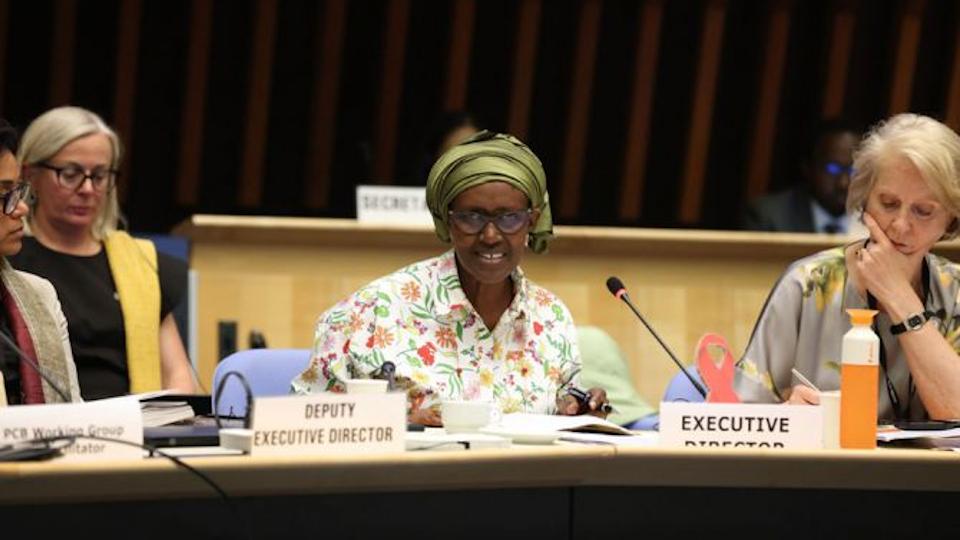
Winnie Byanyima (centre), executive director of UNAIDS.
More than 3 million people worldwide could be infected with HIV by the end of the decade following a steep fall in international aid funding, according to the United Nations.
In a special report (PDF) published to mark the International AIDS Conference underway in Rio de Janeiro, Brazil, the UNAIDS organisation has warned that efforts to end HIV as a public health threat are faltering, in part due to an 18% reduction in international financing, from $8.8 billion in 2024 to $7.3 billion last year.
The reduction – to the lowest level in nearly two decades – follows the abolition of the USAID agency by the Trump administration in the US, as well as decisions to slash international aid budgets in many other countries, including the UK.
In 2025, 1.2 million more people became infected with HIV and 570,000 more people died of AIDS-related illnesses. While these levels are at their lowest in more than 30 years, UNAIDS is concerned that the current HIV response is "fragile" and the world "is not on track to achieve the 2030 goal of ending AIDS as a public health threat."
Underlying the low case figures are worrying signs, including new infection rates rising in 25 countries, and around 9 million of 41 million people living with HIV not on treatment, including almost half of HIV-positive children, according to the report.
Funding for condoms has been cut by more than 90% in some countries, and there have been big reductions for community-led support for prevention medicines and HIV care, particularly for men who have sex with men, sex workers, and survivors of gender-based violence.
HIV prevention services have been largely funded with international aid, according to UNAIDS, and as that support starts to dry up HIV prevention and community-led HIV service delivery risk total collapse, according to the agency, which notes that increases in domestic funding have offset some of the decline.
"The era of relying on international aid is over," said Winnie Byanyima, executive director of UNAIDS. "Countries cannot wait, and they cannot go backwards. The world must urgently fix the broken financial system and accelerate debt restructuring so that governments can invest in what matters most – the health, education, and futures of their people."
The worrying trends come at a time when pharma companies are starting to deliver new HIV prevention medicines that deliver "vaccine-like" protection, such as Gilead Sciences' twice-yearly pre-exposure prophylaxis (PrEP) product Yeztugo (lenacapavir), which was endorsed by the WHO last year.
UNAIDS acknowledged that UNITAID and partner organisations have raised funding to offer lenacapavir-based medicines to around 3 million people in 2028, but said that is currently a "drop in the ocean," involving a few thousand people at the moment, and would have to be scaled up to 20 million people to have a real impact.
"Scientific breakthroughs are giving us tools that previous generations could only dream of," said Byanyima. "However, innovation without access is not innovation, it is injustice. The test of success is not whether medicines exist – it is whether the people who need them can get them, and at an affordable price."