
Aureka offers open-source AI module for drug discovery
While many AIs used to assist drug discovery are provided by big tech companies at a cost, a small US and China-based techbio company is taking a different tack.
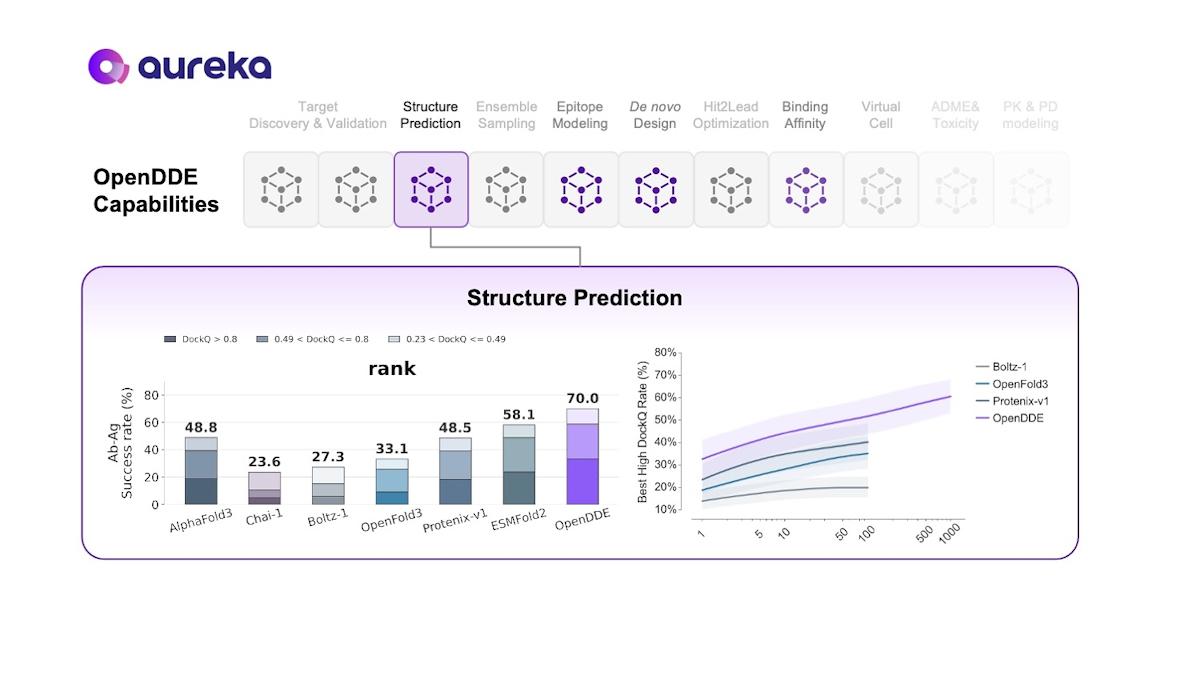
Laguna Hills, California, and Shanghai-based Aureka has released Open Drug Discovery Engine (OpenDDE), an open-source foundational model that it says is "designed to serve as the structural reasoning core of next-generation drug discovery systems."
The launch, an attempt to democratise access to biomolecular co-folding studies used to model interactions across proteins, nucleic acids, small-molecule ligands, and other molecules, making this activity "more accessible to researchers, startups, academic laboratories, and multinational corporations," according to the company.
At the moment, many of the big AI systems used in drug discovery are closed-source, meaning they are proprietary and carry an ongoing cost to use. Examples include Insilico Medicine's Pharma.AI, Isomorphic Lab's AlphaFold successor IsoDDE, and Recursion's Boltz-2.1.
Aureka's AI is billed as an "all-atom" platform, one that simulates every single individual atom in a biological system, rather than using simplified representations.
At the moment, OpenDDE covers structure prediction, antibody-antigen modelling, and drug discovery research, but Aureka intends to expand its capabilities to include de novo design of drug molecules and other functions.
That includes estimating the strength of binding between drug candidates and their targets and conformational ensemble modelling, which is used to simulate the dynamic, changing 3D shape of proteins – rather than the conventional 'lock-and-key' modelling – that can sometimes reveal hidden binding sites.
Other future features will include structure-conditioned optimisation, i.e. the use of generative AI to design candidates that perfectly fit a target, as well as experimental feedback loops.
Will Hua, head of AI research at Aureka, said in a social media post that the release of the co-folding module is a "first small step" for Aureka as it works towards "a real drug discovery engine," at a time when biomolecular foundation models are "entering the scaling era."
The company is pairing the AI with a high-throughput automated wet-lab platform to build a dry-wet closed-loop discovery system, and is developing its own therapeutic candidate pipeline.
"For Aureka, OpenDDE is part of a larger AI-native drug discovery infrastructure spanning foundation models, compute, molecular design, high throughput functional validation, closed loop optimisation, and asset data room generation," he added.
"OpenDDE is not a complete drug discovery engine yet. It has flaws, but it forms a foundation layer. By connecting biomolecular modelling with physical wet lab validation, we hope to make therapeutic discovery more scalable, reproducible, and accessible."













