Anthropic AI tool conducts physical scientific experiments
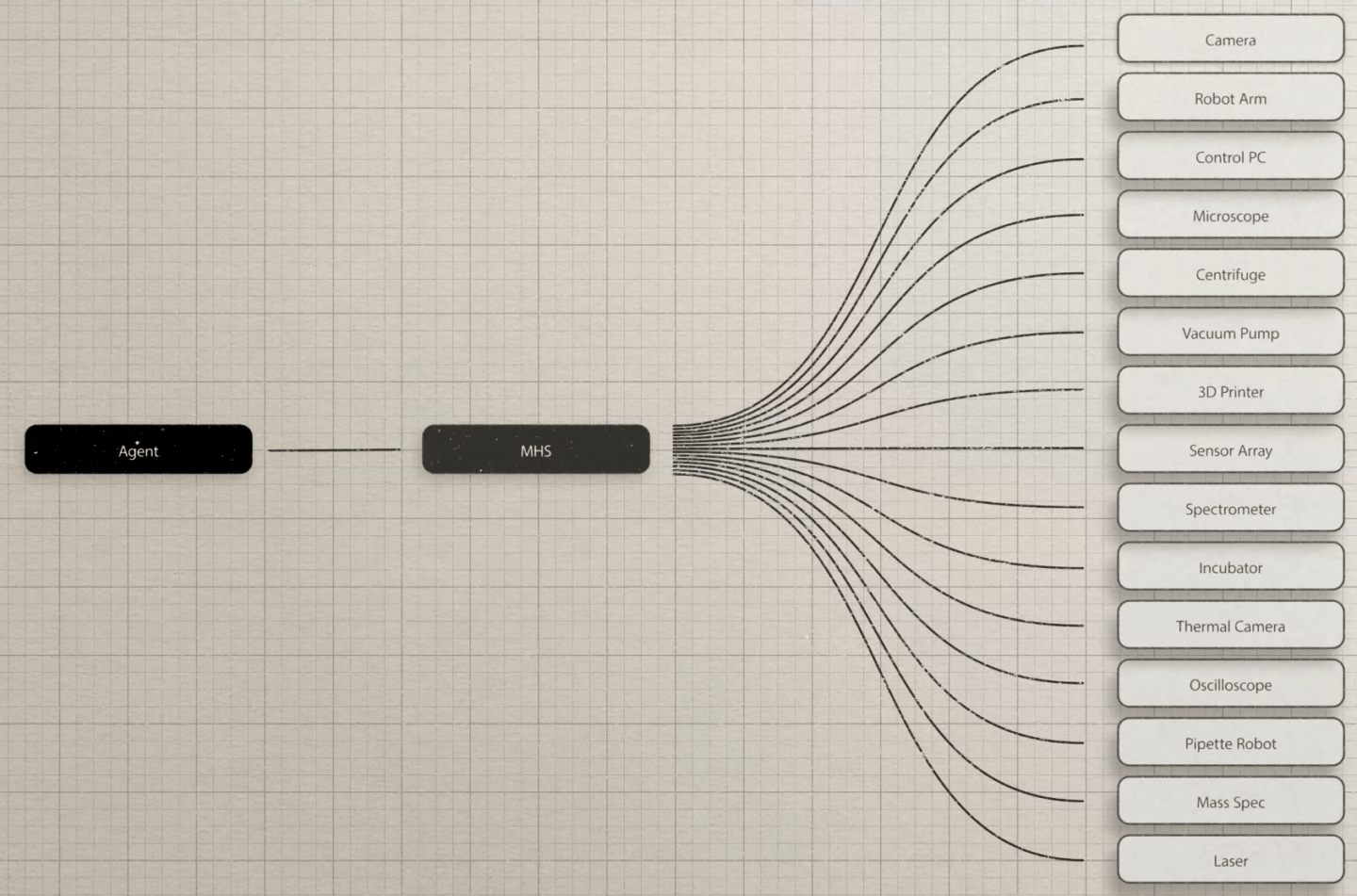
Anthropic has opened a research preview of its Model Hardware Standard (MHS), allowing AI agents such as Claude to control scientific equipment, automate experiments, and manage workflows across labs.
The MHS technology is Anthropic’s first tool designed to operate in the physical world.
According to the Financial Times, Anthropic says its new tool enables AI agents to autonomously operate devices ranging from complex microscopes to liquid handlers, lasers, and robotic arms.
The research preview comes as the company seeks to expand new applications into manufacturing, robotics, and pharmaceuticals, ahead of a planned IPO that could value the company at $2 trillion.
The development of MHS began as a collaboration between Anthropic and HHMI Janelia Research Campus. Since, Anthropic has been testing the technology with a small group of labs and hardware manufacturers in biotech, robotics, and quantum computing, including the Howard Hughes Medical Institute, Carnegie Mellon University, Genentech, and QuEra.
Anthropic explains that “a standardised driver is software that translates between a computer’s operating system and a hardware device. The MHS driver uses a simple set of primitives – commands like “read” (for example, “get temperature”) or “write” (for example, “set temperature”) – that any hardware device can understand and act on. And it makes each device discoverable in a standard format, so that devices and agents can find each other and communicate across networks without needing a bespoke “translator” program in between.”
MHS can be controlled by three mechanisms: MCP, the command line interface, and code files (APIs). These work together to enable orchestration across multiple devices via a single line of code. “Once the agent can control the devices, it’s able to receive operating data from each one and supervise and direct the work at a high level,” states Anthropic.
Amazon Web Services will support MHS through Strands Robots, the library for connecting AI agents to physical devices, while Automata is adding MHS support to LINQ, their lab automation platform, to perform intelligent error handling of instruments in autonomous labs. And, with Danaher, Anthropic will actively explore how MHS-supported capabilities could enable its smart instruments and autonomous laboratories to scale biomedical research and development.
MHS does not yet operate with hardware that lacks a programming interface.
Anthropic will work to safeguard the system from making unforced errors before offering MHS open source. Instead, for now, the research preview will be available to a first group of scientific research labs and advanced manufacturers.
Last month, Anthropic launched Claude Science, for an AI 'workbench' for researchers involved in drug discovery. Claude Science has over 60 functions built in for areas like genomics, single-cell studies, proteomics, structural biology, and cheminformatics, assisting researchers with tasks like 3D protein structure rendering, analysing genome maps, single-cell RNA sequencing analysis, and CRISPR screen design.
Access to the MHS research preview can be applied for here.