How female leadership can benefit industry

STEM – science, technology, engineering, and mathematics – are crucial fields for progressing necessary innovations to benefit both people and planet. But for too long women were prohibited from playing a role.
In 2026, much attention has been given to this issue, driven by the work of UNESCO, the United Nations, international events and other organisations, as well as new and ongoing research and policy discussions around closing the gender gap once and for all. Nonetheless, as we near the end of the year, women remain underrepresented in STEM. Indeed, they make up less than one‑third of the world’s researchers.
In order to continue to review how far gender equality has come across life sciences, and assess what more can be done to further harness female potential from the beginning, pharmaphorum speaks with female industry experts from time to time.
In this Q&A, two female leaders – Day One Strategy’s founding partners Abigail Stuart and Hannah Mann – share the benefits female leadership can bring to industry, and why that especially matters today.
Q. What led you to build Day One, and why did you feel the healthcare industry needed a different kind of insight and strategy partner?
Hannah Mann [HM]: We had both worked inside a large global marketing and communications group and could see the industry changing around us. Clients’ needs were evolving quickly, but in a large organisation it was hard to move at the same pace. So, we decided to go off and do it ourselves.
Healthcare and pharma teams were facing more complex business questions, more data than they knew what to do with, and less time to make decisions. Insight could be too slow, or too distant from the point where decisions were actually being made. We wanted to rethink how healthcare insight could work, and build an agency that helped clients get to clarity faster.
Abigail Stuart [AS]: Right from the start, we knew technology would play a big role, but the real goal was clarity. Clients did not need more information. They needed sharper answers to the decisions in front of them.
Our positioning from the start was about combining human intelligence with technology, and we have stayed true to that ever since. That is even more relevant now as AI changes what is possible. But our belief has not changed: technology can make insight faster and more powerful, but human thinking cannot be replaced.
The name Day One captured the spirit of what we wanted to build: a business that stays curious, keeps moving, and starts each day with fresh ideas and new thinking.
Q. Hannah, Day One was founded and is led by women. How has that shaped the business you have built?
HM: I think people expect, and hopefully get, a different culture from a female-run business. For us, that means being more collaborative, more transparent, and less hierarchical. The fact that our Great Place to Work survey shows people enjoy working here and stay here hopefully means that is true.
We also do not believe growth should come at any cost. Someone can be brilliant commercially, but if they damage the culture, they are not right for Day One. We do not tolerate jerks, and that is written into our employee value proposition.
Being female-founded has also helped us attract people who want a different kind of workplace. When we ask people why they joined Day One, many mention the fact that it is female-founded and led. That matters to men and women, in the UK and the US. We always said we wanted Day One to be the company people want to work with and work for, and that has become a real test for how we make decisions.
AS: It has also meant we have built a leadership team with a lot of women in senior roles, which is still unusual. At the same time, we are very conscious that diversity of thinking matters. It is not about one type of person succeeding. It is about creating a business where different people can do brilliant work together.
Q. From your work with healthcare and pharmaceutical companies, what are the biggest decision-making challenges facing pharma teams today?
AS: Everything is more complex. Pharma teams are dealing with more complicated science, more specialised medicines, more stakeholders, more competition, and much faster shifts in customer perception. Often, there is not one customer anymore. There are multiple customers and influencers who can shape whether a medicine is understood, adopted, and used in the right way.
Teams also have more data than ever, but not always the clarity they need to make decisions. The hard part is not accessing information. It is knowing which information matters, what it means, and what decision it should change.
Like all businesses, pharma companies are under pressure to be profitable and growing. That means everything is coming under more scrutiny. Teams have to justify why they are spending money, why a piece of insight matters, and what it will change.
That puts more pressure on insight and strategy partners to help clients get to the right decision, not just give them more information.
Q. You have both been working in pharma for over two decades. How has the role of insight changed in pharma, particularly as teams face more complexity, faster timelines, and greater pressure to demonstrate impact?
AS: Insight used to be treated more like a standalone project: commission the research, run the fieldwork, deliver the debrief, then move on. That model is changing. Clients are being more selective, and rightly so. Research needs to inform important strategic choices, not just answer interesting questions.
Pharma teams now need insight much closer to the point of decision-making. They need to understand what is happening, why it is happening, and what to do about it while there is still time to act.
The other big shift is that insight can no longer sit on its own. It has to be contextualised with other sources: behavioural data, secondary research, competitive intelligence, sales data, and the lived context of the market. Insight is one source among many, and the value comes from bringing those sources together.
HM: For us, that is where the future is heading. Less one-off, ad hoc projects that end with a report, and more connected knowledge that compounds over time and helps teams find the insight that shifts the needle among all the noise.
Q. Abigail, you often write about how AI is reshaping healthcare and life sciences. Where do you believe it can genuinely improve decision-making, and where should the industry be careful?
AS: One area that has really taken off is using existing knowledge to create synthetic customer personas. These can help teams pressure-test positioning ideas, explore different customer reactions, or identify where a message may be unclear before going into primary research. Used well, that gives teams earlier learning and helps them use primary research more intelligently.
We also see value in using AI to fill the gaps between real-world conversations. For example, a team might use synthetic advisory boards to explore hypotheses between live advisory boards or research waves. That can be very powerful, as long as it is used in a complementary way, not instead of real human understanding.
AI can improve decision-making when it is pointed at the right problems. The danger is using it because it is there, rather than because it is helping solve something that really matters. Sometimes it is easier to use your own brain. The value comes when AI helps solve something that is too complex, too fragmented or too time-consuming for humans to do alone.
HM: The caution is not that AI is bad. It is that AI cannot replace human thinking or the context experts bring from years of working in the industry.
It does not understand the politics inside a brand team, the nuance of a treatment pathway, or the commercial trade-offs behind a strategic choice unless those things are brought into the process. AI can give you more information and help you make a more informed decision, but humans still need to decide what to do.
Q. Hannah, you lead the people side of Day One. What have you learned about scaling a specialist healthcare business while protecting the culture, standards, and values that made it successful?
HM: It all comes back to people. When Day One was small, Abigail and I could personally shape everything: who joined, how we worked, what good looked like, and what kind of behaviour was acceptable. As the business has grown, we have had to be much more deliberate about protecting that.
The biggest lesson is that you need real clarity on what makes someone a Day One person. That does not mean hiring the same type of person again and again. In fact, that would be dangerous. We need different skills, experiences, and ways of thinking. But we do need consistency in values, attitude, curiosity, and standards.
We are also scaling at a time when the industry itself is changing, so we are hiring people not just for the roles we need today, but for the business we are becoming. People need to be adaptable, commercially curious, and interested in how technology is changing the work.
The other lesson is to bring people with you. We try to be open about where the business is going, what we are building, and why things are changing. We spend a lot of time thinking three years ahead, and then making sure the team understands the mission and the direction. Culture is much easier to protect when people feel part of the journey.
Q. What advice would you give to women who want to build senior careers, businesses, or leadership roles in life sciences?
AS: Early in your career, it is tempting to chase the biggest title, the biggest company, or the best salary. But often the better choice is the place where you will learn the most. Go where there is growth and opportunity. Go where you can get exposure to senior leaders and experts. Go where you can see how decisions are made.
If you want to start a business one day, work with entrepreneurs. Work somewhere small enough that you can see the whole operation, not just your own part of it. We were lucky to experience both ends of that: small businesses where you have to do everything, and large organisations where you see scale and structure.
HM: I also think we should be honest about how much support around you matters. The people you build your life with can either push you forward or hold you back. You need people who see you as an equal, back your ambition, and want you to succeed.
And finally, do not wait until you feel completely ready. You learn by taking on the challenge and working it out as you go.
About the interviewees

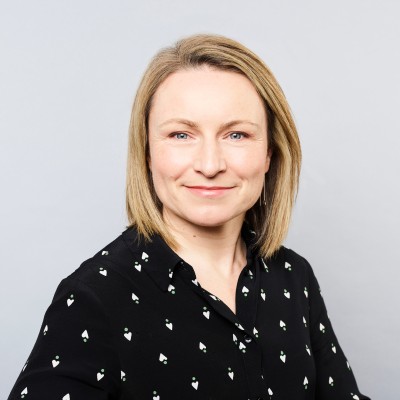
Abigail Stuart (above) and Hannah Mann (below) are founding partners at Day One Strategy.