Can AI agents reimagine pharma marketing from the ground up?
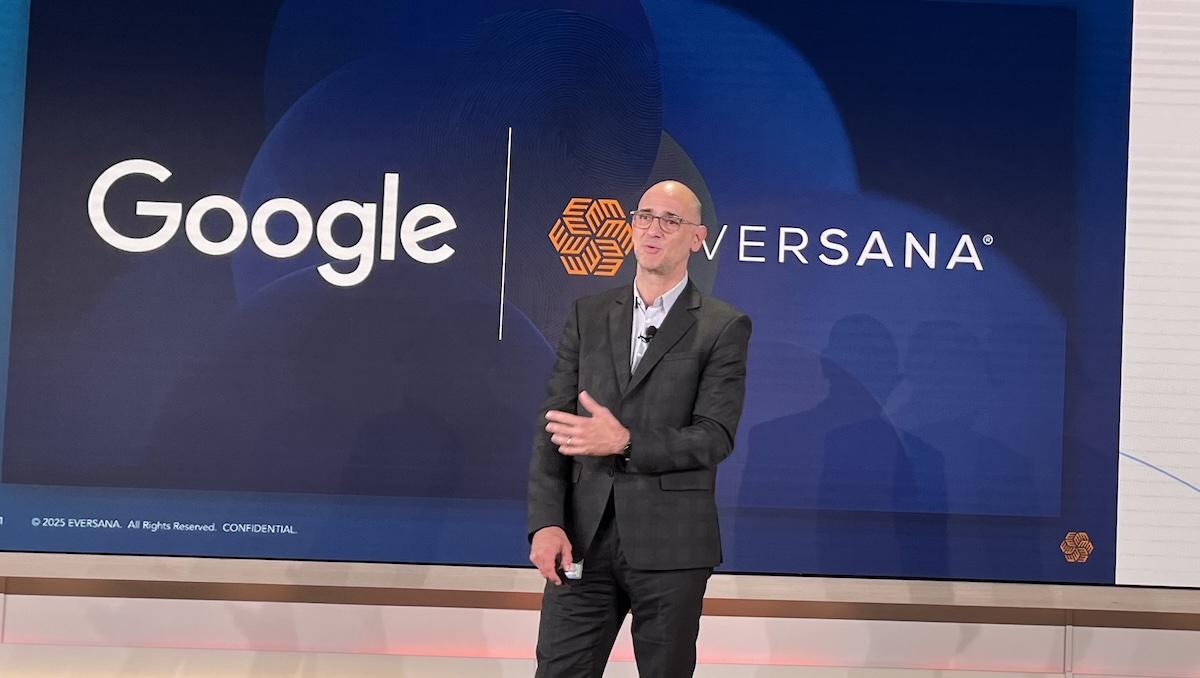
Dr Peter Clardy, lead for the Google for Health Clinical Enterprise Team, speaks at the Google-EVERSANA event on Friday.
Editor's Note: pharmaphorum is an editorially independent publication owned by EVERSANA.
Pharma marketing is a complicated endeavour, to say the least. Starting even before a drug is fully developed, pharma companies and their strategic partners must engage in brand planning and strategy, including competitive analysis, figure out how to market to both prescribers and patients, navigate complex regulatory compliance environments, and create a tremendous amount of bespoke content to fuel the demands of omnichannel marketing.
And while pharma marketing agencies are embracing AI like everyone else, most are using AI tools on a case-by-case basis to tackle one or more of those areas. But what if an agency were to redesign the pharma marketing process from the ground up, using AI across the board in an integrated way?
That’s the pitch that EVERSANA and its partner Google made at an event last week on Google’s New York City campus, launching the full-service commercialisation company’s new end-to-end AI agency product.
Reinventing pharma marketing with AI
“Most people don't realise that of the $1.1 trillion we spend on medicines around the globe, about $150 billion is spent on commercialisation,” EVERSANA CEO Jim Lang said at the start of the event. “That's more than the amounts we spend on either manufacturing those products or on doing the clinical trials on those products. We thought there was a better way.”
That better way, shown to EVERSANA clients and friends and a few reporters in a 30-minute demo, is a system of interlocking AI agents and sub-agents, each charged with executing a different part of the pharma marketing process. But unlike human agents, they don’t execute their functions one at a time.
“Let me give an example,” Faruk Capan, EVERSANA’s chief innovation officer, said. “[Typically, we] always we come up with the strategy, idea, concepts, and then we take it to MLR (medical, legal, regulatory), then we realise that we're going to make some major changes. We're going to go back and start again or go into the middle and try to fix it, etc. Our system actually includes MLR claim management at the very beginning of our journey.”
As EVERSANA’s Shane Mayer and Abid Rahman showed off in the demo, the system is built around three master agents focused on business strategy, omnichannel, and content creation, with sub-agents under each of those. A small team of humans can use these interlocking agents to carry out corresponding tasks in a faster, more cost-effective way.
Mayer showed how the system could quickly generate a competitive analysis and business strategy for a fictional cell therapy company, then just as quickly pivot when the user decides they want to focus their strategy on unseating a single market leader rather than taking on the field more broadly. Oversight agents are constantly at work making sure the output is accurate and compliant.
But it’s the content pieces that had the most wow factor with the audience. EVERSANA’s Kathleen Ferry showed off an AI-generated product advertisement that she said took one day to concept and one day to produce.
Specialised agents and humans in the loop
EVERSANA and Google presenters spoke a lot about how the system ensures accuracy and avoids hallucination. The keys are twofold: high-quality input data and highly specialised agents.
“When you think about agents, these are very distinct and discrete, and they're trained to do very unique things," Rahman said. "They're not just large language models. Anyone can go in and go to Gemini and ask whatever they want, and they will get a very general answer. These agents are trained to be very specific as to what they're supposed to know about, what they're not supposed to know about, and what they're supposed to do."
Ryan Terry, managing director for healthcare and life sciences at Google Cloud, explained a little about where the data comes from.
“We made it completely accessible inside of your own corporate data,” he said. “So working with that or sign-on, and how you think about your data, how you manage it, you'll be able to leverage that all security inside your infrastructure. What that does is when you build campaigns and you build direction, it takes [it from a large] amount of data to [a smaller] amount of data. And why that's relevant is because it reduces that margin of error.”
Another selling point of the system is that at the end of the day, humans are still accountable for the output – EVERSANA says it’s 80% AI, 20% human. It’s designed to run with a much smaller team than a traditional full-service agency, and, interestingly, it will be billed at a flat rate, rather than charging for the hours of the team members.
“Instead of getting a very large number of people involved, you'll be only dealing with four or five, a handful of people based on your project type or the assignment,” said Capan. “Meaning that these people are already established and learn this system, how to use it. They have to think differently, they have to work differently because everything's going to be so fast and at the same time, provide it to you on the go.”
Working closely with Google
AI announcements are a dime a dozen in 2025, so it was clear from the outset that the event would be focused on proving that this was real, meaningful, practical innovation. The first step was holding the event on Google’s campus and inviting prominent Googlers like Terry and Dr Peter Clardy, lead for the Google for Health Clinical Enterprise Team, to speak at the launch.
This was meant to emphasise the closeness of the partnership with Google – not just a tool rolled out using Google Cloud.
“Every year, we select a handful of partners that we go to market with at the level we're going with EVERSANA,” Terry said. “Full access to an understanding of our R&D, early access to our technology, access to our physicians, our researchers, the cutting-edge things we do behind curtains, they get access to. They get access to see and understand how it could potentially have an impact in each of your businesses.”
Clardy spoke about how Google’s approach to healthcare has evolved over the years as they realised that rather than building a vertical suite of health-related tools, they needed to integrate healthcare horizontally across their business. He also emphasised Google’s commitment to data privacy and security.
“The work that we do with Google Cloud is really designed to bring AI to the data where it lives, and not ever to bring data over into Google or in any way to use data that is partner data, that is private data, that is the most private data there is,” said. “So it's not used for training, it's not used for research, it doesn't guide ads, and we don't use it to train models.”
The future of pharma marketing?
In addition to Google’s cachet, EVERSANA was also able to point to the fact that this system is not a proof of concept or a pie in the sky. Parts of it are already in use with EVERSANA clients, and the system as a whole – as it’s meant to be used – is ready to go.
There are plenty of questions about a system like this that only time will answer: Will the system prove as hallucination-proof as advertised? Will the regulatory oversight agents succeed in keeping content in legal bounds? And what impact will this have on the job market for pharma marketers – including at EVERSANA itself?
But if this launch event was any indication, we’ll have the opportunity to see those questions answered. Because end-to-end AI for pharma marketing is here, and it’s backed by one of the most storied tech companies in the country.