Google claims quantum advance could speed up drug discovery
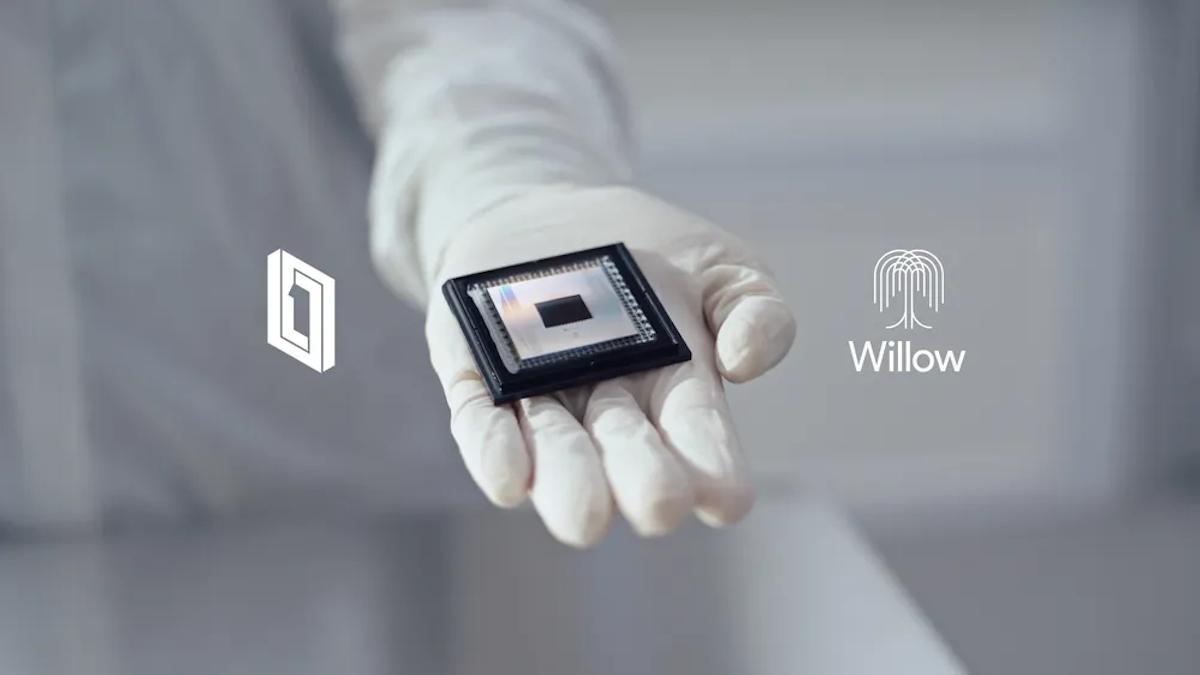
Google Willow quantum computing chip.
Google says it has made a breakthrough in its quantum computing research with an algorithm that can run calculations 13,000 times faster than even the top-performing classical supercomputers.
The algorithm, called Quantum Echoes, has already been used to compute the structure of a molecule, which Google said "paves a path towards real-world applications" in a nod to its well-established aspirations in drug discovery.
The algorithm, which runs on the tech giant's Willow quantum chip, which was revealed last year, is described in a paper in the journal Nature. Meanwhile, a second study comparing its performance to nuclear magnetic resonance (NMR) spectroscopy analysis of chemical structures has been uploaded to the arXiv prepress server.
That describes a proof-of-principle experiment, run in collaboration with the University of California, Berkeley, in which Quantum Echoes was used to study two molecules, one with 15 atoms and another with 28 atoms.
The results showed that the computed results matched those of traditional NMR – sometimes described as a 'molecular microscope' that allows scientists to see the relative positions of atoms in a molecular structure – and revealed information not usually available from NMR scanning that could provide "a pathway towards determining molecular structure and properties that are otherwise challenging to learn."
The researchers say that quantum computing-enhanced NMR could become a powerful tool in drug discovery; for example, by helping to determine how potential medicines bind to their targets.
"Today's breakthrough moves us much closer to quantum computers that can drive major discoveries in areas like medicine and materials science," write Google Quantum AI researchers Hartmut Neven and Vadim Smelyanskiy in a blog post, although, they have acknowledged that real-world use of the technology is probably still several years away.
"This is the first time in history that any quantum computer has successfully run a verifiable algorithm that surpasses the ability of supercomputers," an achievement referred to as "quantum advantage," they add.
Their study also shows "quantum verifiability" – meaning the experiment can be repeated on Google's quantum computer or any other of the same calibre – and deliver the same answer, something that the company had not been able to achieve before.
"This repeatable, beyond-classical computation is the basis for scalable verification, bringing quantum computers closer to becoming tools for practical applications."
A report in the Financial Times notes that previous quantum advantage claims by Google and rivals have been met with scepticism, with some rival groups claiming the results achieved have been replicable on classical supercomputers.