One year later, EVERSANA plans to go beyond the AI agency
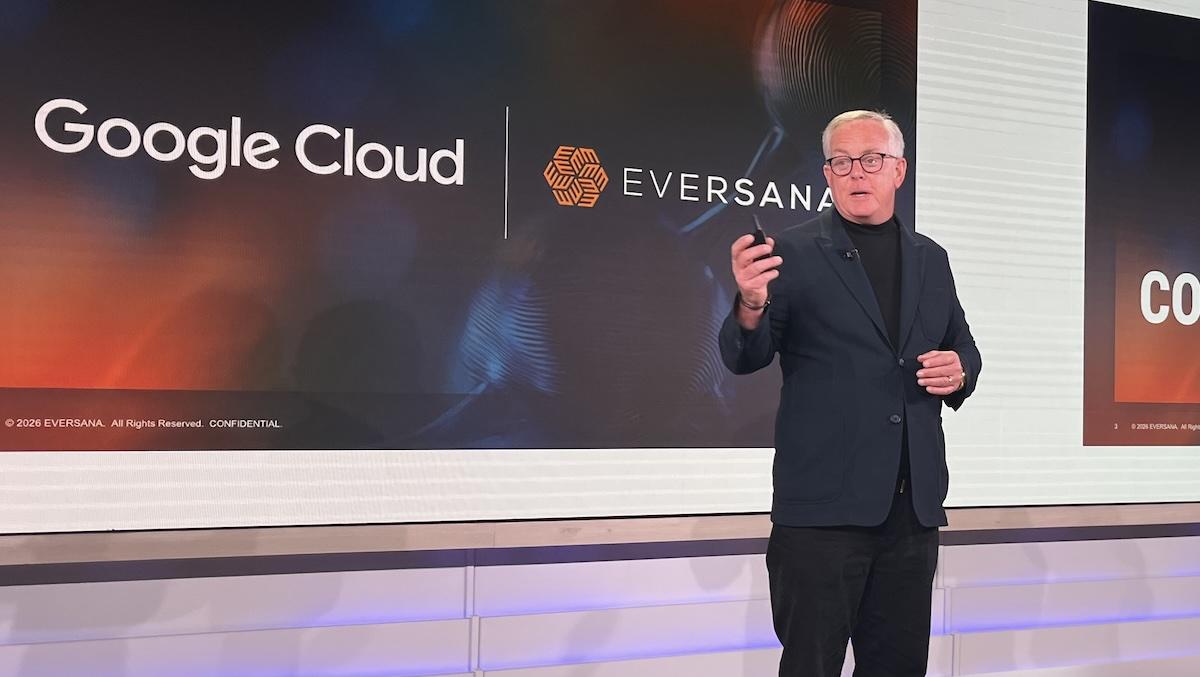
EVERSANA CEO Mark Thierer speaks at the EVERSANA-Google event in New York City last week.
Editor's Note: pharmaphorum is an editorially independent publication owned by EVERSANA.
It’s been one year since EVERSANA rolled out its ambitious AI agency in partnership with Google Cloud. Last week EVERSANA invited a select group of clients back to Google’s Manhattan HQ for an update on the system, including its expansion from marketing to additional parts of the commercialisation process and some reflections from customers who have been using the tool.
“In 2026, our platform evolved and we brought in the global capabilities, we brought some additional marketing capabilities, and it's still end-to-end,” said EVERSANA Chief Innovation Officer Faruk Capan. “It really differentiates us. … In the last few months we’ve added synthetic research, MLR acceleration, and also an insights optimisation engine into the platform, and they all work together in harmonised way.”
“It is not about transforming a particular task here, a function there,” said Patricia Florissi, technical director at the office of the CTO at Google Cloud. “It is about bringing together strategy, vision, data, context, content, workflows, and creating the connected commercialisation.”
Bionic ambitions and operating systems
At the event, EVERSANA customers and Google representatives spoke about how AI is evolving and how commercial teams are adapting.
“What started as a chatbot became a tool, a tool became a solution, a solution became a product, a product became a platform, and a platform has now become an operating system,” said Raghvender Arni, managing director of AI tech at Google Cloud.
The key thing about an operating system, he said, is the user experience.
“My mission with our team is to make AI invisible,” he said. “The more visible it is, it's painful. When you think of an operating system, like, unless you're operating in Windows and it reboots, that's when you remember the operating system. But for the most part, if you're operating with a real operating system, it just is invisible. It just works. And I think we are heading to that world where AI is just going to work for us.”
Lundbeck Chief Commercial Officer Shae Maughmer said that her team thinks of AI in terms of “bionic ambitions”. She compared it to the way that Olympians are using AI.
“They're bringing their elite performance that's all human, and they're using AI to give them tips on how to turn quicker or how they can shave seconds off. It’s the same case for us – how do we infuse those tools so that we're taking our performance to that next level?”
But in these early days, she warned, it’s still important to carefully manage AI rollouts.
“I think there's this perception that AI will give you efficiency, and If you're not careful in correctly choosing where you're going to deploy the tool and how you deploy it, it can actually create a lot of inefficiency and more workload,” she said. “And then the second thing is, these agents, they're not always set it and forget it. And we've actually had a situation which, as the tool learned, it learned the wrong things.”
Market research
In the live demo at the event, Abid Rahman, EVERSANA’s head of AI Agency platform and innovation, and Shane Mayer, EVP and head of technology and transformation, showed off some of the new features Capan mentioned. One of the most head-turning: synthetic market research.
“Through synthetic market research, we're able to create any number of different audience groups and we can do it instantly, right?” Rahman said. “So we can create audience groups on the HCP side as well as on the patient side. And all we have to do is … tell the AI what we're trying to do. So it can be things like, hey, I need a group of oncologists and these are the high-level parameters that I'm looking for, and it will automatically generate a number of those synthetic populations within the segment.”
It’s not a replacement for market research; real market research still needs to be done from time to time in order to generate the data that keeps the models accurate.
“Once you do a large primary market research and maybe a segmentation and some demand study work, it's synergistic,” Graham Goodrich, chief commercial officer at ApniMed, said during the customer panel. “So you're actually building the substrate that you need to be able to run that synthetic market research, you know, at scale. And we're getting— we're going to be able to tie those otherwise disparate projects together in a way that I think is going to be really powerful.”
The upside is that research can be deployed much more frequently at a negligible cost in time and money. This allows for a much more iterative process than traditional market research can facilitate – using the AI to design two concepts, AB test them, redesign them, and test them again, all within the platform in a matter of minutes.
“By the way, we have tested it against real research and they on average align about 90% of the time,” Rahman said.
Medical, legal, and regulatory
Even though the agentic nature of the platform and the use of customer data cut down quite a bit on hallucinations, it’s still important to have the human in the loop, especially for high-risk functions. This is especially true when the AI is helping with medical, legal, and regulatory (MLR) functions, which Capan described as “much more rigorous” than the marketing tools.
“This platform is a very human-in-the-loop process,” Mayer said. “It's actually a tool that can be used as an MLR check tool. It can be used as an MLR accelerator by the MLR teams, should we ever evolve to that.”
Similar in function to a spell check, the MLR tool processes marketing materials and highlights any areas that might create MLR issues. This includes checking any claims against internal data as well as looking for compliance problems.
“Then the power of this platform is that depending on how your current MLR workflow works, we're able to download that annotated PDF with all the references, right, for submission into your review process, or we can integrate into Veeva and actually start that review process right from this tool,” Mayer said.
What’s next?
The vision for EVERSANA is more than just AI Agency: it’s what CEO Mark Thierer calls “pharmatising AI”.
“You'll be hearing about how we pharmatise HEOR. We pharmatise the field. We pharmatise all our commercialisation services. It includes market access. And it's all with regulatory in mind because that's, you know, the tripwire you cannot trip in your world,” Thierer said. “…We built this tool in a year. And now we know how to do it. The rest of this platform is not going to take us very long. And what will we be when we get there? I call it the Emerald City in our business. We'll be the fully AI-automated commercialisation engine helping pharma, who's dying to get there, to meet your business objectives using these tools.”
EVERSANA President of Patient Services Brian Laird spoke a little about how the agency is queuing up AI tools for his area of expertise.
“Really what this AI-driven engine is doing is it will be doing all of the work that we would traditionally be doing in the [patient services] hub. It’s teeing up the answers, it's teeing up the support that's needed, it's bringing the answers to the patient quickly and when they need it. Essentially what we're doing is we're cutting out all the middle steps, right? The queues, all of the manual benefit checks and all the processes, the faxes to the doctor that get in the way. Every interaction – and this is an incredibly important part – the Rx, the affordability, the claims, all land in one digital platform.”
There’s one caveat to this future, however, Apnimed’s Goodrich warned: the best AI system in the world won’t work if companies don’t invest in adapting their systems and workflows to take advantage of it.
“Do you know people that have these amazingly pristine kitchens with the latest technology, but they don't use them?” he said. “They have an amazing kitchen but they always order takeout. I don't know why, but I think we're going have a lot of amazing kitchens with people who don't necessarily know how to cook. And I think cooking in this future is redesigning your processes, redesigning your decision-making. Culturally, it means having shared KPIs and goals that transcend functions. … I think the, the leaders of the future will have done that and done that well, and they will be using their kitchens.”