Agile learning focused on driving change: Lessons for Centre of Excellence leaders

Less than 30% of digital transformations succeed across industries, while biopharma remains significantly behind (~20% succeed), with only a small minority of companies achieving scaled, enterprise-wide impact.[1]
The Stem research and interviews with senior Centre of Excellence (CoE) leaders at Boehringer Ingelheim, Takeda, Merck, Novo Nordisk, AstraZeneca, Organon, and Harmony Biosciences, reveal that, while technical implementation is relatively straightforward, changing human behavior and organisational processes is a primary challenge to achieving high rates of capability adoption.
Lisa R. Courtade, a commercial data and analytics CoE lead at Organon, captures this dynamic: "In my experience, the easiest part of transformation is automating something […] Changing behaviour is actually the hardest part".
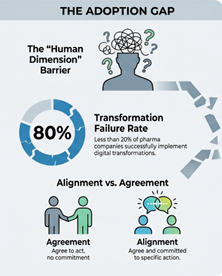
Underlying problem: Change skills make or break capability adoption
A key reason why CX CoEs struggle to gain capability adoption is that their COE professionals are insufficiently trained in change methods, skills, and mindsets.
Most CoE leaders say they are underfunded when it comes to training CoE professionals in effective change management. This dynamic results in an inability to overcome change resistance, leading to failed initiatives and unrealised business impact.
It creates a self-fulfilling prophecy where senior leaders are tempted to view COEs as a wasted investment because "nice proposals" fail to reach implementation. One CoE leader notes that they “used to have a dedicated training budget for people. I haven't seen that, honestly […] in 20 years now.” The leader added that they have “to get creative with how they invest in their team” because, "if it is called a training budget, it would be the first thing cut".
The imperative & challenge: Investing in change leadership upskilling
Failing to develop the change leadership skills that are necessary to drive capability adoption is a missed opportunity. The following skills are seen as most instrumental to CoE professional success in driving change: strategic thinking, business acumen, strategic storytelling, change management, socio-emotional intelligence, consultative skills, cross-cultural acumen, and growth mindset.
These are evergreen skills mandatory to convert opportunity into results. That said, unless continuously cultivated, they go dormant.
The solution: Agile learning & development
To address the time and impact measurement challenges, the importance of agile learning approaches cannot be overstated, as they make the most of constrained time and resources and embed learning and development into daily workflows of change leaders.
Agile learning is an approach to education and skill development that emphasises flexibility, adaptability, and continuous improvement – borrowing ideas from Agile software development. Agile learning focuses on short, iterative cycles where one learns a small amount quickly, applies it right away, reflects on what worked or didn’t, and adjusts their approach accordingly. A fast feedback loop is created, helping one learn more efficiently while aligning with changing environments and staying current with changing environments.
For example, instead of spending months studying theory before practicing a skill, an agile learner might learn a concept today, try it immediately, evaluate the outcome, and refine their understanding tomorrow.
Putting agile learning into practice
Below are 7 key methods that make agile learning work.
-
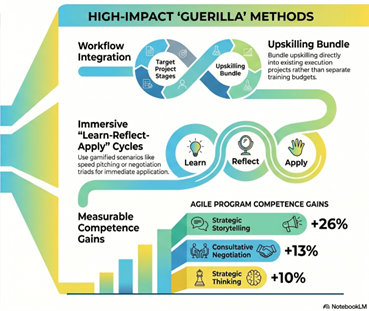
Upskilling integration into workflow embeds upskilling directly into execution projects, uses external coaching to foster behavioural change, and integrates training investment in operational budgets.
Courtade explained her “bundling” approach: "I hired a company to help us […] develop a launch strategy. [I told them] in addition to this project [...] to train my team how to do it. So that every step along the way, [they] bring them in and teach them […] I bundled [training] into the programme".In this manner, not only was the work product delivered, but the team was engaged in active learning and had hands-on experience – training wasn’t an extra task that they had to complete; it was embedded in the work they had to deliver.
-
Immersive learning cycles and gamification use rigorous “Learn-Reflect-Apply” cycles executed as a group process accompanied by games and simulations. By integrating games – such as "speed pitching" to cultivate strategic thinking skills, "story spines" to teach storytelling using tension and resolution, or “negotiation triads” to teach consultative negotiation by allowing learners to play the roles of negotiators and observer – participants are challenged to immediately apply concepts in low-risk, high-engagement scenarios.
Lars Merk, with AstraZeneca's Enterprise AI team, recounted how impactful immersive learning can be: "We were all trained in storytelling. It was amazing [...] a true storyteller came in to teach the power of storytelling. And people are using [stories] in [meetings] all the time now. They're using the skills that they learned".
-
Training teams in their “native habitat” is an approach that trains individuals within their regular work teams and project portfolios. It integrates upskilling in the learner’s natural development and execution cycles, sharpening individuals and their teams simultaneously.
Novartis launched a massive effort to become a "data-driven" medicines company by establishing "Agile Hubs" for digital skill-building. By embedding Learning & Development (L&D) specialists directly into their "Product Squads", Novartis ensures that team training is developed iteratively alongside the product within their native work configuration, rather than as an afterthought.
- Experiential measurement and commitment drives accountability by employing pre- and post-, peer- and self-assessed competence measurement to both quantify and qualify the degree of upskilling achieved and requires post-workshop “application commitments” that assure learning application to “real-world” outcomes in their project portfolios.
- Stakeholder-engaged simulations recognise that CoE success is helped by direct stakeholder engagement in training. Not surprisingly, participating stakeholders also benefit from this approach.
-
CoE plan of action meeting (POAs) & team hours use periodic “all-hands days and meetings” as upskilling opportunities, building community, showcasing processes and results, and inviting stakeholders to share insights. Merk champions this approach at AstraZeneca, leveraging monthly 'Team Hours' to bring teams together for briefings and learnings.
Benefits
These “Agile Learning & Development” approaches deliver distinct benefits to CoEs and their stakeholders:
- For CoE professionals, these approaches grow confidence in navigating ever more complex stakeholder environments. Recent programmes that used these approaches have seen self-assessment score improvements in strategic thinking (+10%), strategic storytelling (+26%), and consultative negotiation (+13%).
- For CoE teams, they accelerate cohesive culture development. By working through simulations together, teams strengthen their affinity and alignment, and navigate operational tensions.
- For organisations, they facilitate the shift from reactive order-taking to proactive strategic value creation. This ensures global solutions are effectively implemented in local markets, mitigating the risk of rigid global standards slowing local execution. It enables standardisation that lowers unit costs and shortens cycle times.
- For external life sciences stakeholders, upskilling enhances value delivery to patients and healthcare providers by ensuring that capabilities are effectively adopted beyond only being built. Furthermore, it makes the CoE an effective focal point for external collaborations with suppliers and healthcare ecosystems.
As more CoE leaders deploy agile learning & development methods to continually upskill their staff, and avoid the barriers of scarce time and budgets, we will see the value of CoEs grow and persist, and the future-readiness of life sciences companies and ecosystems do likewise.
With contributions from Lisa R. Courtade of Organon, Joyce Ercolino of Harmony Biosciences, and Lars Merk of AstraZeneca.
References
[1]Boston Consulting Group, Flipping the Odds of Digital Transformation Success. Low success odds are also referenced in other industry reports from Mckinsey.
About the authors
 Gregg Fisher is founder and managing partner at The Stem, a global consultancy serving biopharmaceutical clients in customer engagement and digital transformation. He has more than 30 years’ experience in strategy, marketing, and technology. His primary focus, as a consultant, executive, and speaker over the last 12 years, has been to reinvent healthcare customer engagement through technology.
 Craig DeLarge is an independent consultant and member of The Stem. He is a former Centre of Excellence (CoE) leader, having led CoEs at J&J, Glaxo, Novo, Merck, and Takeda. DeLarge brings his expertise to clients at the intersection of learning and development and change management with a focus on organisational transformation.