Navigating the strategic path to enantiopurity
Chiral resolution remains a critical challenge in pharmaceutical development, where the demand for enantiopure compounds continues to shape both strategy and innovation.
This article explores how controlled crystallisation and complementary approaches can be used to efficiently separate and purify chiral molecules, drawing on practical experience across solid form development, process chemistry, and analytical integration.
The requirement for enantiopurity
In drug development, the ability to isolate a single enantiomer is a critical safeguard for patient safety and a fundamental requirement for therapeutic success.
While enantiomers are equivalent (in terms of solubility and melting point), in biological systems, they can differ significantly due to the presence of a chiral environment in vivo. Thalidomide remains the definitive case study in this regard: where the (R)-enantiomer provided the intended sedative effect of the therapy, its (S)-counterpart acted as a potent teratogen, resulting in severe clinical consequences.1
As a result, the pharmaceutical industry typically requires new chiral molecules to be enantiopure, consisting of a single enantiomer, in line with regulatory expectations such as ICH Q6A/Q3A(R2).2
Chiral presentation and development approaches
While the ideal approach is often to synthesise only the desired enantiomer from the outset, chiral synthesis is not always straightforwards or cost-effective in practice. Chiral synthesis remains a well-established and efficient route to chiral molecules, competing with or complementing crystallisation and resolution, depending on the programme’s needs.
Development teams should therefore consider all viable approaches, together with their technical and commercial implications, from the outset. In early development, however, critical information on chemistry, solid form behaviour, and process performance is often still emerging, so synthesis and resolution are frequently evaluated in parallel. In this context, integrated development across analytical, chemistry, and solid form or crystallisation groups remains the gold standard for selecting the most appropriate route to an enantiopure compound.
Separation by crystallisation
Within drug development, controlled crystallisation remains one of the simplest and most efficient unit operations for delivering pure material. At its core, crystallisation enables the target molecule to form a solid lattice while excluding impurities.
Effective crystallisation, including chiral crystallisation, requires consideration of solvent choice, physicochemical properties, and stability. A robust study should incorporate:
- Temperature-solubility behaviour
- Purge behaviour of impurities
- Solution chemical stability
- Polymorphic landscape.
This is best accomplished through an integrated approach to chemical and solid-form/crystallisation development.
Two of the most important crystallisation-based approaches to chiral separation are classical resolution and preferential crystallisation. While both aim to isolate the desired enantiomer, they rely on different principles and are suited to different types of chiral systems
Classical resolution
In simple terms, classical resolution, also known as Pasteurian crystallisation of diastereoisomeric salts, converts the two mirror-image forms of a molecule into related compounds with different physical properties, allowing one form to crystallise more readily than the other.
Classical resolution remains the most widely applied approach in development. Ideally, this method should rely on expertise across solid form, crystallisation, analytical methods, and chemistry to deliver a purification process that is both scalable and sustainable (Figure 1).
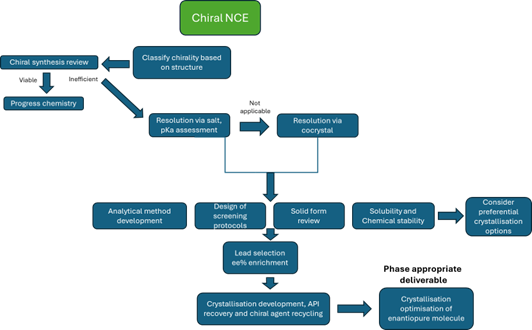
Figure 1 – Flow diagram illustrating a basic development process for isolating an enantiopure API.
Initial screening is typically carried out using commercially available chiral resolving agents, most often acids or amines. These are selected across a range of pKa values to favour formation of a salt, usually where the pKa difference is at least 2 to 3. In some cases, a cocrystal may form instead. Although less common, cocrystal-based resolution can also be an effective approach. In this case, one enantiomer of a coformer selectively associates with one enantiomer of the target molecule, forming a diastereoisomeric cocrystal that leads to enrichment.
To improve efficiency, screening is usually performed in parallel using a well-designed experimental workflow. This allows a broad range of conditions to be explored using small amounts of material. Lead conditions are then selected by balancing enantiomeric enrichment (ee) with material recovery, since the highest enantiomeric excess does not always correspond to the most practical process if yield is low.
A cascade approach to analytical testing is the most efficient. Analysis of solids is performed initially by chiral HPLC and X-ray powder diffraction (XRPD) to confirm whether a novel, chirally enriched crystalline phase has been produced. Subsequent testing by proton NMR confirms stoichiometry and structural integrity, and HPLC analysis assesses chemical purity.
In particular, the following are pivotal to success:
- Preliminary reference characterisation, stability, and solubility data
- Detailed process chemistry information (purity, impurities, stability)
- A cascade approach to characterisation
- Manipulation of ‘failed’ entries
- Solid form interrogation
- Iterative feedback and screen design
- Bespoke resolving agents
- Application of seeded crystallisation
Preferential crystallisation of conglomerates
Rather than creating new salts, preferential crystallisation aims to selectively crystallise one enantiomer directly from a mixture containing both enantiomers, whether from a fully racemic mixture or one already slightly enriched in the desired enantiomer.
For this approach to work, it is important to distinguish between a racemate and a conglomerate. In a racemate, both enantiomers are incorporated together within the same crystal. In a conglomerate, each enantiomer forms its own separate crystal, so the solid is a physical mixture of crystals of each mirror-image form (see Figure 2). This distinction matters because preferential crystallisation is generally possible only when the compound behaves as a conglomerate, which is relatively uncommon and reported for only 5–10% of chiral molecules.
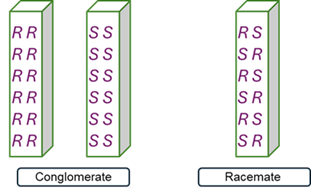
Figure 2 – Pictorial description of a crystalline conglomerate vs a racemate.
Beyond the fundamental principles, preferential crystallisation has also been applied to more advanced, scalable processes. For example, continuous crystallisation approaches can be used, where homochiral seeds are introduced into separate crystallisers to selectively grow each enantiomer under controlled supersaturation conditions (Figure 3).
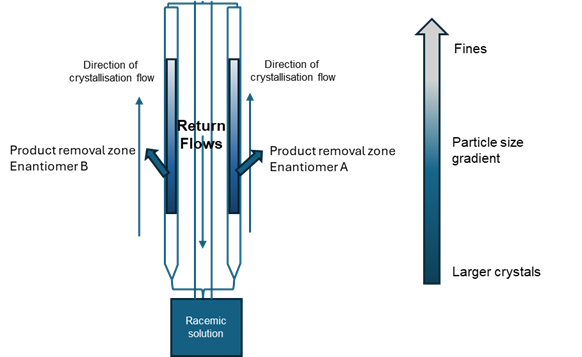
Figure 3 – Diagram to illustrate the principle of simultaneous preferential crystallisation (modified from ref. 12).
In this example, a homochiral seed of each enantiomer is fed separately into a column crystalliser from a tank containing the racemic solution. A state of supersaturation is created, and crystals of each enantiopure phase grow from the enantiopure seed added to the separate columns.3
Viedma ripening, or attrition-enhanced deracemisation, is another important variation. In this approach, mechanical grinding combined with solution-phase racemisation enables conversion towards a single enantiomer over time. This technique has been applied commercially, for example, in the manufacture of Clopidogrel.4,5
Targeting successful chiral resolution
Integration is the cornerstone of effective chiral resolution. A deep understanding of the molecule’s solid-form landscape and physicochemical characteristics is essential for successful crystallisation. By embedding this insight into the development process, developers can drive more informed design and strategic decision-making.
While classical resolution remains a robust option, other techniques are available that, with suitable attention to detail, can be leveraged to the programme’s benefit. Importantly, processes applied should be phase-appropriate. The methods applied in Phase 1 are not always carried forwards into later phases, as more investment and additional information are typically available in the latter.
The future of chiral resolution: Innovations and emerging trends
The range of options for delivering the critical quality attributes required of chiral small molecules continues to evolve. Advances in sustainable crystallisation, chiral catalysis, and resolving agents will continue to improve the effectiveness of this critical unit operation.
Emerging technologies such as artificial intelligence and machine learning are expected to play an increasingly important role in early-stage screening, while continued advances in continuous processing will support more efficient and sustainable manufacturing in later phases.
References
1 https://www.thalidomide-tragedy.com/thalidomide-the-active-substance-in-contergan-and-its-consequences7 Corey, E. J.; Bakshi, R. K.; Shibata, S. (1987). "Highly enantioselective borane reduction of ketones catalyzed by chiral oxazaborolidines. Mechanism and synthetic implications". J. Am. Chem. Soc. 109 (18): 5551–5553. doi:10.1021/ja00252a056
2 ICH Tripartite guidelines specifications: Test procedures and acceptance criteria for new drug substances and new drug products: chemical substances Q6A / ICH harmonised tripartite guideline impurities in new drug substances Q3A(R2)
3 J. G¨ansch , N. Huskova, K. Kerst, E. Temmel, H. Lorenz, M. Mangold, G. Janiga , A. Seidel-Morgenstern; Continuous enantioselective crystallization of chiral compounds in coupled fluidized beds; Chemical Engineering Journal, 422 (2021), https://doi.org/10.1016/j.cej.2021.129627
4 J. E. Hein, B. H. Cao, C. Viedma, R. M. Kellog, D. G. Blackmond, J. Am. Chem. Soc. 2012, 134, 12629-12636
5 W. L. Noorduin, P. van der Asdonk, A. A. C. Bode, H. Meekes, W. J. P. van Enckevort, E. Vlieg, B. Kaptein, M. W. van der Meijden, R. M. Kellog, G. Deroover, Org. Process Res. Dev. 2010, 14, 908–911
About the author
 Julian Northen is technical director at Onyx. He followed his PhD in Medicinal Chemistry and Anti-Cancer Drug Design at the University of Newcastle upon Tyne with two post-doctoral positions (Arizona State University – Natural Product Isolation and Anti-Cancer Drug Design and total synthesis of a novel Cephalostatin; and University of Newcastle upon Tyne Cancer Research Department – various oncology programmes – Drug Design and Synthesis). He then moved to Onyx, where he has over 24 years of industrial experience in PR&D supporting early phase development to commercial supply. Northen progressed from a chemist to research manager, solid state manager, and in 2025 to technical director. In his current role, Northen is responsible for advancing material science and integrated PR&D activities at Onyx.