ASCO: War, disasters, policy compound cancer care challenges
When the topic of patient access is raised, discussion often revolves around rural and low-income patients. But in today’s world there are many groups of patients who face even more severe access challenges – challenges made worse by policy decisions and geopolitical forces.
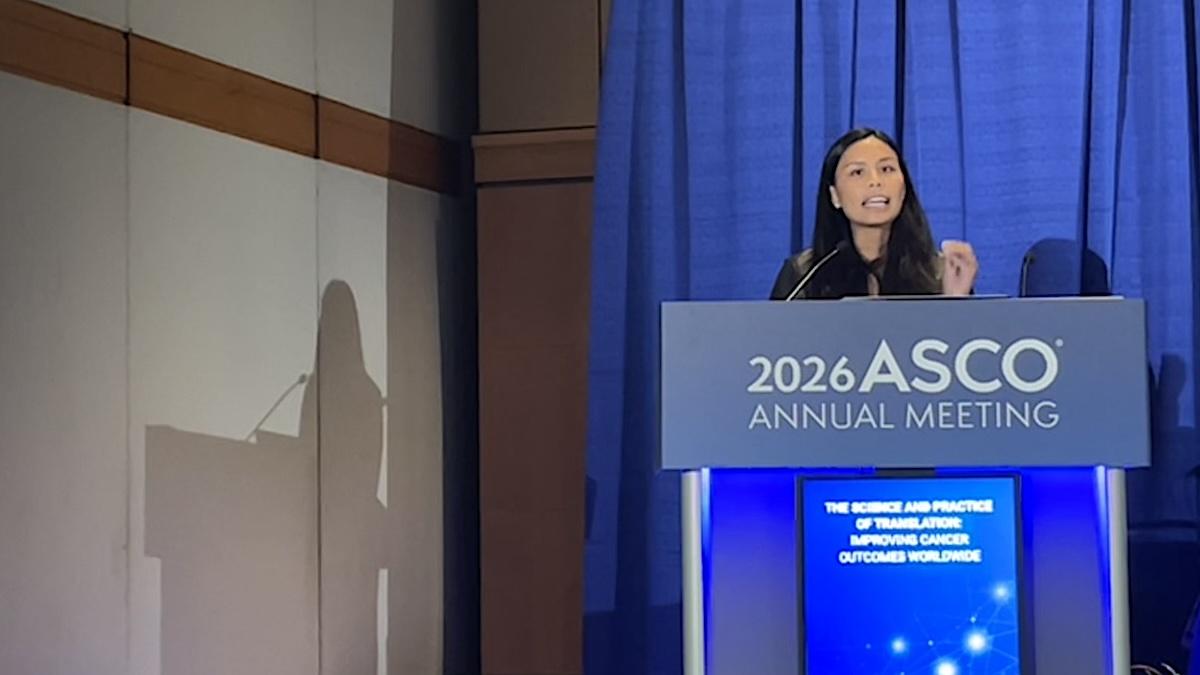
At an ASCO 2026 education session on Friday, researchers spoke about three such populations: Africans displaced by war and conflict; survivors of climate-related natural disasters; and undocumented immigrants in the United States. All three presentations underscored an important concept: Cancer doesn’t discriminate who it will affect, so cancer care shouldn’t either.
Cancer care and conflict
According to the United Nations, more than 123 million people, or 1/67th of the world’s population, are forcibly displaced by war or conflict. Forty-three percent of those displaced people are Africans.
Dr Nazik Hammad of the University of Toronto spoke about how these refugees have extremely limited access to cancer care for a number of reasons – war and conflict destroy the infrastructure of care; specialised doctors and surgeons get re-directed to trauma care; and long-lasting conflicts prevent the initial development of cancer services, leading to care deserts.
“Cancer does not know, first of all, whether you are in a conflict or war zone or not. If it wants to strike, it will strike,” she said. “We have to remember that 86% of deaths from noncommunicable disease happen in low- and middle-income countries. The average length of displacement for refugees is 20 years. And for internal displacement it’s 10 years. So that's a lot of time for cancer to happen. And the reality is that these patients will try to seek care for cancer despite everything.”
Unfortunately there is no large-scale organised effort to facilitate that care.
“There's no major funding that's happening to support cancer medicines and other aspects of care. No offers to open safe corridors to transport patients, and no evacuation of children. Children have been evacuated in Ukraine and Gaza, but never a child with leukaemia in Africa. They have not been evacuated, although they do make the poster child,” she said, referring to the use of African children in marketing materials for groups like the World Health Organisation.
Furthermore, she said, efforts that exist to improve cancer care in Africa often ignore or exclude conflict zones, perhaps out of a desire to protect practitioners.
Some countries with large refugee populations, like Uganda, are working hard to provide cancer care using innovative models, Hammad said. But solving this problem more broadly will involve global participation and prioritisation.
“We need greater solidarity and equity between countries. That is essential to ensuring that no region is left behind,” she said. “Cancer should be included in peace and humanitarian agendas grounded in the principle of dignity and justice for all.”
Cancer care and climate disasters
Climate change has led to an increase in all kinds of natural disasters around the world, from floods to hurricanes to wildfires. These disasters can be highly disruptive to medical care, including cancer care.
“We are concerned as oncology professionals,” said Dr Manali Patel of Stanford University. “The fact that we have a podium during this time at ASCO, I think, is kudos to the Educational Program Committee. We are concerned. We are worried. It's impacting us. And I think the data … are showing that we feel underprepared. We don't know what to do. And we are struggling and want to know lessons learned from other individuals and also develop community.”
There are a few studies linking poor cancer outcomes to natural disasters, including a study that showed a 43% increase in mortality for lung cancer patients who were exposed to California wildfires. But generally Patel decried a lack of data connecting climate-related natural disasters to cancer outcomes.
“I will argue that true impact that we see is severely underestimated,” she said. “The data is just not there. We may see data during the sentinel event, but we never look years later to attribute what we're seeing for negative cancer outcomes that are rising and attributing it potentially back to that main cause of disruption. Our data just doesn't connect the two. So the true impact is severely underestimated.”
What hospitals can do for now is be proactive, crafting emergency plans for natural disasters specifically, not just “all hazards” plans. And they can learn lessons from cancer centres that have been through natural disasters, like the Texas Medical Center, which was devastated by Tropical Storm Allison in 2001.
“They improved their infrastructure, so they improved flood protection including flood walls, they relocated electrical light support systems, and then they also activated a team,” she said. When Hurricane Harvey struck in 2017, “they were able to resume radiation to more than 500 patients in less than three days after that storm.”
But natural disasters don’t just impact the communities where they hit – they can also affect chokepoints in the supply chain – such as IV bags, which were largely manufactured at a single facility that was hit by Hurricane Ian, causing a nationwide shortage.
Going forward, the whole industry needs to consider these kinds of effects when designing infrastructure and supply chains.
Cancer care and the immigration crackdown
Despite rhetoric on the American political right, undocumented immigrants in the United States are not the beneficiaries of massive amounts of free healthcare. Their access to care is often quite limited, including cancer care.
“Cancer is the leading cause of death among immigrants in the United States,” Dr Patricia Mae Garia Santos of Emory University’s Winship Cancer Institute told ASCO attendees. “Among Asian Americans and Hispanic Americans, the two largest and fastest growing immigrant populations in the United States, it represented 83% of all-cause mortality. And for immigrants without health insurance, this is especially troubling, as we know that [a lack of] health insurance is one of the strongest predictors of worse cancer outcomes in the United States.”
The Affordable Care Act, which mandated insurance coverage in the United States, didn’t provide much help to undocumented immigrants.
“While the ACA added provisions that would allow all citizens to qualify and purchase marketplace coverage, the ACA largely retained per mora restrictions, which meant that undocumented immigrants were ineligible for coverage altogether,” Santos said. “Consequently, while the uninsured rate for U.S. citizens and foreign-born citizens reached historic lows in 2023, uninsurance rates remain disproportionately high among non-citizens, with rates as high as 18% among lawful permanent residents and 50% among undocumented immigrants.”
When these individuals need care, the cost often ends up being covered by emergency Medicaid – state-level programmes designed to cover acute, emergency care, not ongoing chronic care. And even that safety net is in danger right now, thanks to provisions in Congress’s “One Big, Beautiful Bill” Act, or HR-1.
“The law reduces the federal share of emergency Medicaid dollars, arguing that this measure was needed in order to stop, quote unquote, initiatives to prevent free healthcare for illegal aliens,” Santos said. “However, not only do our data suggest that immigrants are not significantly more likely to use acute care services despite having higher rates of uninsurance, when it comes to the actual dollar amount amounts, research shows that immigrant healthcare spending represents only a fraction of total Medicaid spending overall. In our JAMA study, we show that emergency Medicaid accounts for less than half of one percent of total Medicaid expenditures.”
Santos called for oncologists to advocate for care for these communities.
“As oncologists, and more importantly, as physicians, our privilege and our positions in society give us tremendous power,” she said. “Power to advocate against anti-immigrant policies, power to protect our communities, power to generate the data needed to dramatically shift the national conversation on a broader stage. And power to draw attention to policies that have the potential to harm ourselves, harm our patients, and harm the communities that we care for. Because at the end of the day, behind every policy decision that we make and that our government makes, there is a real human life, one that we can choose to support or one that we can choose to ignore.”