Trump, Pfizer announce MFN deal; Lilly, others to come
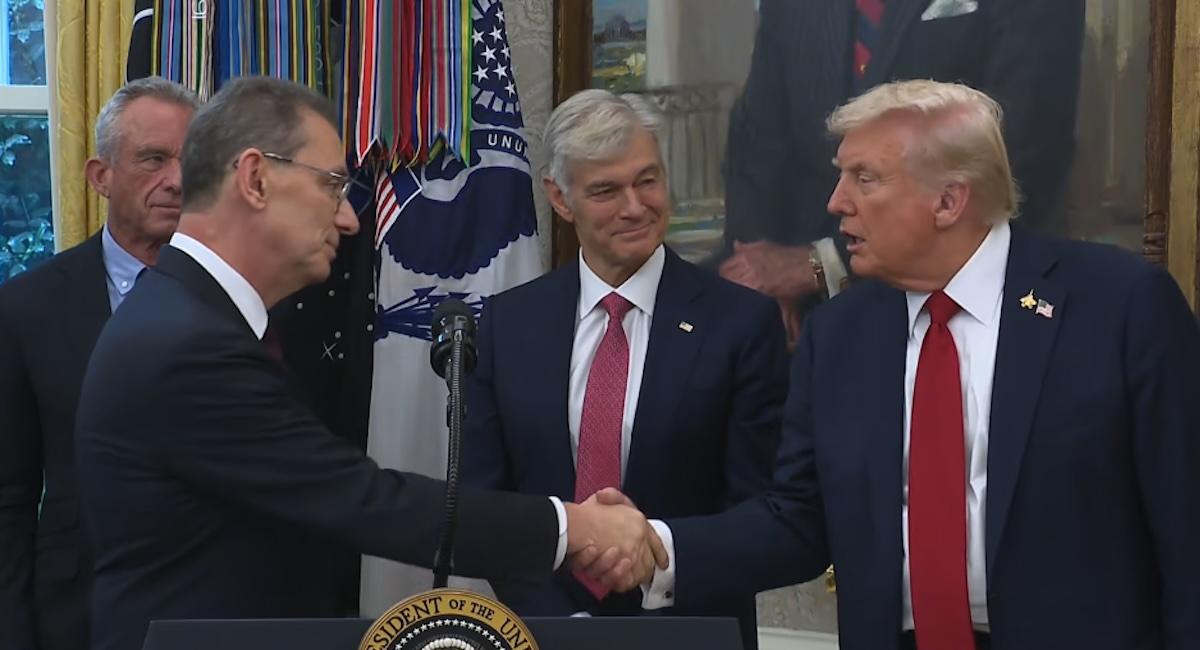
Pfizer CEO Albert Bourla shakes hands with President Donald Trump in the White House.
President Trump stood beside Pfizer CEO Albert Bourla in the Oval Office today to announce that Pfizer will offer all of its drugs to Medicaid at prices aligned with what they charge around the world. Pfizer is only the first company to announce a deal with the administration, the President said, with many more to come, including Eli Lilly, in the next few months.
The White House also announced the launch of TrumpRx, a website for patients to buy drugs directly from the manufacturer at discounted prices, and a plan to prioritise FDA reviews for companies who support the President's priorities of lowering prices and moving manufacturing to the United States.
"Today, Pfizer is committing to offer all of their prescription medications to Medicaid, and it will be at the most favoured nation's prices," Trump said. "We're working with other major pharmaceutical companies to secure similar agreements. Everyone understands that the status quo where Americans pay more for drugs, prescription drugs, and they pay more than foreign countries who take advantage of us in many other ways [...] I think we've pretty well got that stopped [...] The United States is done subsidising the healthcare of the rest of the world."
"For years, other rich nations refused to pay the fair share for the medical innovation," Bourla said. "And as a result, Americans had to assume this proportional cost on their shoulders. This situation, we all knew, is not sustainable. This situation is a situation that many wanted to change, but no one could. This is changing today with this agreement."
The Pfizer deal will require the company to offer all of its products to state Medicaid programmes at "MFN prices", as well as to guarantee that future medicines launched by Pfizer will launch at the same price in the United States as in other wealthy countries.
"Let's start with the definition of MFN. What do we mean by that?" said Medicare director Chris Klomp. "This is not made up list prices that have often been quoted in prior administrations, stuffed with fees and rebates. We're talking about we start at net prices after fees, after rebates - the prices people actually pay in other wealthy countries. We then index to a basket of countries, wealthy countries, across the world. We go drug by drug and we look for the lowest price. That becomes the starting point for what an MFN price is in the United States."
Pfizer has also agreed to invest $70 billion to bring manufacturing to the United States in exchange for relief from the promised 100% pharma tariffs. Finally, the company will offer its drugs directly to consumers via a new website, TrumpRx, at lower prices than retail, though not necessarily MFN prices in every case.
The Administration offered three examples in a fact sheet released during the announcement: Eucrisa (crisaborole) for atopic dermatitis will be offered at an 80% discount, Xeljanz (tofacitinib) for rheumatoid and psoriatic arthritis at a 40% discount, and Zavzpret (zavegepant) for migraines at a 50% discount.
FDA Commissioner Dr Martin Makary also stated that the FDA will be moving companies' drug applications to the front of the line in exchange for cooperation with the administration's goals.
"A voucher to get a review in weeks has a market street value of about $500 million because every day is money when it comes to getting a drug approved," he said. "If you meet one of the President's national priorities stated very clearly, moving manufacturing to the United States, meeting a large unmet public health need, or equalising your prices [...] that application is going to move to the front of the line."
He also said the FDA will work with manufacturers to inspect new US plants during construction so they can open as soon as possible.
Bourla said that Pfizer is going along with this deal because it ultimately eliminates the two major sources of uncertainty that have plagued the industry all year.
"The first one was the uncertainty of tariffs, because the President is absolutely right. Tariffs are the most powerful tool to motivate behaviours, Mr President, and clearly motivated ours," he said. "The second overhang in our industry was this uncertainty, what will happen with the framework of pricing in the country [...] Well, now we have clarity about what is the framework for the US pricing. Read the letter of President Trump, read the four points, and this is the framework. We will abide to that. Going forward, this is how things will be priced in the US and abroad."