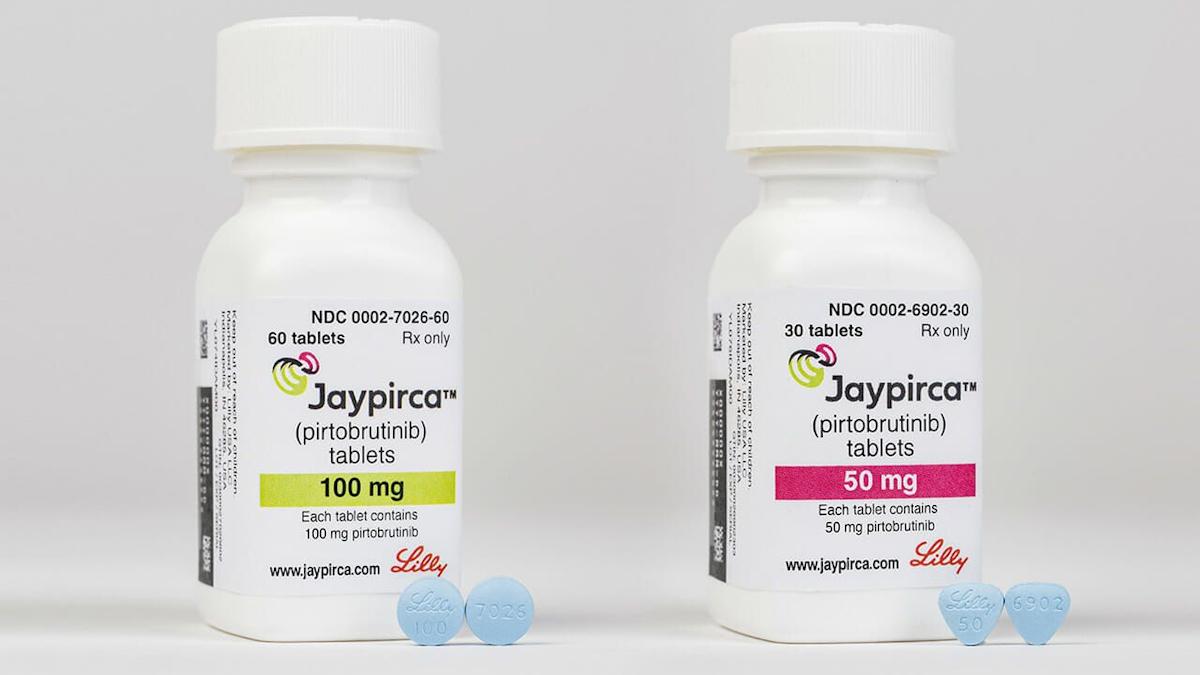
Lilly's BTK drug Jaypirca joins first-line options in US

Eli Lilly's noncovalent BTK inhibitor Jaypirca has been cleared by the FDA in its first frontline indication for chronic lymphocytic leukaemia or small lymphocytic lymphoma (CLL/SLL).
The new approval for Jaypirca (pirtobrutinib) covers use of the drug in CLL and SLL patients without 17p deletions, making it an alternative to other BTK inhibitors with frontline labelling, i.e. AbbVie/Johnson & Johnson's Imbruvica (ibrutinib), AstraZeneca's Calquence (acalabrutinib), and BeOne Medicine's Brukinsa (zanubrutinib).
Jaypirca has been approved in the US since 2023 as a third-line treatment for CLL/SLL patients, after earlier treatment with a BTK inhibitor and a BCL-2 inhibitor, and had its label extended last year to include second-line use after prior BTK inhibitor therapy.
First-line use – which was also cleared in Europe in June – has been cleared largely on the strength of the BRUIN CLL-313 study, which showed that Jaypirca improved progression-free survival by 80% compared to standard chemoimmunotherapy (CIT) in CLL/SLL without 17p deletions. Patients with a 17p deletion do not tend to respond to CIT.
The first-line approval may, however, not translate into a big sales boost for Lilly's drug, at least in the near-term. That is because its non-covalent mechanism of inhibiting BTK means that it retains activity against the target, even if patients have developed resistance to earlier, covalent inhibitors, so oncologists like to keep it in reserve.
The dataset for Jaypirca in treatment-naïve settings also includes the BRUIN CLL-314 study, which found that Jaypirca was as effective as Imbruvica in previously untreated CLL/SLL and was also less likely to cause potentially serious side effects like atrial fibrillation or flutter and hypertension.
A pooled analysis of results from both the BRUIN CLL-313 and BRUIN CLL-314 trials, reported at this year's European Haematology Association (EHA) congress, demonstrated that pirtobrutinib monotherapy achieves an overall response rate of 93.3% in treatment-naïve patients with CLL/SLL, which could help build the case for wider use.
"Doctors can now consider pirtobrutinib for appropriate patients when initial therapy is needed, not just later in a patient's treatment journey," said Jennifer Woyach of Ohio State University Comprehensive Cancer Centre, who was an investigator on BRUIN CLL-313.
"Given the efficacy and tolerability of modern targeted therapies – coupled with factors like age or comorbidity – many people diagnosed with CLL or SLL today may only receive one or two lines of therapy, making initial treatment choices critically important," she added.
Jaypirca is growing pretty strongly, with sales up 66% in the first six months of 2026 to reach $357 million, but for now is still a minor player behind Brukinsa, the market leader with sales of $2.3 billion in the first half, as well as Calquence ($1.9 billion) and Imbruvica ($1.1 billion).