J&J's subcutaneous Rybrevant cleared by FDA
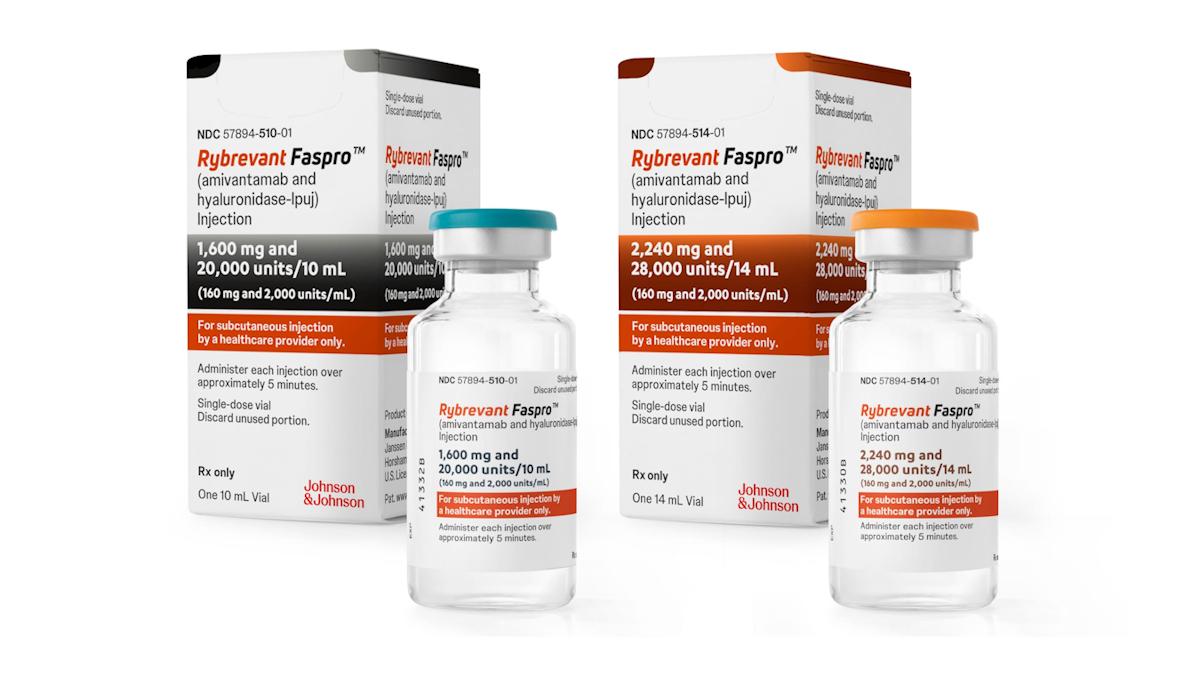
Johnson & Johnson has claimed FDA approval for Rybrevant Faspro, a subcutaneous version of its EGFRxMET bispecific antibody, for all the indications approved for the current, intravenous formulation.
It's a case of second time lucky for J&J, as the FDA turned down its first marketing application for the subcutaneous variant of Rybrevant (amivantamab) last year due to manufacturing quality concerns. That was seen as a major setback to J&J's stated ambition to grow the drug into a $5 billion-a-year blockbuster.
The green light for Rybrevant Faspro – which combines amivantamab with hyaluronidase – means that the drug is the first subcutaneous therapy cleared by the FDA for EGFR-mutated non-small cell lung cancer (NSCLC) and reduces dosing time from hours to minutes with reduced administration-related reactions, according to J&J.
The IV formulation of Rybrevant has four FDA approvals in previously untreated and relapsed/refractory EGFR-mutated NSCLC – as a monotherapy and in combination with other drugs, including chemotherapy and J&J's companion EGFR inhibitor Lazcluze (lazertinib).
It has been billed as a major competitor to market-leading EGFR inhibitor Tagrisso (osimertinib) from AstraZeneca, which is dosed orally. Tagrisso made sales of $5.8 billion last year, but was bested by the Rybrevant/Lazcluze in the MARIPOSA trial on the primary endpoint of progression-free survival (PFS).
So far, the growth of Rybrevant has been held back by complicated administration that sometimes needs split dosing, prolonged infusion times, and side effects – now overcome by Rybrevant Faspro – and J&J is now expecting sales to accelerate. In the third quarter, the combined turnover of Rybrevant and Lazcluze reached $198 million, driven by the MARIPOSA readout.
The approval of the subcutaneous version comes on the back of the PALOMA-3 and improved clinical outcomes trial, which showed equivalence with IV Rybrevant at achieving blood levels of amivantamab and improved clinical outcomes, including extended overall survival (OS).
AZ has hit back with a recent approval for Tagrisso in combination with chemotherapy, which seems to have matched Rybrevant on PFS and OS in the FLAURA2 trial, and the two companies are now engaged in a marketing battle to extol the virtues of their respective datasets in the frontline setting.
"Patients now have a simple, chemotherapy-free frontline option that not only targets the disease more precisely, but also significantly improves survival," commented Joelle Fathi, chief healthcare delivery officer for the GO2 for Lung Cancer patient advocacy organisation.
"This therapy reduces the physical and emotional burden of lengthy infusions, giving patients and their families the opportunity to reclaim precious moments and focus on living, rather than treatment," she added.