Claude Science outperforms experts in protein binder task
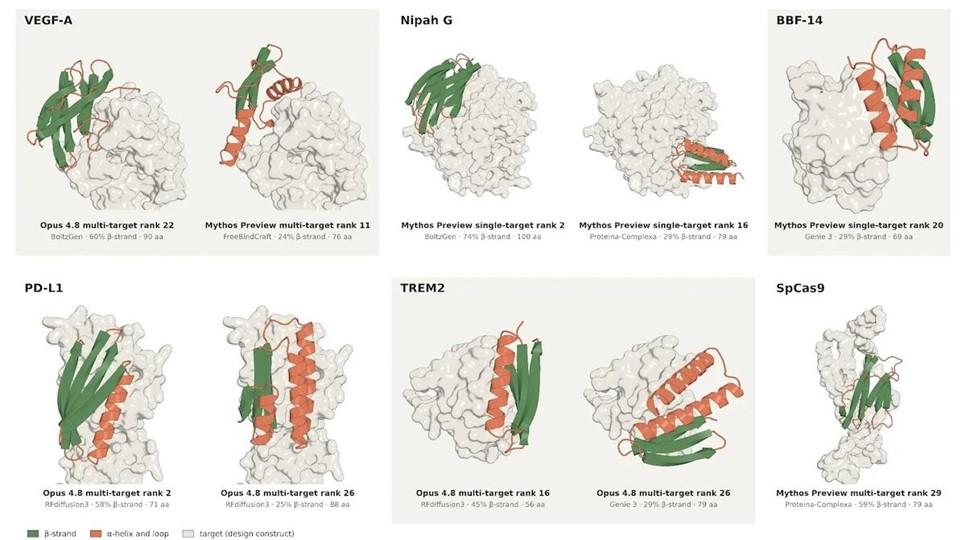
Anthropic's Claude Science performed impressively in a protein design exercise, designing binders against 14 out of 15 targets and improving, in many cases, on the results of design competitions tackling those same targets.
Anthropic published a detailed write-up of the exercise, as well as second test of Claude's ability to accelerate chemical analysis, on its blog on Tuesday.
The company worked with Adaptyc Bio and Twist Bioscience to validate the AI's designs in the lab. Claude Science, using the Mythos Preview and Opus 4.8 models, was able to achieve hit rates of 26.7% and 22.6%, respectively, while designing for all 15 targets in a combined session, and that rate rose to 35.1% when each target was tackled separately, compared to a typical hit rate of 10% to 15% for typical protein design campaigns.
Researchers chose targets that had been studied extensively, so that they could compare them to existing designs by humans, as well as a few targets that Adaptyv Bio was running design contests for. For most targets, the AI had better hit rates than contest entrants and a higher affinity binder in their best performing entry than the contest winner.
For four of the six contests, the AI did have access to the contest entries, but it was instructed not to use existing binders as a starting point.
"In protein design, Claude can execute binder design campaigns end-to-end with minimal input, producing binders that match or surpass the best previously published designs," the company wrote. "Protein minibinders are not a standard therapeutic modality for drugs and even for the common drug modalities, such as monoclonal antibodies and small molecules, designing a high-affinity binder is just the first step in the process of generating a drug-like molecule. However, we view this work as foundational, and are extending it so that Claude can run the entire development process end-to-end across all drug modalities."
Speeding up chemical analysis
The other result shared in the blog post is less dramatic, but perhaps more important to improving efficiency in drug design and development. The AI was able to greatly speed up output analysis of nuclear magnetic resonance spectroscopy and liquid chromatography-mass spectronomy, a time-consuming process that typically has to be done by hand when a molecule is synthesised.
Claude was able to analyse these results even without the manufacturer software that's typically required to even process the raw data.
"Supplied with only a contract lab’s raw files for a routine quality-control sample and a short plain-language prompt, with no vendor software and no operator, Claude, working within Claude Science, returned processed NMR and LC-MS results in 23 and 19 minutes, respectively, working in parallel. Its results matched the lab’s own processing—hydrogen counts per peak were within 0.08 ¹H of the lab’s, and its purity was measured at 96.4% versus the 96.33% of the lab," Anthropic wrote.