Case study backs YolTech's AATD gene therapy
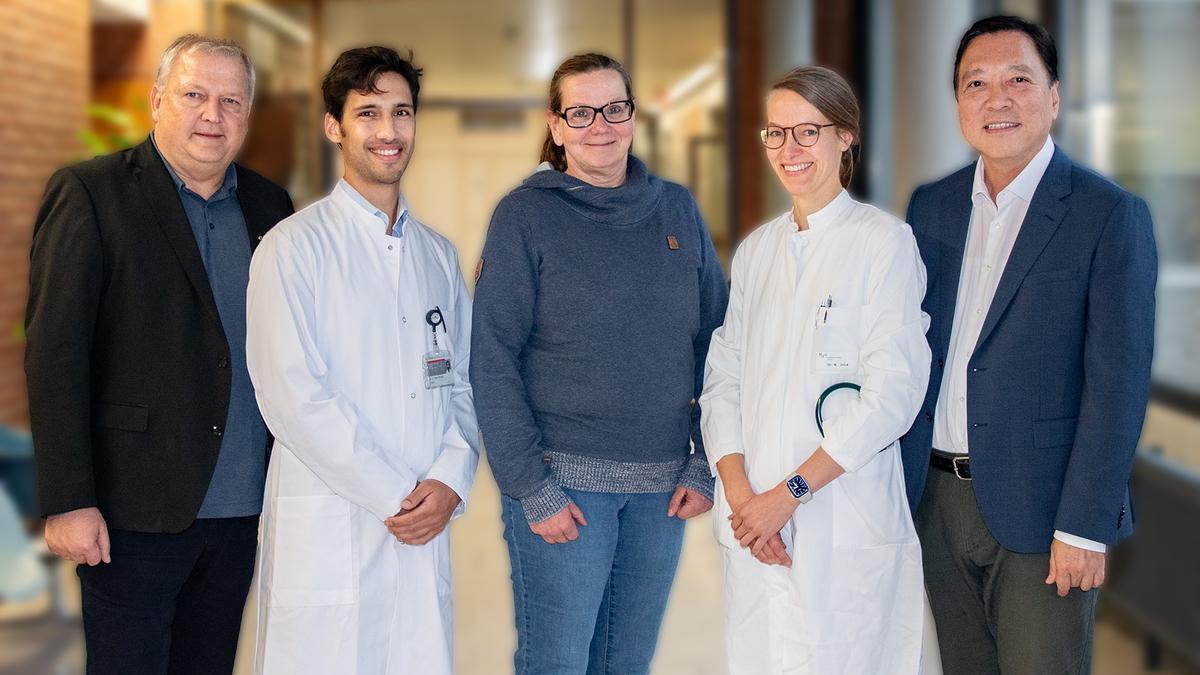
The team at Hannover Medical School and Ren Ji Hospital who carried out the treatment.
An in vivo gene therapy for alpha-1 antitrypsin deficiency (AATD) developed by Chinese biotech YolTech has successfully treated a patient with the PiZZ form of the rare inherited disorder.
The case study – the first case published after peer review – appears in the Journal of Hepatology and involved a 66-year-old man with genetically confirmed PiZZ AATD, a severe form of the disorder in which patients inherit two mutated copies of the SERPINA1 gene that codes for AAT.
It showed that a single 35 mg dose of base-editing therapy YOLT-202, given by intravenous infusion, corrected the genetic defect causing the disorder with a high degree of precision and an encouraging safety profile.
In AATD, the production of misfolded AAT can lead to life-threatening pulmonary emphysema and damage to other organs such as the liver. Medicines are available to treat the pulmonary manifestations of the disease, such as AAT preparations made from human donor plasma, but transplantation remains the only definitive treatment for the liver damage it causes.
In the case study, a liver biopsy revealed high correction efficiency at the 35 mg dose, the lowest planned for the gene therapy, with no bystander edits or off-target alterations detected.
The therapy effectively converted the patient's PiZZ genotype into a mosaic of PiMM (fully corrected), PiMZ (partially corrected), and PiZZ (unedited) cells, shifting him from a homozygous to a heterozygous state that should – at least in principle – reduce the risk of organ damage.
"This is a transformative moment," said Prof Michael Ott of Hannover Medical School in Germany and Ren Ji Hospital in Shanghai, one of the investigators. "We are now a step closer to offering permanent, minimally invasive therapies to many patients with hereditary liver diseases."
The publication comes shortly after YolTech reported data on four patients treated with YOLT-202 at this year's European Respiratory Society (ERS) congress, which showed dose-dependent increases in normal AAT in serum, and reductions of the pathogenic form, which were sustained for at least six months of follow-up.
Hannover Medical School investigator Dr Simon Krooss, who presented the data at ERS, said the correction efficiency and precision were "truly surprising and highly encouraging."
YolTech's single-arm, open-label study of the gene therapy has enrolled 18 patients with homozygous PiZZ AATD and is due to be completed sometime in the first quarter of 2027.
Other companies are also looking at genetic medicines for AATD, but without one-shot dosing. Among these, Arrowhead and Takeda's fazirsiran is in phase 3 for liver disease caused by AATD, while Wave Life Science' WVE-006 cleared a phase 1/2 trial in 2024 and is currently in mid-stage testing.
Single-shot, in vivo rivals to YOLT-202 include: Beam Therapeutics' BEAM-302, which has shown early promise in a phase 1/2 trial and is designed to address both lung and liver complications; and CRISPR Therapeutics' CTX 460, which recently started a phase 1/2 specifically looking at lung symptoms only.