Biolinq bags FDA okay for autonomous glucose sensor
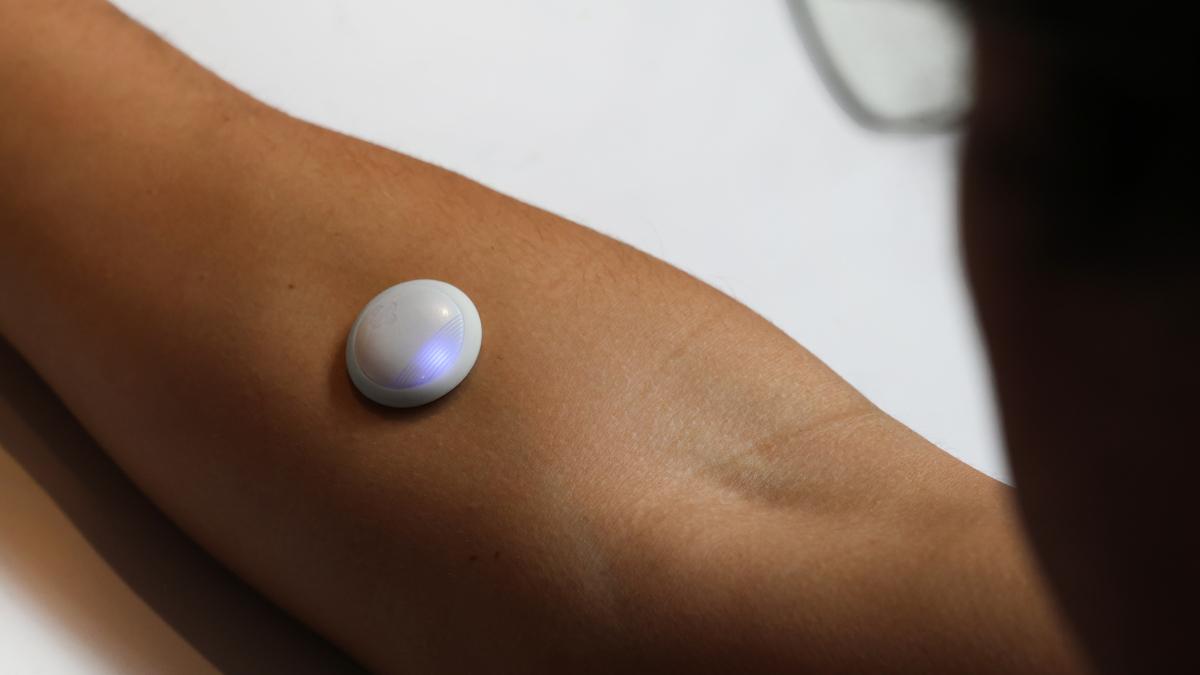
Wearable technology developer Biolinq has won FDA authorisation for a biosensor that can measure glucose levels continuously just beneath the skin's surface, without the need for a needle.
The San Diego-based company claims a number of firsts for its coin-sized Biolinq Shine device, including that it is so far the only fully autonomous, needle-free glucose sensor that has an integrated display, so it does not need a linked smartphone to show its readings.
The device, which is worn on the forearm, also monitors activity and sleep information via a smartphone app and provides users with real-time feedback if their blood glucose levels stray out of recommended ranges through an LED indicator light, according to Biolinq. A blue light means levels are in the target range, while a yellow indicates the user is hyperglycaemic.
The privately-held firm raised $100 million in a Series C earlier this year in preparation for a commercial rollout of the product, after completing $58 million and $100 million rounds in 2024 and 2021, respectively.
Biolinq Shine is being launched into a booming CGM market, which, according to presentations at the 2024 JP Morgan Healthcare Conference, is predicted to reach a value of $20 billion by 2028.
It is operating in a space with some real giants – Abbott and Dexcom – which already report billions of dollars a year in sales of CGM products and have even launched over-the-counter (OTC) devices for people with type 2 diabetes who don't need to use insulin.
In a statement, Biolinq said it is also planning to market the device initially to non-insulin-using type 2 diabetics who want a device that can go beyond simply measuring glucose and deliver insights into other aspects of their metabolic health.
Medtech round-up
Also this week in the medtech arena, Medtronic's Altaviva device – used to treat people living with urge urinary incontinence (UUI) – has been implanted into the first patient since its FDA approval last week. The implantable tibial neuromodulation (ITNM) device was inserted near the ankle of a patient using a minimally invasive procedure at Urology Partners in Dallas, Texas.
According to the company, it is the only therapy of its kind in the US to offer same-day activation, allowing patients to walk out of the doctor’s office with therapy turned on after a procedure that doesn't require sedation or medical imaging.
French start-up Sonomind has raised €3 million (around $3.5 million) for a low-intensity ultrasound-based transcranial neuromodulation system that it is developing as a non-invasive, brain-stimulating treatment for depression.
The Paris-based company plans to begin clinical trials within the next few months to evaluate its technology in the treatment of drug-resistant depression (TRD), which is seen in somewhere between a third and a half of the estimated 330 million people worldwide living with major depressive disorder (MDD).
Researchers at Washington University in St Louis, Missouri, are developing a wearable device that tracks blood loss by measuring cardiovascular variables, such as haemoglobin levels and blood flow, using a novel light-based sensor. One application of the wrist-worn device will be the detection of postpartum haemorrhage, the leading cause of maternal death worldwide. At the moment, heart rate and blood pressure are used to warn of blood loss, but can remain stable even if a patient has lost 1.5 litres of blood.
The project is being supported with a five-year, $2.8 million grant from the US National Heart, Lung, and Blood Institute (NHLBI). The scientists behind the work predict that a more accurate and continuous early-warning system could potentially prevent 50% to 90% of bleeding-related maternal deaths if paired with adequate treatment.
Finally, Florida, US company Smart Meter has launched a new sensor that uses radar technology to passively track patient vital signs – such as heart rate, respiration, movement, and bed exits – without any need for wearables or camera-based monitoring systems.
Called iAmbientHealth, the unintrusive system makes use of an AI algorithm that Smart Meter claims can predict a decline in overall health status and an emerging healthcare event up to seven days in advance, helping to reduce hospitalisations.