Remove the friction to unlock the true potential of AI: Precision Intelligence
Most insight leaders can now see the strategic potential of AI. They understand where it could help them with faster sense-making, broader exploration, and decisions made with greater confidence when time is short.
What tends to get in the way is not scepticism or lack of ambition, but friction. The kind that creeps in when new capability sits outside established ways of working and begins to demand extra explanation and scrutiny at precisely the moments when speed and confidence matter most.
Where friction really enters the system
In many organisations right now, AI still shows up as something to adopt, rather than something to rely on. It appears as a visible addition to the process, which in turn triggers new conversations about governance, safety, and precedent.
For insight leaders operating in regulated environments, that visibility matters, because each use becomes a judgement call, rather than a routine step. Under pressure, teams naturally gravitate towards approaches that are already trusted, already approved, and already safe to stand behind. Not because they are better, but because the system makes them easier to defend.
Where good intentions stall
We all have good intentions, but we know they don’t always happen in practice. For instance, let’s look at a typical scenario. Imagine a global insights lead is preparing to launch a time-sensitive study. If the team moves quickly, there is a real opportunity to shape thinking and stay ahead of events. If they don’t, the moment passes.
AI is suggested as part of the approach, which makes sense, as it would improve the research in terms of speed, as well as depth. Unfortunately, it enters the process as something additional. IT needs to be involved, compliance consulted. What was meant to accelerate the work slows it down. The AI component gets quietly removed, with a promise to revisit later. The strategic opportunity is lost.
Why this keeps happening
In many insights agencies or departments, AI is still being treated as a tool to add, rather than as infrastructure to embed. When it sits at the edge of the workflow, it struggles to shape decisions while they are still being formed.
This is where hybrid thinking becomes critical. Strategic insight does not come from automation alone, and nor does it come from human judgement in isolation – it comes from the interaction between the two. But that interaction only works when both are present at the same moment, inside the same process.
Until AI is close enough to the work to support that exchange, its use will remain episodic. Interesting in theory, difficult to sustain in practice. Yet, this matters because high performing organisations don’t use AI in this way. They embed it within the business and see its value as driving transformational change.1 AI is something that is part of the fabric of the business, driving innovation and competitive advantage.
A different way to think about AI in insight work
If AI continues to be introduced as something new to adopt, it will continue to struggle to become strategic.
The alternative is to treat AI as part of the insight infrastructure. Embedded into existing workflows, aligned to established standards, and safe to use without renegotiation each time.
Crucially, this does not mean lowering the bar on governance, accuracy, or compliance. In regulated environments, those requirements are non-negotiable. Frictionless AI works best when safety, validation, and quality assurance are already designed in, tested, and trusted.
When AI is embedded in this way, its role changes. It no longer needs to be explained or defended because the hard work has already been done upfront. It becomes available at the point where questions are being shaped, assumptions tested, and implications explored. Human judgement remains central, but it is supported earlier and more continuously.
This is what frictionless AI makes possible. It is also the foundation for Precision Intelligence: insight that is not simply faster or broader, but more decision-relevant, arriving at the moment it can genuinely influence outcomes.
What embedded AI looks like in practice
Consider a global insights lead preparing for a series of potential competitor launches. The challenge is not simply to understand what competitors might do, but how those moves could unfold over time and how the brand should respond at each stage. Speed, flexibility, and ideation matter. The team needs to explore scenarios, test messages, and pressure-test counter-strategies before the market moves.
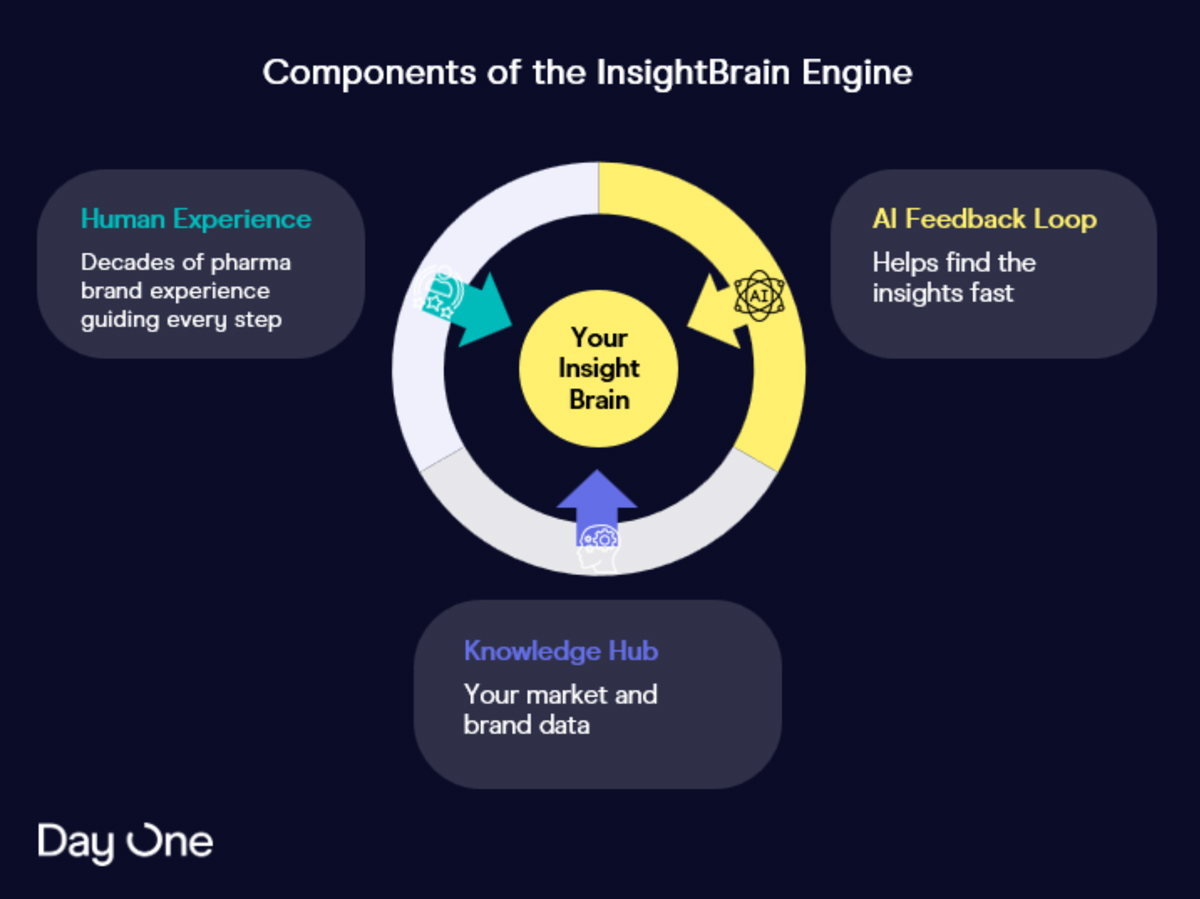
In this context, AI is already embedded within the insight environment. It’s the approach we are taking at Day One. Using InsightBrain, our AI-powered Precision Intelligence operating system, different AI agents represent competitor brands and their marketing teams, drawing on existing market research outputs and rich contextual information. Because the capability is already validated, governed, and designed to meet compliance requirements, it can be used with confidence from the outset, rather than introduced as an exception.
The work moves beyond reporting into foresight. Teams can explore what might happen, not just what has happened, while keeping human judgement firmly at the centre.
If used right at the outset of the project, there is no system to build and no extended adaptation period. Within hours, it is operating as part of the existing workflow. Standard enough to not need constant re-approval for use, yet, flexible enough to be tailored to the individual business challenge in question. The result is not just faster analysis, but better strategic conversation. Insight supports decisions while they are still being shaped, rather than arriving after the opportunity to act has passed.
A question worth asking
The question for insight leaders is no longer whether AI can add value, it is whether the way AI is introduced makes it usable when it matters most – when decisions are time-bound, scrutiny is high, and confidence counts. It’s a question worth asking now, not at some future point when the moment has already passed.
If AI still needs to be explained, approved, and justified every time it appears, it will continue to sit at the edges of insight work. But when it is embedded deeply enough to feel familiar, safe, and almost invisible, it has the potential to support genuinely strategic thinking.
That is where adoption begins. And where Precision Intelligence becomes possible.
References
- McKinsey – The State of AI in 2025: Agents, innovation and transformation.
About the author
 Hannah Mann is a market insight expert with over two decades of experience. She is the Co-Founder of Day One Strategy, a fast-growing UK and US based insights and strategy agency that leverages hybrid thinking to deliver Precision Intelligence to the world’s leading healthcare companies.
As a leader in the field of market insight, Mann is a regular speaker at industry events and is known for being at the forefront of bringing exciting, new technology into her sector.
Mann is an Insights Top 250 winner, two times winner of the EphMRA award for innovation, and part of the Ffinc Forward Faster Accelerator programme for leading UK founders.
About Day One Strategy

Day One is a healthcare insight and strategy partner to the world’s leading pharma brands. We combine deep human expertise with purpose-built technology to help leaders navigate high-stakes moments with clarity and confidence. Our work is trusted and compliant, proven across more than 50 applications for 7 of the top 10 leading global pharmaceutical companies.
Contact: Hannah Mann, Founding Partner
h.mann@dayonestrategy.com
Website: www.dayonestrategy.com
InsightBrain: https://www.insightbrainlive.dayonestrategy.com/