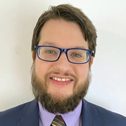
One Drop founder announces broad market CGM on Frontiers stage
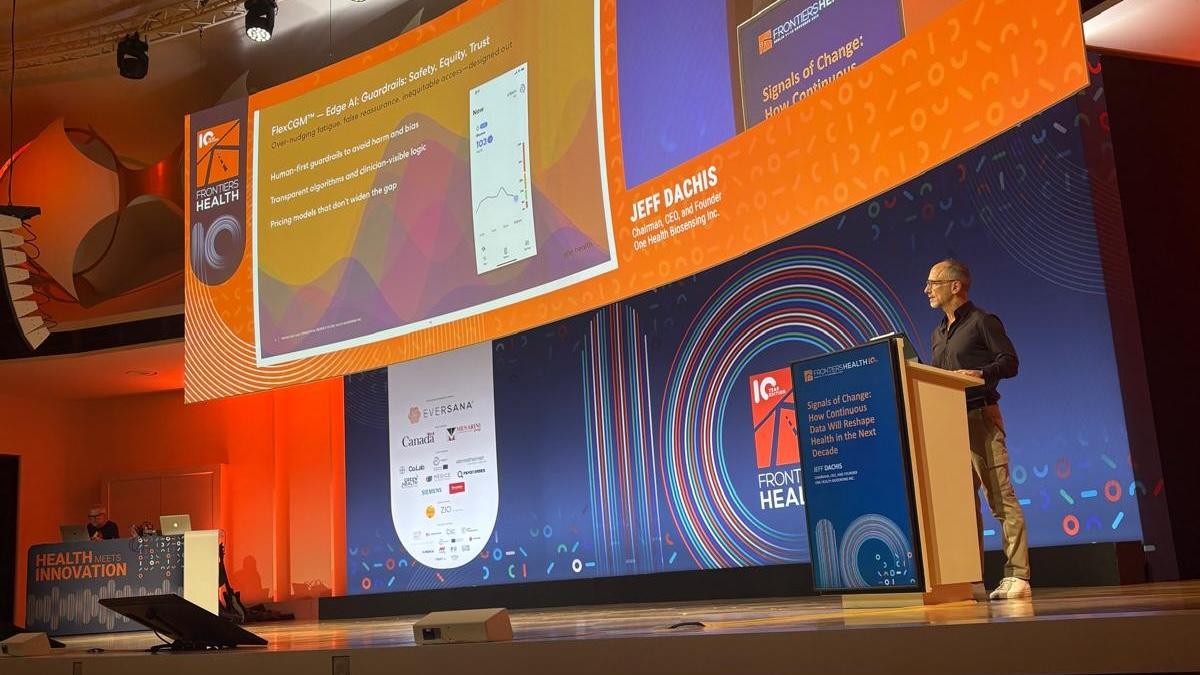
Jeff Dachis presents his keynote at Frontiers Health 2025 in Berlin.
Jeff Dachis, the founder of diabetes management One Drop, brought his new venture, One Health Biosensing, out of stealth mode in a keynote from the Frontiers Health stage in Berlin. His company's first product, FlexCGM, is a continuous glucose monitor with a new business model designed to bring real benefits of biosensing to a larger market than just people with diabetes.
"Continuous glucose monitoring, or CGM, is our strongest real-world proof that real-time biological feedback changes behaviour and outcomes," Dachis said. "It collapses the learning loop. People see their glucose and respond instantly to food or movement or stress or sleep, and the body stops being a mystery. In type 1 diabetes, the CGM has been paired with automated insulin delivery, and we've closed the loop and dramatically changed outcomes for people with type 1 diabetes. ... I believe CGM is the kernel and the foundational proof that continuous sensing can transform health."
The company is prepping FlexCGM for FDA submission in 2026, Dachis said.
"FlexCGM is our blueprint for the next decade of continuous biosensing," he said. "It's built for accessibility. It's built for behaviour change at scale. It applies what we learned with CGM, but removes the barriers that limited adoption cost, friction, and clinical gatekeeping."
One of the key innovations is that FlexCGM isn't meant to be used like a typical health wearable like a Fitbit or an Oura Ring. Instead, it's meant to be worn in short spans to train people with a variety of metabolic conditions, including Type 2 diabetes and obesity, to alter their behaviour.
"The goal is intuition," Dachis said. "Over time, individuals should need less sensing because they've internalised how their bodies respond. This is a shift from a device-centric model to a decision-centric model."
Depending on the use case, different stakeholders will pay for the device. Insurers and employers will pay in circumstances with particular ROIs tied to a healthcare event, while the consumer can pay directly in a "daily dose model" in other circumstances. And the company has put a strong focus on unit economics so they can offer the device at a low price point.
CGM is just the beginning -- Dachis says the company plans to add more sensors in the future to improve the user experience and the value of the product.
"Continuous biosensing is going to move from glucose to multi-signal insight that helps people course-correct daily across a variety of metabolic conditions," he said. "We're going to make this shift from reactive care to proactive health, from treating conditions to developing resilient humans who know how to make decisions based on data. I believe that real-time human data will outperform episodic care models in driving outcomes because we've seen it in CGM in type 1 diabetes, and we can take that seed and we can grow it into a massive force for change."