Lilly's M&A team strikes again with $2.3bn Ajax takeover
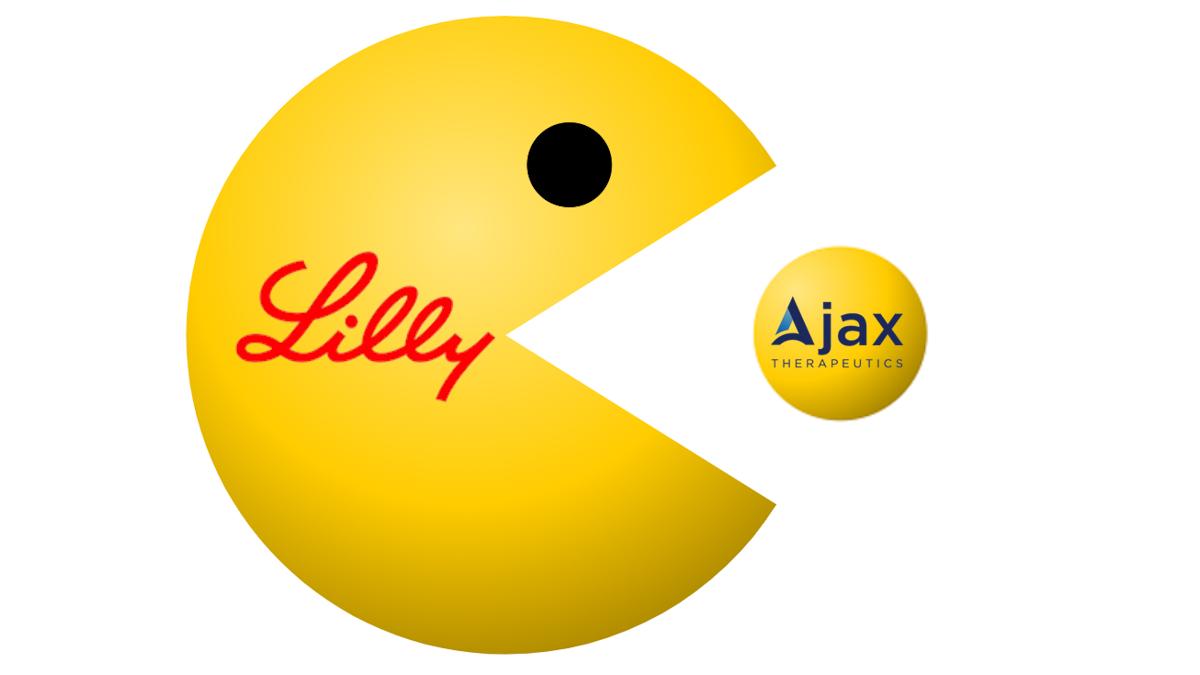
With the ink barely dry on an agreement to buy Kelonia, Eli Lilly has signed a deal to take ownership of Ajax Therapeutics and its pipeline of blood cancer therapies.
Under the terms of the deal, Lilly will pay up to $2.3 billion to shareholders in New York-based Ajax, whose pipeline includes a first-in-class type 2 JAK 2 inhibitor, which is in early-stage clinical testing and has potential for diseases like myelofibrosis and polycythemia vera (PV).
The once-daily, oral drug, codenamed AJ1-11095, is due to report preliminary results in patients with myelofibrosis who have previously been treated with drugs that bind to the type 1 form of JAK2, such as Incyte/Novartis' Jakafi (ruxolitinib), SOBI's Vonjo (pacritinib), and GSK's Ojjaara (momelotinib).
Selectively targeting type 2 may deliver superior efficacy and overcome resistance to type 1-directed drugs, according to Ajax, which said AJ1-11095's profile could support "deeper and more durable disease control" than currently-approved JAK2 drugs for myelofibrosis and PV. Results from the phase 1 trial are due before the end of the year.
Lilly has been spending the cash generated by its dual GIP/GLP-1 agonist therapy Mounjaro/Zepbound (tirzepatide) in a string of pipeline-building takeovers, with the Ajax announcement its fifth acquisition of the year so far.
Along with a $7 billion play for obesity and diabetes drug developer Kelonia, since the start of 2026 it has also made a $7.8 billion offer for sleep disorder specialist Centessa Pharma and launched a $2.4 billion bid for in vivo CAR-T therapy developer Orna Therapeutics, and completed the $1.2 billion acquisition of immunology-focused Ventyx Bio.
Ajax emerged from stealth with a $40 million financing in 2021, which was followed most recently by a $95 million Series C in 2024. Lilly knows the biotech well, having been a founding investor in the company, which was set up by five scientific founders, including Ross Levine, chief scientific officer at Memorial Sloan Kettering Cancer Center.
Martin Vogelbaum, co-founder and chief executive officer of Ajax, said that the company is now looking forward to Lilly "advancing AJ1-11095 through the clinic and providing a much-needed new therapy for patients."
Lilly already has an established presence in haematological cancers with products like reversible BTK inhibitor Jaypirca (pirtobrutinib), which was recently approved by the FDA as a second-line therapy for chronic lymphocytic leukaemia (CLL) patients whose disease advances despite earlier treatment with a non-reversible BTK inhibitor. Jaypirca has been tipped as a potential $3 billion-a-year seller at peak.
Lilly's head of corporate business development and president of Lilly Oncology, Jacob Van Naarden, said the company is looking forward to "the presentation of clinical proof-of-concept data later in 2026, rapidly advancing AJ1-11095 into registrational clinical trials, and using our expertise in blood cancer to hopefully deliver another important new medicine to patients and haematologists."