As drug costs for US employers rise, some cut GLP-1s from plans
Employers in the United States are facing rising healthcare costs for next year, and drug prices are a major driver of that increase, according to a new survey released today by the Business Group on Health.
“An array of forces across the healthcare industry, from soaring hospital and drug costs to the rapid innovation of specialised treatments and unintended impacts from federal health policy changes, have contributed to a considerable unpredictability in cost,” said Ellen Kelsay, president and CEO of Business Group on Health, in a statement. “This represents an unfortunate new reality for employers, who now face growing difficulty in budgeting and forecasting. It’s a call to take a more disruptive approach and rethink how to deliver value and improved health outcomes.”
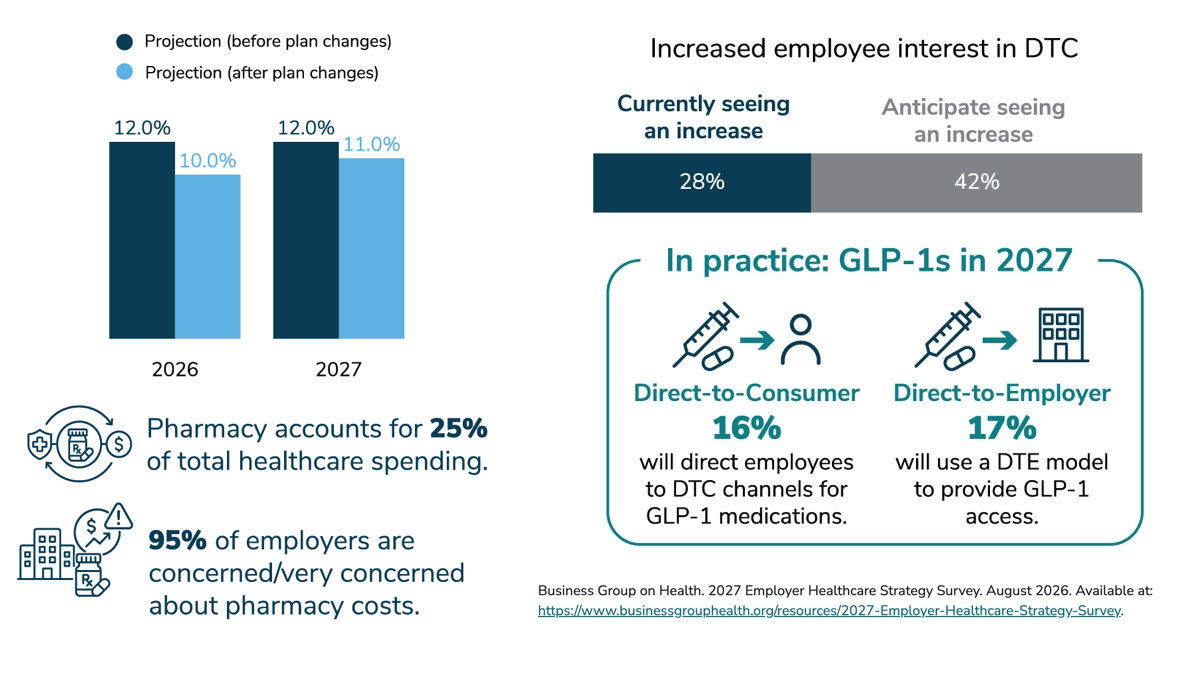
The group spoke to 127 employers in June, representing 11 million covered lives. While a number of factors are causing costs to rise, pharmacy now accounts for 25% of healthcare spending and those costs are expected to rise 12% next year, according to the report. BGH attributes this increase to "rapid growth in GLP-1 utilisation, the expansion of high-cost specialty drugs, broader treatment indications, and the emergence of breakthrough cell and gene therapies."
Around GLP-1s specifically, the survey found that the share of employees who plan to cover GLP-1s for obesity dropped from 72% in 2025 to 60% in 2026. Some employers are turning to new access models for GLP-1s, with 16% saying they would direct employees to direct-to-consumer channels and 17% opting for direct-to-employer channels that bypass the PBM for these medications.
In general, employers are more wary of their PBMs as costs rise, with 18% now engaging with next-generation or transparent PBMs, 14% adding them in 2027, and 47% saying they're looking at those options for the future.
While obesity may be a fast-growing cost area, it's far from the largest - only 10% of employers surveyed put it in their top three cost drivers. Seventy percent of employers cited cancer as the top cost driver for their health plans, up from 58% in 2025.
Another interesting finding: Although often touted as a cost-saver and efficiency driver, 64% of employers surveyed said that artificial intelligence is actually driving costs up as insurers employ it for revenue optimisation and upcoding. Employers, of course, are also leveraging AI in areas like care navigation and administrative automation.