FTC leader: "We're up to the challenge" of coming merger boom
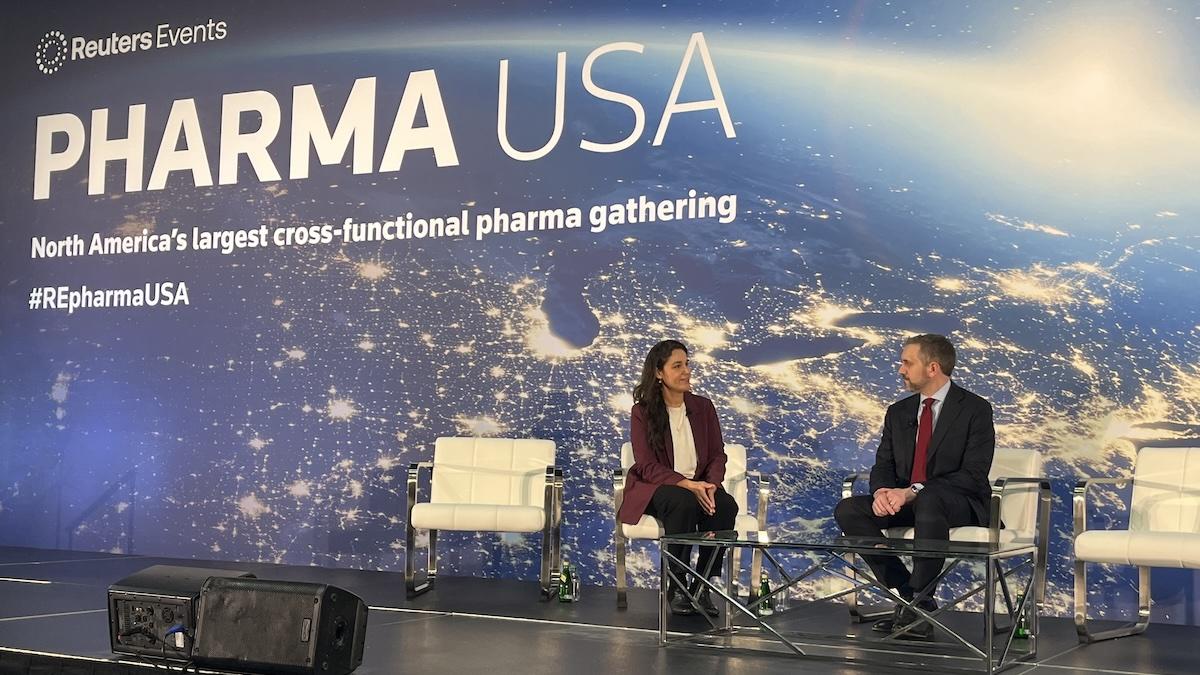
Reuters Antitrust Correspondent Jody Godoy interviews FTC Bureau of Competition Director Daniel Guarnera at Reuters Pharma USA this week in Philadelphia.
With patent cliffs approaching and plenty of dry powder in pharma's coffers, analysts are predicting a major M&A boom this year. So far, President Donald Trump's Federal Trade Commission hasn't given many clear signals of standing in the way of that boom.
But at Reuters Pharma USA in Philadelphia this week, FTC Bureau of Competition Director Daniel Guarnera told attendees the agency was ready to be vigilant for any anticompetitive dealmaking, citing recent its recent actions in the medical device space as proof.
"We've heard the same predictions that this is going to be a big year for mergers, that the volume of mergers might be historic, as you said. And I think we are certainly up to the challenge," Guarnera told Reuters Antitrust Correspondent Jody Godoy in an on-stage interview. "...We at the FTC are just laser-focused and obsessive about healthcare. It is the sector of the economy that we spend a huge amount of our time and energy thinking about. It's an area that we care a lot about, not only because of obviously the huge effect it has on the economy, but also because it has such a direct effect on Americans, both pocketbooks and wellbeing."
Guarnera pointed to the FTC's recent halting of two mergers in the medical device space, Alcon's attempt to purchase LENSAR in the cataract surgery space and Edwards Lifesciences' proposed acquisition of JenaValve Technology in the heart valve space. In addition to showcasing the focus on healthcare, Guarnera said, these actions show that FTC sees protecting the affect of competition on innovation as a major priority.
"Innovation cannot be measured quite as easily as price differences or quantity or output decreases," he said. "But that doesn't make it any less important."
Although Trump's FTC has yet to take action against a pharma merger this term, they did insert themselves in the Pfizer-Novo Nordisk bidding war for Metsera with a warning letter issued to Novo Nordisk.
"Basically we raised the concern that the deal was set up such that Novo Nordisk would pay the overwhelming majority of the consideration for Metsera up front before there was any premerger review, about $8 billion or so," he explained. "And the idea was that only later would the parties actually file for the FTC to review the merger. And at that point again, the money would have been paid and distributed to Metsera shareholders and key employees and the competitive dynamics at that point would have been again dramatically altered in this important space."
Although it ultimately ended up moot, Guarnera stressed that the FTC was prepared to take action.
"We noted that the FTC has various tools at its disposal that it can bring to bear in these situations, including an injunction potentially preventing money from being distributed to shareholders before an HSR form is filed, or if money is distributed, even potentially rescinding it," he said. "The way that the matter actually played out, we never had to make a final enforcement decision or anything like that. But again, we wrote a letter flagging that we had concerns and I think we would we continue to look for novel and creative deal structures that again seem to intentionally run against the policy decision that Congress has made."
He mentioned a few other areas where the FTC had taken action around drug prices: Settling with Express Scripts last month to lower drug prices and continuing to issue warning letters against companies improperly listing patents in the FTC's Orange Book.
"I think the warning letters have been very effective so far for the patents that we've sent letters about," he said. "So I think we look at that as a big success that has again enabled generic competition to enter on the timetable that's intended really under the statute, without abuse of the Orange Book system."
Guarnera's main takeaway was that nothing is off the table when it comes to protecting competition in healthcare. The FTC will look at vertical mergers as well as horizontal ones, something that largely sets them apart from the FTC under Biden.
"We're aware of the number of blockbuster drugs that are approaching the end of their exclusivity," he added. "And yes, that is a transition in the market where there is some potential for anti-competitive conduct. We are always happy to hear concerns from market participants, including generics makers and patient groups, to make sure then that sort of the entry of generics can happen as it's designed to under patent laws."