How pharma and start-ups are working together for AI success
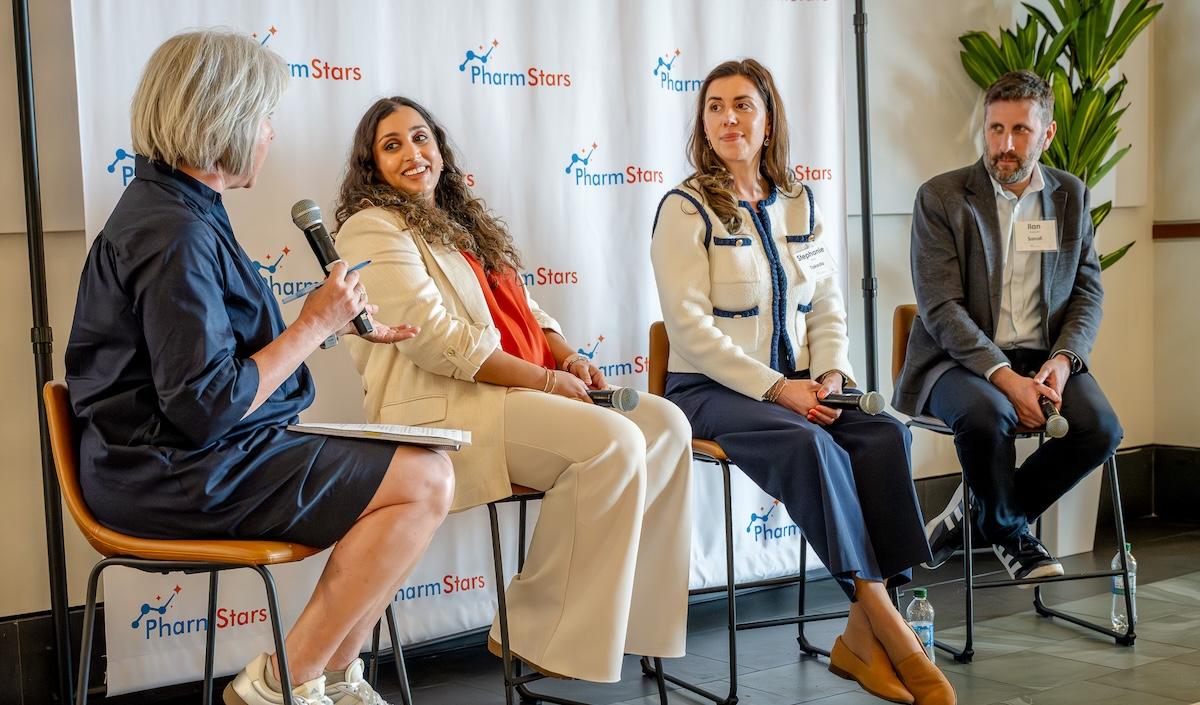
Moderator Christi Hill, Alexion Innovation Accelerator Lead Taiba Quraishi, Takeda Head of U.S. Patient Diagnosis Center of Excellence Stephanie Klock, and Sanofi Head of Digital In-Silico Research Ilan Wapinski at the PharmStars PharmTech Innovation Summit in Boston.
At the first ever PharmStars Pharmtech Innovation Summit in Boston, a mix of start-up founders and pharma executives took the stage to share lessons learned from both sides of the table when pharma companies and start-ups partner to develop AI solutions.
Success requires more than just a technology that works, speakers said. Companies need the right internal champions, the right KPIs, and a plan for making that all-important jump from pilot to full-scale deployment.
What start-ups need to know about pharma
When pharmtech start-ups initiate a relationship with pharma companies, both sides need to go in with the right mindset.
“I think where I've seen success is when there's the ability to co-create, because the start-up is coming with something innovative, but coming with an innovative idea alone isn't going to be successful,” said Stephanie Klock, head of the US Patient Diagnosis Centre of Excellence at Takeda. “Start-ups need to recognise that they're coming to a company that has deep scientific knowledge and expertise, that has knowledge of commercialisation, that has strong expertise around capabilities. And so trying to marry those two and coming to the table not with, ‘Here's my incredible idea, it's going to work as is', but how do you co-create to actually find something that works and can leverage the expertise and the capabilities that both sides bring?”
It helps to have someone on your team – an investor or a mentor perhaps – who understands the pharma world.
“I’ve told lots of the younger founders with purely AI backgrounds, that you have to partner up with someone on the industry before really coming to this industry,” Lu Zhang, founder and managing partner at Fusion Fund, said. “It's a big market for sure, 20% of the US GDP, but on the other hand it's very, very complicated.”
“The start-ups that don't get it right don't understand one fundamental problem, that in pharma the buyer is not the user and the user is not the decision maker,” said Taibi Quraishi, Alexion’s Innovation Accelerator lead. “So you have to sort of approach this double-edged problem and solve for the entire ecosystem, … and it's usually an incentive problem in this country. You're not really solving a technology problem.”
Ilan Wapinski, head of digital in-silico research at Sanofi, agreed.
“The thing that I always tell partners and potential prospective partners that I want to work with is that the technology can be really great, it could be the best thing ever, but it's like one of three things that matters, and it's probably the least important thing that matters. The most important thing is how well your solution is going to integrate with all the other things that we do at Sanofi.”
That means that start-ups need to do their research – not only about pharma in general but about the particular company they want to work with. Finally, start-ups need to be honest about their progress and their capabilities.
“From our perspective a company being early is not an issue,” said Jonathan Walsh, head of digital innovation fund and programmes at CSL. “In fact, we like it because typically the problems that an innovation space that we're focused on are— there aren't any known solutions out there, so we've got to find companies that are thinking about the problem that you're interested in solving. So the first thing we want to understand is where they are in their start-up journey. As a start-up, there's this facade where you're trying to make it seem like you're not a start-up and you're further along. That's tricky.”
What pharma needs to know about start-ups
What about on the start-up side? What do big pharmas need to know about working with start-ups? Sasha Seymore, cofounder and president of Ethos, says they’ve encountered pharma companies with hardly any AI strategies and companies with detailed infrastructure, and he knows which he prefers to work with.
“They have set up their own AI and said, we want you to use this when you plug your tools into that particular AI system,” he said. “I think these are the ones who have seen the most clear value in me because they've said, okay, twe know this is the future, we know there's tremendous value here, we're going to set up a very structured, clear way that we are going to approach it and give you guidelines on how to do it, as opposed to like in a vacuum where people are in the middle, they're kind of like, ah, can I do this, can I not do this, I don't know.”
Pharma companies also need to have an awareness of the sorts of timelines start-ups are capable of working on, said Trishan Arul, CEO of Picture Health.
“Some of our earlier pharma customers really wanted us in their trials quickly,” he said. “They said, go contract with our CRO, that'll be a lot faster. We can put it into trial, pilot, and a couple others, and then we'll start doing the same. I'm literally doing MSAs now, like, a year plus after we started working with them. … So we found some workarounds to that, … some different shortcuts that we're running in terms of how you get there because going through an MSA process is very long and very painful. And as a start-up, you just don't have that time.”
Sometimes the culture fit with big pharma is too much to overcome – and in that case, start-ups should consider starting smaller.
“We've done all of our learning with biotechs,” Angela Holmes, founder and CEO of OmniScience, said. “A big pharma will never go first. We don't ask them to go first. So we've proven out, immunology, oncology, rare disease, neuroscience, all at biotech and mid-market portfolio scale. We knew we had to do this for probably two years before starting our big pharma conversations.”
The right champions and the right KPIs
To make a partnership work, start-ups need not just a champion at a pharma company, but the right champion – and that’s a tall order.
“You need someone who's a champion, that's at the right level that they're close enough to the execs that have budget, but also close enough to the problem where they understand the problem,” said Shrawan Patel, one of the cofounders of PharmStars. “They can translate it for the senior executives, also understands tech, can work with the team in terms of direction, can right-size the pilots, understands how many people need to work on projects to get it off the ground and get it to a place where you can scale it out. Does that person really exist?”
Sometimes they don’t, panelists admitted; sometimes you need multiple champions within an organisation. But it’s very easy to end up with someone who just doesn’t have the access to ensure a project’s success.
“For me, the difference between success and failure is very often whether the person that sets up your pilot has access to the people that have real budget and for whom a KPI is directly related to what you're doing,” said Nader Alaghband, founder and CEO of Ampersand Health.
When it comes to KPIs, the important thing is defining them ahead of time and knowing what success looks like.
“The thing that I've seen helps is having very good benchmarks on what success looks like from early on,” said Sanofi’s Wapinski. “This can be tricky to do with an external partner when you're trying to set up what success looks like and what are the kind of milestones that you would need to see in order to see the partnership grow, to see the technology grow, to see the impact grow.”
“Come prepared with understanding not just the problem, but how your solution is positioned, and from a data standpoint, showing what you have measured, what you can measure, and being very much focused on the metrics,” said Klock.
The key is finding the right metrics that align both with what the start-up can measure and with what the pharma organisation prioritises.
“Everyone rushes, let's get a pilot, let's get a pilot, let's get a pilot,” said Arul. “Like, define the pilot properly to make sure you understand what it is and that you're aligned with your sponsor. [Make sure that] for the person inside, the sponsor who's working with you, that these are the right metrics.”
Getting past the pilot
It’s easy for both start-ups and pharma to be so focused on pulling off a pilot they’re not ready to transition into a full deployment.
“When you're going from a pilot, you're talking about OpEx money, it's easy to get,” said CSL’s Walsh. “When you talk about scaling, now you're introducing using all these processes in the company and to scale all of that, like, you've just now increased, ten times the number of people that touch it.”
Sometimes the transition from pilot to full deployment involves adjustments along the way; that’s when that co-creator relationship becomes valuable.
“You have to find a good balance of when you're actually going in and testing this, knowing that full well is that you're probably going to learn things that you didn't know, and you're probably going to have to pivot, whether it's your product or your business model around it,” said Walsh.
Holmes, of OmniScience, says she’s come to agree with a mentor of hers who suggested that the whole concept of the pilot may be holding pharma back.
“Don't call them that anymore,” she said. “By the time you start a pilot, you've invested so much time, so much money on both sides, so much, you know, especially if you're bringing in tech, there's a lot of compliance you probably want to do, procurement, security, all the audits. If you have picked the best in market, not just the leading tech, but the company you like, you want to work with and you've built a relationship and trust, there shouldn't be failure. That project shouldn't be about pass/fail. It should be about how do we learn together, how do we work together, how do we start planning from day one for scale. None of us have time to invest a year and then have it go sideways.”
Several panellists mentioned that pharma attitudes about AI have been evolving rapidly, so the appetite for these kinds of partnerships is stronger than ever. For example, Arul mentioned that the drug price negotiation in the Inflation Reduction Act has created increased demand for AI in drug discovery.
“With the mandatory pricing negotiation clock starting to tick, once they find a drug they like in a program, they really like to trial across tons of indications,” he said. “And so for us, because we're able to look at the mechanism of action of the drug with response, as a response to our biology, they're rolling this out very quickly. We’re signing like six or seven contracts in a fast succession as they roll out across the entire indication.”
In general, conversations have moved from scepticism about AI to an eagerness to not miss the boat on the technology.
“I was just on the phone this morning with a client and they said, unless you got a way of integrating AI, I don't want to hear it. That's the new perception that we're hearing,” said Mark Linver, a senior client partner at Endava. “But you better have a way of doing it, and it better be proved as successful. The idea of the pilot and the trial and error failure, that's gone. You have to be able to say, this is a proven approach, here's your proven methodology, and here's something that we know will work, but to get there let’s work together as a team. It's not, ‘I'm going to do it to you,’ it’s ‘I'm going to do it with you.’”