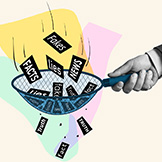
The trust gap: GLP-1s and the new information economy of obesity
Sitting alone at her kitchen table, Julia Bergstedt remembers reading and re-reading the instructions several times before she worked up the nerve to inject herself for the first time. She had never administered medication into her own body before – not like this. Flu jabs were one thing. Drawing blood was clinical, external. But this… This felt different.
“I had to really hype myself up to stab myself,” she recalls.
The pen itself was relatively straightforward. The prescribing pathway – comprised of an online consultation, photos and questionnaires, and ultimately approval through a private online pharmacy – had been efficient. But the act of pushing the needle in carried more psychological weight than she had expected. It marked a threshold.
For Bergstedt, a 33-year-old living with polycystic ovary syndrome (PCOS), the decision to start a GLP-1 medication was not impulsive. She had watched the celebrity before-and-after transformations circulate online and heard the online buzz swirl around the so-called “miracle drug”, Ozempic.
But, at the time, she assumed it was a phenomenon reserved for the rich, famous, and well-connected. A weight loss drug was unlikely to reach ordinary people in the UK any time soon. And even if it did, getting it through the NHS would surely take years.
Then, two friends began a GLP-1 drug. Quietly at first. Privately. When they eventually revealed they had been taking the medication for months having received a prescription through a telehealth provider, Bergstedt’s perception shifted from spectacle to possibility. Just as her friends had done, she too could access these life-changing treatments now – provided she could pay.
She did not approach her GP – experience told her that the NHS would not prescribe it for her intended use and she wanted to begin treatment straight away. So, she filled out the forms, read the leaflets, absorbed the FAQs, and added the cost – around £50 a week at the time – to her budget.
Bergstedt’s experience of navigating the transition from spectacle to decision largely alone has quietly become a common one. And as prescriptions climbed, something else was accelerating just as quickly: the flow of information around these drugs.
A constellation of sources
By 2025, one in four people in the UK reported having been prescribed or that they were currently taking an obesity management medication, and nearly half said they knew someone who was. For Bergstedt, and many others like her, the decision did not end with the prescription. It began a period of research.
“These are prescription only medications for a reason and everybody is different. You need to take into account your medical history. What works for one person might not work for another.”
– Zoe Griffiths, VP behavioural medicine, Numan
She carefully read the information leaflets that arrived with each pack. She trawled pharmacy websites, Googled side effects and dosage guidance, and compared experiences with friends who were also taking the medication.
There was no single, authoritative voice guiding her through it. Instead, there was a constellation of sources – some clinical, some anecdotal, some commercial – that she learned to navigate herself.
Her experience reflects a broader shift.
According to Numan’s State of Obesity 2025 report, 34% of people say social media is now their primary source of information about obesity management medications. Others cite word of mouth. A growing proportion report turning to AI-based tools. In short, the patient journey no longer begins in a consulting room. It begins in a feed.
Zoe Griffiths, Numan’s VP of behavioural medicine, sees a direct link between information source and attitude to safety. Those who got their primary information from AI tools, social media, or word of mouth, she notes, “tended to have attitudes that these medications are fine to take without a prescription” – a view she considers dangerous. “These are prescription only medications for a reason and everybody is different. You need to take into account your medical history. What works for one person might not work for another.” The unregulated nature of social content compounds the risk: posts may come from people with no clinical training, or with commercial incentives to promote a specific product or service.
The speed of pharmacological innovation has outpaced the traditional pathways of patient education. GLP-1 receptor agonists have moved from specialist diabetes treatments to headline-grabbing obesity therapies in just a few years. But while the science has evolved rapidly, the translation layer – the infrastructure that helps patients understand what these drugs are, how they work, and what they are not – has struggled to keep pace.
Translators, algorithms, and authority
In the early days, much of the detailed information about these medications was directed either at investors or at clinicians. Patients, meanwhile, were left piecing together fragments from press coverage, online forums, and emerging creator-led accounts.
“[The GLP-1 information environment is] so cloaked in industry jargon that it’s not super approachable for the average person.”
– Dave Knapp, founder, On The Pen
If information is now assembled, rather than delivered, the question becomes: who is doing the assembling?
A new layer of translators has emerged. Some are clinicians using social media to explain receptor agonism and satiety hormones. Others are patients documenting their own journeys. Some are affiliated with telehealth providers. A few, like Dave Knapp, founder of On The Pen, sit somewhere in between.
After his own type 2 diabetes diagnosis, Knapp threw himself into research, combing through medical journals, trawling GLP-1 discussion forums, and reaching out to those involved in developing these complex medications, to find out as much as he possibly could about the evolving drug class. What he found was a dearth of accessible information. “There was a huge deficit of information out there that existed for patients,” he explained. “All of the information – especially early on – that flowed about obesity medicine was either intended for the investor community or the medical community. And unless you spent a lot of time reading that stuff as a patient, there just really wasn't much for you.”
Incentivised, he began to translate theses complex concepts it into everyday language. Being an early adopter who engaged deeply with the science, he says, quickly connected him with medical professionals, making the translation more credible. In a space increasingly shaped by affiliate codes, monetised telehealth pathways, and algorithmic amplification, he is well-aware of the trust his audience places in his reporting, a responsibility he says that he takes very seriously.
“I never give medical advice,” he emphasises. “The [On The Pen] ecosystem is intended to empower people to have better conversations with their doctors.”
Knapp’s diagnostic is sharp. The information environment, he argues, is so “cloaked in industry jargon that it’s not super approachable for the average person.” The most basic conceptual bridge – that Ozempic, Wegovy, Mounjaro, and Zepbound are simply peptides mimicking something the body already makes – is rarely explained in the content patients actually encounter.
But algorithmic environments favour simplicity. They reward clarity, confidence, and emotional resonance over uncertainty and caveats.
Clinical nuance does not trend.
Bergstedt experienced something like this herself. The information she encountered online was rarely overtly wrong or misleading. But it was optimistic – weighted toward transformation stories, before-and-after arcs, the clean narrative of a drug that worked overnight. The less aesthetically captivating caveats, the non-linear progression, the need to think hard about food and lifestyle habits: these elements all came later, through her own experience, rather than anything she had read online.
Market acceleration, public expectation
Each advance in the pharmacology of obesity treatment generates renewed public interest, which generates more content, which reshapes expectations about access. The cycle is self-reinforcing: clinical success drives cultural penetration, cultural penetration drives information diffusion across decentralised channels. Information diffusion, in turn, creates demand – and sometimes pressure – for access that the healthcare system moves too slowly to satisfy.
“Actually, all the evidence suggests that you should just be on these medications long term.”
– Zoe Griffiths, VP behavioural medicine, Numan
Oral formulations, currently advancing through development, could accelerate this further. Tim Blackstock, analyst at Citeline, points to their convenience advantage: a small-molecule pill avoids the injection requirements of current peptide-based drugs and could lend itself particularly to long-term weight maintenance, potentially at lower doses. “Perhaps a tablet could be much more convenient for staying on at a lower dose to keep the weight off,” he says – a prospect that matters given the emerging evidence that, like any chronic disease, patients may need to stay on treatment indefinitely.
The healthcare system, meanwhile, operates at a different speed.
In the UK, access to GLP-1s through the NHS remains tightly restricted and geographically uneven – with waiting lists stretching for years in some areas. More troublingly, Griffiths notes, the NHS imposes time limits on semaglutide treatments like Wegovy, that sit in direct tension with the clinical evidence supporting long-term use. “This is a biological-based disease, it deserves medical treatment,” she says, “and actually, all the evidence suggests that you should just be on these medications long term.” For patients currently on NHS treatment, that finite end date is generating real anxiety. The Numan report adds a further structural barrier: two-fifths of respondents said that fear of being judged remains an obstacle to seeking formal support for their weight.
This leaves patients with few options, none ideal. Some go private. Some wait. Some experiment with unregulated “skinny jabs” promoted online.
Digital pathways offer immediacy and validation. But immediacy can come at the expense of context. As Griffiths warns, medication and behavioural support “have to go hand in hand.” Without structured care, nutritional deficiencies, muscle loss, or unrealistic expectations can undermine long-term outcomes.
The fragile balance
For Bergstedt, the drug was not a shortcut. Knowing that this was likely to be a lengthy and costly journey for her gave her the motivation needed to make the lifestyle changes that had previously seemed unobtainable. “If I’m now spending £50 a week on this,” she recalls, “I want to also change my habits and actually learn things and not just treat this as the crutch.”
Such lifestyle interventions are essential to maintaining weight loss long term, but Griffiths is direct about the consequences of embarking on dramatic dietary changes without support. Patients who manage the medication without behavioural guidance risk developing unhelpful relationships with food, losing excessive lean body mass, and failing to manage side effects effectively. “That ultimately results in a poorer outcome,” she says. The medication, she argues, is an investment – one that needs to be protected.
Bergstedt spent months working to establish a healthy balance. She calorie-counted intensely at first. She examined portion sizes and reconsidered cooking habits. But, over time, she stopped counting religiously, choosing to focus on smaller, more sustainable, changes. The weight loss slowed. She accepted that. “I now know more [about] what I need to eat,” she says
Her story is not unusual. Patients navigating this landscape are often deliberate, reflective, and pragmatic – far from the passive recipients of hype they are sometimes assumed to be. Bergstedt taught herself what she needed to know, but she did so largely alone, stitching together a picture from leaflets, forums, friends, and her own trial and error.
GLP-1s may represent a turning point in obesity medicine. The harder question – the one the molecules themselves cannot answer – is whether the systems built around them will catch up before the next generation of patients has to figure it out for themselves.

About the Author
Eloise McLennan is the editor for pharmaphorum’s Deep Dive magazine. She has been a journalist and editor in the healthcare field for more than five years and has worked at several leading publications in the UK.
Supercharge your pharma insights: Sign up to pharmaphorum's newsletter for daily updates, weekly roundups, and in-depth analysis across all industry sectors.
Want to go deeper?
Continue your journey with these related reads from across pharmaphorum


The Ozempic dilemma: Balancing demand, supply, and patient safety in a viral GLP-1 world

On inflammation, heart health, and GLP-1 possibilities, with Sandeep Kulkarni

Weighing in on GLP-1 drugs

Treating the chronic diseases GLP-1s miss, with Laurent Audaly


Click on either of the images below for more articles from this edition of Deep Dive: GLP-1 2026