How to land a deal with big pharma
At LSX 2025 in Boston, top business development executives from more than two dozen big and mid-sized pharma companies took the stage to talk about what they look for in a biotech partner. Here’s what they had to say.
Big pharma companies are devoting a lot of resources to external innovation, scouring the biotech landscape for everything from licensing deals to acquisition targets. With pending losses of exclusivity and an uncertain policy environment that could lead to major revenue losses, pharma companies are looking to spend – but also more intent than ever on getting bang for their buck.
“I think what we're seeing is, yes, there's capital, but it's isolated to a more select group of biotech companies,” Steven Ladd, vice president of business development and acquisitions at BeOne Medicines, said at the show. “Those companies are the ones that are coming up with some data that shows a differentiation. And those are also the assets that are most interesting for large pharma.”
Meanwhile, on the start-up side, things are tough. But that can also create opportunity on both sides.
“I think if you look at the macroeconomic picture with the IPO market cooling, many companies are staying private longer,” said Mankit Law, senior director for business development, search, and evaluation at GSK. “What that, I think, translates into is more de-risked innovations with the clinical data. That creates a bit of a sweet spot for pharma, particularly on the M&A side.”
Scott DeWire, corporate SVP and head of global business development at Boehringer Ingelheim, concurred.
“It's a pretty good time to be in strategic partnership with pharma right now,” he said. “Most of the big pharmas have a big forecast, and we have [loss of exclusivity] LOE issues, so we are shopping. There's a real willingness from small companies, that I haven't seen in seven to five years, to deal with big pharmas.”
How to stand out
Repeatedly, big pharma executives were asked what makes a biotech stand out for them as a partner or an acquisition target, and the answers they gave were remarkably consistent. First and foremost, they’re looking for first-in-class or best-in-class assets. And that notion goes hand in hand with the idea of differentiation.
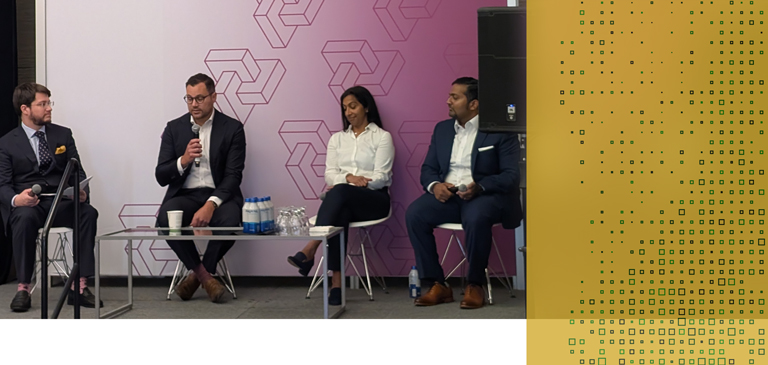
Pictured: (L to R) Jonah Comstock (pharmaphorum), Steven Ladd (BeOne Medicines USA), Anu Connor (IPSEN), and Nikhil Mutyal (AstraZeneca). Photo courtesy of LSX
“We need either first-in class or best-in-class,” said Venky Raghavan, executive director for search and evaluation in oncology at Novartis. “But, even if you're first-in-class, if it's a super competitive landscape, we'd want to see what the differentiation would look like. And when we see a differentiation, it's got to be pretty important. We look at it in two different ways. One is like a scientific differentiation in terms of what is the unmet need you're trying to solve and how much better you're going to solve it […] And more importantly, it's also the patient population. Can we expand beyond where assets are currently being used?”
GSK’s Law noted that best-in-class is easy to say, but actually meeting that standard is complex and multifaceted.
“If we're going to pursue an asset, which is, I would say, a year plus from the most likely first entrant into the market, best-in-class potential becomes an increasingly important factor to scrutinise,” he said. “And when it comes to best-in-class potential […] you're looking at efficacy, you're looking at safety, you're looking at convenience, pricing, I think. In addition, bio-variability, based on the data sets that are supportive of that asset.”
Alongside that differentiated value, pharma companies are thinking about strategic and cultural fit – not just why someone should partner with, or acquire, this company, but why they should.

“We look at how things can complement our pipeline, or combine with our pipeline, and also what the company's strategy is,” said Anuradha Connor, head of search and evaluation for oncology at Ipsen. “The strategy changes from year to year, especially being at a more mid-sized company. We are very opportunistic as well. We also, just like other big pharma, have looming LOEs. We are very interested in late-stage opportunities, things that can bring in near-term revenue in the short term.”
When everything comes together, pharma and biotech can do a great deal even if some of the data isn’t as strong, as long as that differentiator exists. Nikhil Mutyal, head of search and evaluation for respiratory and immunology at AstraZeneca, shared an example:
"We did a deal with PharmaMar for a small cell lung cancer drug,” he said. “At the time, nobody was giving it a chance. It had failed multiple studies in combination. It was not working in the same indication. But monotherapy data was actually very strong. It was a handful of patients; but if you really talked to the doctors and physicians who are treating those patients, they were saying that they have not seen anything like it in terms of tolerability and effect size. We believed in it and took a risk. We only paid $100 million upfront for that drug, actually, and it's now in frontline maintenance in small cell lung cancer and it's probably going to do a couple of million dollars in sales.”
How to think ahead
Another theme that emerged was that start-ups can save potential partners a lot of trouble by thinking through future issues early – even issues that they themselves might never have to deal with.

“It seems hard, especially if something's in a research or preclinical stage, to be thinking what your approvals will be, or what your lifecycle management will be,” Connor said. “It's a lot to ask, but it's very helpful to us when we have an idea of how the companies are thinking about the vision of the programme – where it could start, where it could grow – taking into consideration IRA and all of these other aspects.”
In some cases, poor planning can have serious consequences for a pharma-biotech relationship, according to Novo Nordisk SVP and head of global research, Jacob Petersen.
“Sometimes we see these early-stage collaborations that have gotten a Series A funding […] they rush to the next milestone, to the next value inflexion point, and then sometimes forget to do the right thing. Then when a big pharma like Novo Nordisk has come in, then sometimes we need to redo it. And that's a really difficult conversation to have with a young, flourishing biotech company that has a fantastic technology or target,” he said. “So maybe spend a little bit more time and get the right data because then it's going to be faster and it's going to be a lot more valuable.”
One area in particular where Petersen would like to see companies thinking ahead is around scalability and manufacturing.
“So scalability right now, except for small molecules and peptides, is a big issue for a company like Novo Nordisk, and something we address upfront,” he said. “I can only recommend, if you are in a biotech company, think about it. What is the scalability of the product that you are developing? Because that will play a big role in our decision-making in terms of moving forward.”

There are a lot of factors biotechs need to consider, but generally the more biotechs can think ahead, and avoid cutting corners, the better it will be for them in the long-run.
“The endpoint for biotech sometimes is different than the endpoint for pharma,” said Ladd at BeOne Medicines. “And I think over the last 10 years, we've seen different events drive pullback on some of these. And what I mean by that is a few years ago with China-only data, and then going to the FDA and trying to get approval on China-only data. That obviously backfired, and it was a fast-to-market approach.”
As well as manufacturing, scalability, and good science, companies need to think about the commercial side.
“Every deal at BMS has to be supported by a strong business case,” said Michelle Li, VP of business development transactions at Bristol-Myers Squibb. “That's where the P&L, the cash flow, those types of metrics come in play. For us, especially in this industry, revenue is perhaps the most important factor to decide what growth we are profiling for each of the opportunities. With that in mind, the speed to market, the order of action is really important, especially in highly competitive areas like oncology.”
Finally, as if that wasn’t enough to think about, far too many start-ups haven’t locked down their intellectual property sufficiently.
“I think companies have gotten better at that over time, but it really is the foundation in which your house is built, so make sure that you're taking care of that early,” said Siobhan Pomeroy, VP of corporate development at Gilead Sciences. “Because I would say in my career, in my experience, [IP is] the one thing that has killed deals more often than anything else.”
How to tell your story
It's not just about the data and the differentiation itself, but also about whether the start-up can communicate its unique value. Connor said she looks for companies that know how to tell their story.
“If they can't tell that story, how are we supposed to understand or tell that story internally when we're trying to get the championship? That's a red flag when there's just a lot of data and they don't really know how to put it all together and tell a clearer story,” she said.
Differentiation is the whole ball game, so executives urged start-ups to do their homework on their competition and zero in on differentiation in their pitches.
“I'm absolutely focused right away. How is this different? What is the differentiation? That’s really what I want to know,” Joel Klappenbach, Pfizer’s executive director of business development of immunology and inflammation, said. “Don't make me go search and find out why it's differentiated because we'll do the homework anyway. So just upfront, tell me what's different about this particular asset, the mechanism, the target, how it's going to fit into the commercial paradigm.”
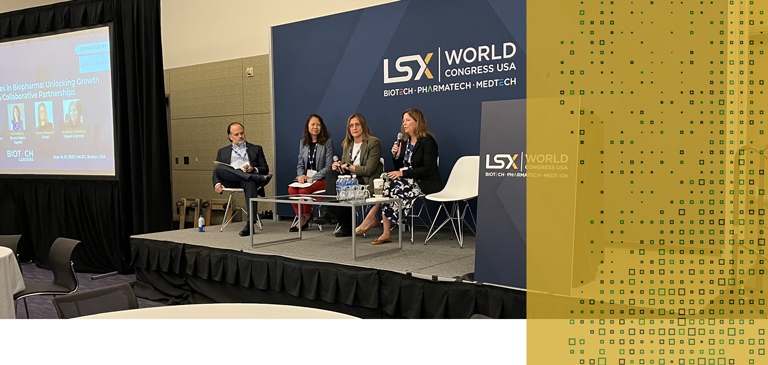
Pictured: Aaron Gardner (Latham & Watkins), Michelle Li (BMS), Irene Pasquali (Chiesi), and Siobhan Pomeroy (Gilead Sciences). Photo by Jonah Comstock
Irene Pasquali, head of global business development for Chiesi’s respiratory group, was even more specific about how start-ups should reach out.
“For me and for Chiesi, the best way is to send an email with the presentation, but pay attention about the email. It shouldn't be very long. The presentation will be very few slides, but what has to be clear is the data. So strong data, scientific data, that should be in some way validated. For example, sometimes we receive interesting data, but with a clinical model that in some way is not fully validated. With this, it's difficult to convince our R&D. But, if the model is strong and the data positive, that is something that will usually will get our attention.”
Start-ups can also get ahead by thinking a bit about strategic fit from the big pharma’s perspective.
“If you do know how your asset would fit with our portfolio, the combinations we can potentially do with your asset, I think that adds a lot more value,” said Novartis’ Raghavan. “It shows us that you've done your homework and shows that you're passionate about potentially partnering with us.”

About the author
Jonah Comstock is a veteran health tech and digital health reporter. In addition to covering the industry for nearly a decade through articles and podcasts, he is also an oft-seen face at digital health events and on digital health Twitter.
Supercharge your pharma insights: Sign up to pharmaphorum's newsletter for daily updates, weekly roundups, and in-depth analysis across all industry sectors.
Want to go deeper?
Continue your journey with these related reads from across pharmaphorum


Agentic AI buoys all stakeholders in oncology, with Eron Kelly

News and advice from an investor-CEO, with Milenko Cicmil
Six things we learned about the obesity market at LSX 2025

Driving innovation through partnership at AstraZeneca, with Nikhil Mutyal


Click on either of the images below for more articles from this edition of Deep Dive: Patients and Partnerships 2025