Six things we learned about the obesity market at LSX 2025
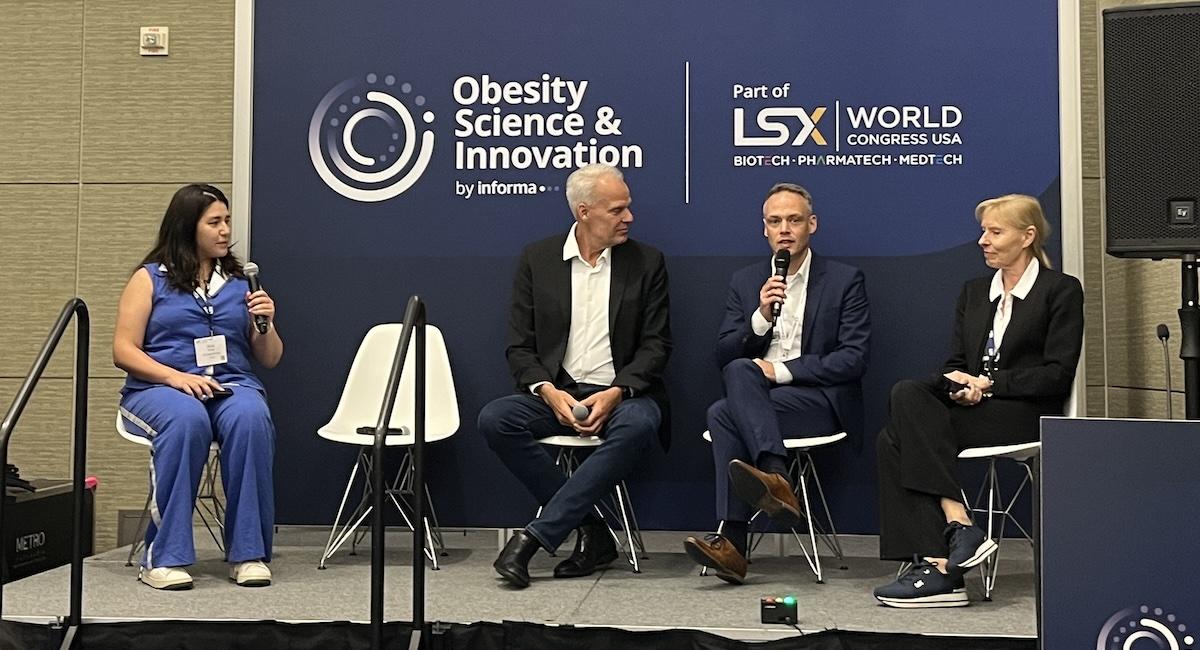
(L to R) Alice Gilman moderates a panel with Jacob Petersen, Daniel Markgraf, and Jovita Marcinkevicien.
At this year’s LSX World Congress in Boston, an entire track was devoted to Obesity Science and Innovation, with pharma leaders, biotech CEOs, academics, and other stakeholders discussing the exploding market of obesity science – not just GLP-1s, but future generations of treatments as well.
Throughout the event, several interesting themes emerged about this much-watched area of science.
1. Target validation, not discovery, is the current bottleneck
Beyond GLP-1s, there are a wealth of promising peptides and molecules for the treatment of obesity. But while pharma companies are working with academics and biotechs to identify those targets, the real bottleneck is in validating them, pharma experts agreed.
“For me, part of my daily work, the biggest struggle is actually target validation,” Daniel Markgraf, head of cardio-renal-metabolic research at Boehringer Ingelheim, said. “That is the huge part. What model do you use? There are many models out there, both in vitro and in vivo. Can you do this by yourself in-house, or do you need a partner in some collaboration?”
Jovita Marcinkeviciene, executive director of cardiovascular and metabolism for Novartis Biomedical Research, agreed.
“Target discovery is very interesting, and we rely a lot on a genetic basis and on academic groups who do a lot of phenotypic screens and other target discovery activities,” she said. “However, target validation is a very different story. I agree that lack of appropriate tools like genetic animal models or well-validated antibodies for very novel targets, it really slows down and makes it very difficult to narrow down those target lists to some manageable amount.”
2. Animal models aren’t cutting it in obesity research
A big part of the difficulty of target validation is that traditional animal models have fallen short in obesity research for a number of reasons.
“The translatability of especially rodent animal models, into humans has been really, really difficult,” said Jacob Petersen, SVP and head of global nucleic acid therapies at Novo Nordisk. “I cannot mention the long list we have of targets that have worked really nicely in animal models, even in non-human primates. Then, when you get to humans, there's nothing there, or the side effects, or what have you. That's, I think, the conundrum of doing research: that you have to kiss many frogs before one of them turns into a princess.”
The most reliable animals – non-human primates – are also the hardest to come by, Marcinkeviciene noted.
One particular example is nausea, a common side effect of obesity treatments and one that’s hard to stud and detect in rodents.
“In a lot of companies, we have to go into the humans to test that,” Marcinkeviciene said. “And not Phase 1, because these are five, six patients per group, you need Phase 2 data. So, addressing tolerability, it will be really challenging. I think we're really looking forward to academic community figuring out, how do we pre-clinically test potentially nausea risk?”
With animal models causing issues, researchers are looking to a number of different avenues: artificial human tissue, historical human data, or AI models. But none of these are fully ready for prime time either.
3. Scalability and manufacturing are major challenges affecting the whole space
One common theme at the conference was the need for companies to think about down-the-road problems like manufacturing and scalability early in their development process, and it turns out this is especially critical in the obesity space.
“GLP-1 molecules are very complex molecules,” said Mimoun Ayoub, global head of sales at Corden Pharma, a global CDMO specialising in GLP-1s. “To make them, it's approximately 100 chemical steps. So, the bottleneck in the global demand is the manufacturing of the API, but also to inject it. If you translate this into quantities, if you consider 10 mg per week, we're talking about 500 kilos per year. If you consider one million patients only, it's half a tonne of API. And for each single kilo, you need approximately 12 to 13 metric tonnes of solvents.”
Petersen, from Novo Nordisk, noted that increasing the complexity of the molecules only makes the scaling and manufacturing problems worse.
“Even if we are just treating tens of millions, scalability is an issue,” he said. “For example, antibodies. Scaling antibodies to tens of millions of patients is not an easy task with the current technology. I'm not saying it will not happen, but there are many binders that would be a lot better because they're more scalable than antibodies. There are also some large proteins that are difficult. Then, when you take antibodies and begin to attach a lot of things to them, scalability becomes an even bigger issue.”
He advised start-ups who want to work with a company like Novo Nordisk to start thinking early about scaling and manufacturing.
4. Regulators have outdated ideas about weight loss
While researchers’ understanding of weight loss is becoming more nuanced, panellists are worried that the FDA isn’t keeping up with that evolving understanding.
“Everything that we have discussed today right now is 5% weight loss,” Petersen said. “That will get you over to an approval. I think it's much more nuanced than that. What if you, for example, gained 10% in lean body mass and only lost 5% fat mass? Five percent fat mass will probably be closer to 10% overall weight loss with the current drugs, right? So, I think we need to have engaged in a fruitful, hopefully, collaboration and discussions with regulators on what does healthy weight loss look in the future, because it's not going to be how it is today.”
Vipin Garg, CEO of Altimmune, also mentioned that the FDA requires very large studies for obesity studies because of the size of the patient population, which can be a major barrier to entry in the space biotechs.
5. Oral GLP-1s might be overhyped
Right now the big pharma companies in the GLP-1 space are racing to get the first oral formulation of their drugs to market, expecting that most patients will prefer a once-daily pill to a weekly injection.
But there are reasons to believe that may not be the case – first among them that the oral GLP-1 for diabetes that’s already approved, Rybelsus, hasn’t seen anywhere near blockbuster sales.
“When Rybelsus was first introduced, people thought it was going to replace Ozempic because everybody's going to want to take oral medication. Well, the facts are that that didn't happen,” Garg said. “Rybelsus expanded the market. So, it's really a life cycle management strategy. Some people would rather take a once weekly injection than having to take medication every day.”
But there are also major challenges with administering peptide medications orally.
“One thing to watch out for is when you take oral medication every day, you're going to get a peak every day. And it's the peak that causes the tolerability issues,” Garg said.
And because more of the drug gets absorbed before it makes it to the target, oral formulations require more of the active ingredient than injectables – further exasperating scaling and manufacturing challenges.
6. The obesity space has a lot of life left in it
Despite the effectiveness of current medications, experts at LSX agreed that we’re still in the early days of this obesity drug revolution.
“If you think about blood pressure medication, 20 years ago, we had four or five blood pressure medications, and people thought, ‘That's it. We're done. We've solved the problem’,” Garg said. “Now, we have hundreds of mechanisms. The doctors know exactly which drug to give each patient. I think obesity will develop like that. It's going to take another 10, 15, 20 years, but it can extend that way.”
In addition to better obesity drugs, pharma companies are very interested in exploring the effects of these drugs, both directly and indirectly, on other related conditions.
“Not only have these drugs shown that there is clearly obesity as a disease on the consumer level, but, on the pharmaceutical side, that there's a very robust market and demand for these products if they're shown to be safe,” said Ashley Zehnder, CEO of Fauna Bio. “And so, that's now had an interesting trickle-down effect in terms of big pharma being willing to do discovery in obesity, but then also the morbidities that come along. So, we've seen a massive increase in interest in partnering around cardiovascular complications, cardiorenal disease, MASH - all of these things that drive along with the success in obesity.”
Finally, pharma companies are, as always, looking ahead to their patent cliffs and not wanting to waste any time.
“If you look at some of the drugs that are going to go generic in five to 10 years, you need to be significantly better than these drugs,” Petersen said. “You need to have something else to offer than these drugs have. Some of them are quite good. If you don't have that in five to 10 years it's going to be really, really difficult.”