What’s holding back precision medicine outside oncology?
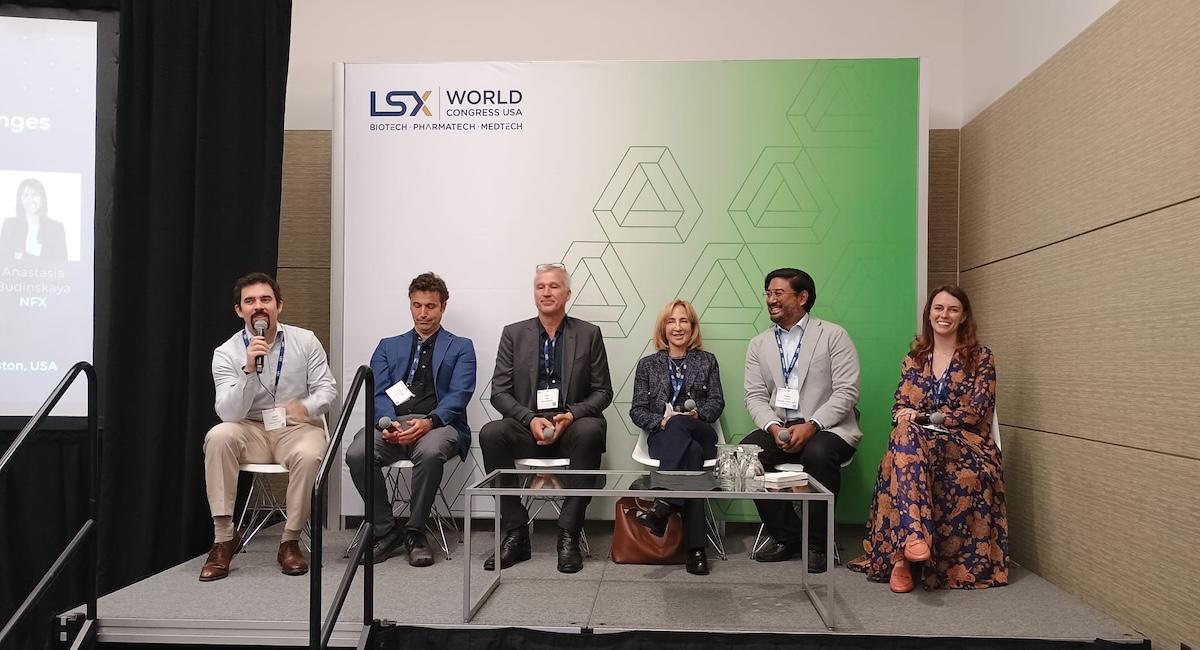
(L to R) Jarod Rutledge, Andrew Beck, Tom Willis, Amber Salzman, Prem Tumkosit, and Anastasia Budinskaya at LSX 2025 in Boston.
For years, panellists and prognosticators have been hailing precision medicine as the future of healthcare. As we learn more about the body and develop more sophisticated drug targeting, we should be able to vastly improve patient outcomes by offering them drugs tailored to their physiology. AI, with its ability to parse large datasets and find patterns, should speed this future along even faster.
And, indeed, in some areas - particularly in oncology - there is scientific progress being made in precision medicine. But in other therapeutic areas the science is much further behind.
At the LSX World Congress USA in Boston this week, investors and biotech CEOs discussed what factors are holding back precision medicine. And while some of those factors are scientific in nature, others have more to do with strategic and economic incentives in pharma.
Challenges with data and data collection
Panellists agreed that there are some aspects in which oncology is just fundamentally better suited to the development of precision therapeutics.
“I think truly understanding the biology has turned out to be surprisingly important,” Andrew Beck, co-founder and CEO of PathAI, said. “I think some of these other diseases, we don't understand the mechanism nearly as well as cancer, which is a somatic genetic alteration disease that drives changes in the tumour and the microenvironment […] The other complex diseases we work on, like IBD and MASH, are huge hodgepodges of many underlying ideologies, and they're not yet at all treated in a precise way.”
Additionally, the nature of cancer treatment lends itself to a lot of involved diagnostics in the normal course of treatment, making it easier to identify patterns in specific subsets of patients.
“In oncology, you're probably already in there taking a biopsy. That's why genetic testing, et cetera, and genetic sequencing of biopsies has been quite successful,” said Anastasia Budinskaya, a health tech investor at NFX. “But the thing that you're building, will this require infrastructure? Will this require a change in the way the clinician works? That's what I'm thinking about.”
Adding additional diagnostics into the workflow isn’t just onerous for doctors; it can affect quality of life for patients.
“If you're trying to get an answer for your specific drug, and you have the precision medicine saying you're going to have to do genetic testing on every participant so you can see where the responses are, that sounds so obvious, but it's complexity,” said Amber Salzman, CEO of Epicrispr Biotechnologies. “So, I don't mean to minimise it. I'm not belittling. But every time you put a patient through another test or another blood draw, you have to think, am I being fair to patients? Is this the right thing to do?”
Incentive problems at big pharma
Fundamentally, however, there are misaligned incentives when it comes to precision medicine in pharma. It’s similar to the incentive problems that plague the rare disease space: what makes a drug profitable isn’t necessarily its effectiveness alone, but rather its effectiveness in a sufficiently large population.
“I think there's trade-off between increasing the response rate versus the market share,” Prem Tumkosit, an investor at Boundless Health Capital who previously worked at MSD, said. “And, historically, big pharma has indexed towards the greater market share. And so, I think having a forcing function to push people towards developing therapies that are rewarded with better outcomes - I think that's the thing that is missing a lot.”
Panellists discussed a lot of missed opportunities for data gathering that would help lay the groundwork for precision medicine. For instance, the data hidden away in unpublished trial data at big pharma companies.
“Often, in trials the protocol is locked and it's designed, and then It's carried out. And then, if it fails, it's just thrown away,” Beck said. “And if it succeeds, even, there's not often a lot of motivation to look at subtype analysis [...] Radiology, pathology, molecular - all of that data plus clinical covariates can be very informative, and I think it's often left on the table or it's not used.”
To really advance precision medicine, pharma companies need to make a company-wide commitment to it. But that’s not how it plays out today.
“I think it is clear, historically, that precision medicine has been a, 'we do it if we need to do it, but it's not something that's core to our programme',” Beck said. “So, it's a very siloed group that, to some degree, seems like they're doing a science project for publication, and it's not always clear what the strategy is, particularly from the outside.”
Who pays for precision medicine development?
As always, money is also a factor; both the money to fund development of precision therapeutics in the first place, and assurance that those therapeutics will be covered by insurers when they reach the market.
“Who's funding this effort?” asked Tom Willis, CEO of Arima Genomics. “To get from a potentially useful biomarker, to be adopted in a clinical trial, to invest in the infrastructure to do that, to generate results, to get it on the market, to convince payers to pay for it - it's a long road and an expensive road. I think if we're asking investors to pay for that, the market is going to have to be pretty big at the end for them to bear the risk and time for that. And many of these are not.”
Here, again, oncology can show the way.
“Medicare’s approach to reimbursing precision medicine for cancer has been, I would say, pretty forward-looking,” Willis said. “Giving clear guidance as to what the coverage barriers are and the clarity around that allows companies to plan for them, and having a lot of reimbursement levels that allow companies to survive until they can build a larger reimbursement story or including private payers. So, I think there's a model that could be extended to other diseases as well.”
And, on the investor side, AI is making a difference by bringing down the costs of precision medicine research, according to Budinskaya, who cited the women’s health space as a prime example.
“We're at the stage in, let's say, second line endometriosis, for example, where we're still just collecting data,” she said. “And those capital requirements, if we did not have AI and if we did not have these multimodal data sets, would be so much higher. And I think that's one of the reasons why women's health has been receiving so much funding within the last couple of years.”