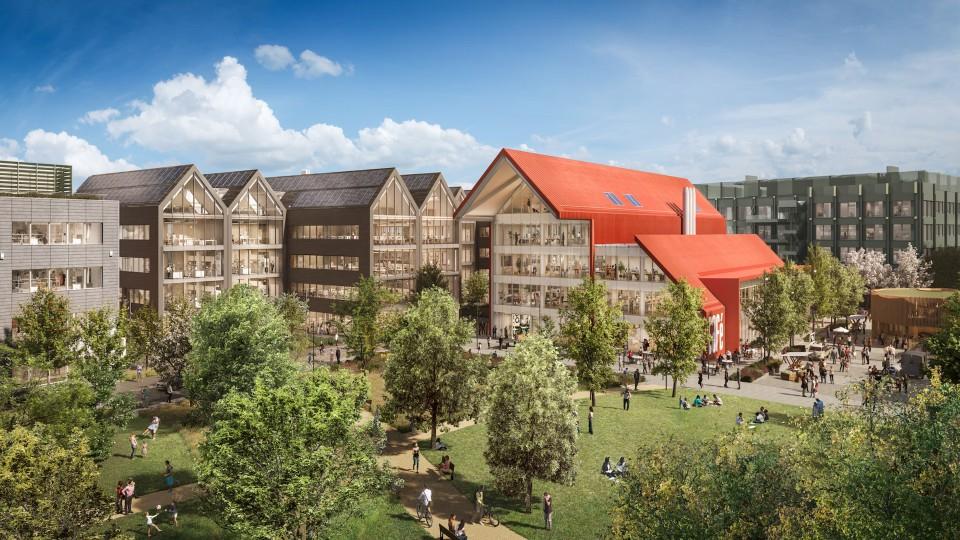
New £1.2bn science park opens in Oxford
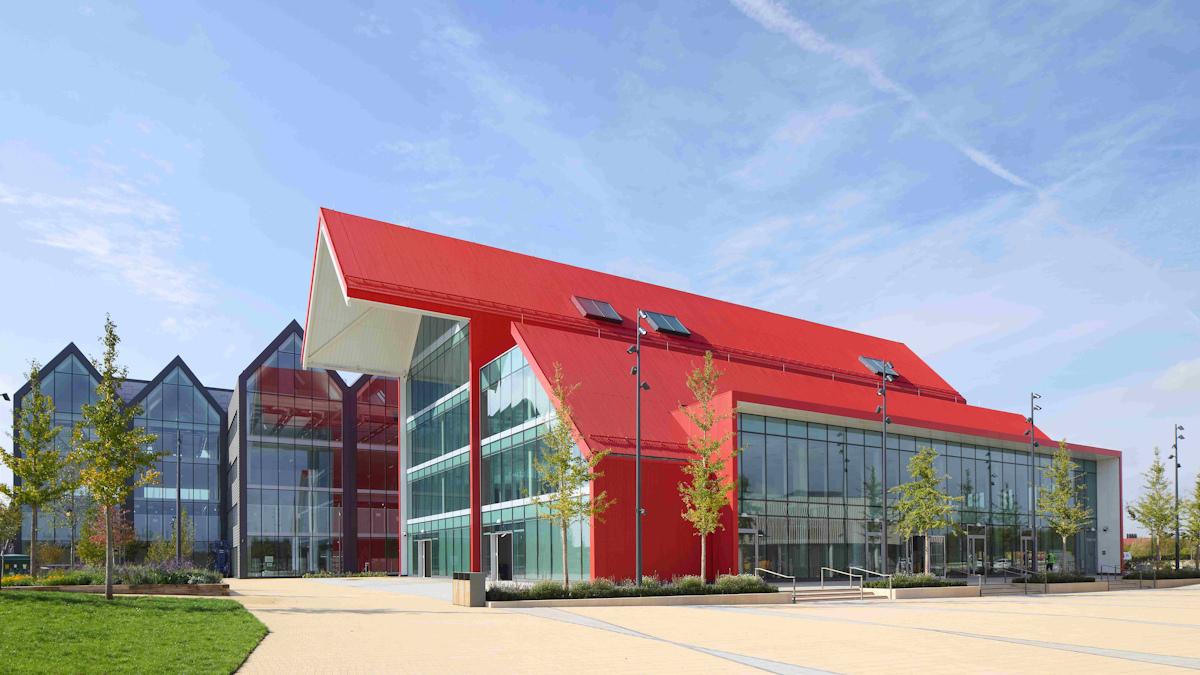
The Red Hall at Oxford North.
A new £1.2 billion science and technology park was formally opened today in Oxford, in a welcome boost to the UK's life sciences sector.
The Oxford North campus has consent for around a million square feet of flexible lab and office accommodation earmarked for use by organisations operating in the science, technology, and AI sectors, as well as around 480 new homes. About 4,500 people are expected to work at Oxford North once the development is complete.
The opening today by Lord Hague of Richmond, Chancellor of the University of Oxford, marks the completion of Phase 1a of the project. It accounts for 158,500 square feet of the available space and comprises two purpose-built lab buildings (1 and 2 Fallaize Street), with flexible space suitable for 1 to 100+ people, and The Red Hall, which will provide community and co-working spaces, along with a cafe-bar and retail units.
Phase 2 will see the construction of three further lab buildings with nearly 375,000 square metres of space and – once completed – the expectation is that the district as a whole will boost the economy by £150 million a year.
According to the developers behind the project – Oxford North Ventures, a joint venture between Thomas White Oxford, Ontario Teachers' Pension Plan and Stanhope – the campus is designed to "cater to the whole science, technology, and AI ecosystem, from start-ups and spin outs through to global giants."
The site is "well-positioned to capture the growing demand' from a broad spectrum of companies, led by those in the AI, quantum computing, biotech, and foodtech sectors, to help support the growth of the UK's life sciences, technology, and innovation industries."
The task now will be to entice companies and other organisations to take up the space at Oxford North. On that front, a spokesperson told pharmaphorum that contracts have been exchanged with a first occupier and it is seeing "strong interest from a range of companies for the remaining Phase 1 space."
The development is opening its doors at a tricky time for the UK life sciences sector, which has been rocked by a series of cancelled investment projects by some big-name pharma groups, including MSD, AstraZeneca, and Eli Lilly, that undermine the government's ambition to make the country the leading life sciences power in Europe by 2030.
There was some good news last week when US biotech Moderna opened a £150 million ($202 million) vaccine facility – also in Oxfordshire – that will focus on the development and manufacturing of mRNA vaccines.
Still, that figure is dwarfed by the nearly £2 billion in lost investment from MSD, AZ, and Lilly's cancelled projects, which have come amid a major spat between the government and the industry over medicine pricing in the UK, as well as other potential headwinds such as the threat of tariffs on pharmaceuticals imported into the US.
Lord Hague highlighted the importance of Oxford and the university in the UK science ecosystem, calling it "a unique hub with an exceptional 900-year history, and is synonymous with life-changing scientific and technological breakthroughs."
The University of Oxford has produced the most unicorn founders in Europe and accounts for 30% of all the capital raised by university spin-outs – some £5.7 billion – which is the highest share of any UK university.