Request to look further into NICE non-submissions in the future tabled

Leela Barham looks at the discussion on non-submissions to the HTA body NICE, informed by the latest metrics for the UK’s scheme that covers access and pricing of branded medicines.
Tracking non-submissions
The UK’s Voluntary Scheme for Branded Medicines Pricing and Access (VPAG) includes a commitment to regular operational review meetings. The most recent metrics, released in August 2026 and dated July 2026, include a breakdown of NICE recommendations, including terminations (Figure 1). Terminations are appraisals that couldn’t be completed because companies chose not to submit to NICE; they get referred to as both non-submissions and terminations for that reason.
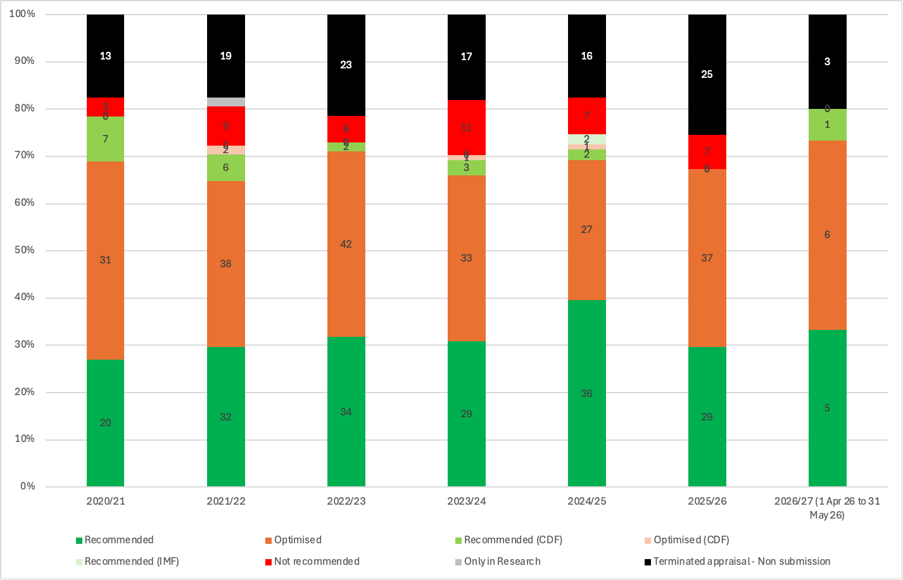
Figure 1: Recommendations by year of publication, including terminations. Source: Data from DHSC. (July 2026). 2024 Voluntary Scheme Metrics Tracker.
According to the Department of Health and Social Care’s (DHSC) metrics tracker, terminations have historically tended to peak in May and June; there’s no further information on why that is. Anyone know why company decisions like this tend to happen then?
For the current financial year at least, the metrics pack suggests that there’s no cause for concern because “2026/27 current termination rate (20% of overall publications) is in line with the historical average and falls within the typical range. There are no early indicators of a sustained increase in terminations, with current and forecast performance remaining stable within the historical range.”
More non-submissions since July
Since the data available in the metric dates, two more terminations have taken place up to 1st July 2026, according to the TACRAWLR from Tom Snell. Three were terminated in August 2026. Three in a month is unusually high. The year is not yet out, so it remains to be seen whether non-submissions will beat the previous peak year of 2025/26 or not, but it may be a less positive outlook for non-submissions than the DHSC tracker suggests.
Tolerance for non-submissions
The metrics deck notes that NICE has a tolerance for termination; the exact tolerance isn’t set out, but since 25 terminations, equivalent to 26% of appraisals in 2025/26, is described as under the tolerance figure, NICE can apparently tolerate quite a few non-submissions. Whilst that means less work for NICE, it also means NICE gets less in fees as companies pay for appraisals, with different charges based on the type of appraisal and company size.
NICE Integrated Performance regularly reports on fee income, although not non-submissions themselves. The September 2026 report notes that there is under-recovery of operating income from fees for Technology Appraisals and Highly Specialised Technologies of half a million. The report notes that “income delivery remains a key risk to the overall financial position [of NICE].”
NICE has its tolerance, and companies do, since they take the decision not to submit even if that may come with backlash, but patient groups like the Blood Cancer Alliance are arguably less tolerant about seeing a disproportionate number of non-submissions, having raised the issue repeatedly. That’s because non-submissions make it harder for the patients that they represent to access new treatments.
Deeper dive in future?
According to a note on the metrics tracker, a pre-meeting before the 9th July 2026 operational review meeting – for which notes are not yet available in the public domain – there was a request for reporting on non-submissions to NICE to include relevant context on deferrals, delays, and appraisal pauses. That also includes Most-Favoured Nation context, if it’s relevant.
This signals that there’s interest in looking beyond temporal trends and going further than the current metrics go.
The reasoning isn’t set out, but non-submissions could be part of tracking the impact of changes prompted by the US-UK trade deal. IQVIA have looked at terminations and pointed out that, depending upon how terminated appraisals have informed NICE expectations, there could be more medicines approved than the three to five a year prompted by a more generous cost-effectiveness threshold and new weights for quality of life used in appraisals. Both were part of the UK-US trade deal.
Non-submissions should continue to be looked at from many perspectives, not just operationally.