Health, growth & renewal: ABPI 2026 looks to UK’s future

The Association of the British Pharmaceutical Industry (ABPI)'s flagship annual conference took place on Thursday, 23rd April, in London’s Bishopsgate.
Under the theme of ‘Health, growth, and renewal: Delivering a shared agenda for the UK’, it explored how to ensure NHS patients benefit from the latest medicines and vaccines, how best to strengthen the UK’s global competitiveness in life sciences, and how to harness the power of health data to revitalise clinical research.
MFN shockwaves and US-UK trade agreement aftereffects
Dr Richard Torbett, the ABPI’s chief executive, opened the conference – his sixth time doing so in the role. But this year, he said, felt different.
“We are in a global pharma market undergoing a profound shift – the emergence of MFN [Most-Favoured Nation drug pricing] in the US is sending shockwaves through global boardrooms and governments alike, forcing all countries to answer what role they want to play in driving medical discovery and in global pharma innovation.
“Is the [UK’s] goal to lead or follow, attract investment or explain why it went elsewhere?” he mused.
What is clear is that the UK can’t have the lowest prices and have the highest access rates; intentional choices need to be made. And Torbett believes the UK is indeed starting to choose. Yes, for a number of years it has been a matter of innovation as a cost and there have been the consequences of a tough commercial environment. Yes, the UK generally has more restricted access and there has been a ‘worrying’ increase in companies choosing to terminate NICE appraisals due to the lack of viable pricing. But Torbett, nevertheless, remains optimistic.
The US-UK trade agreement, said Torbett, addresses the key issue of investing more in medicines, signalling the UK’s desire to compete and be a leader in life sciences innovation. Indeed, the US-UK trade agreement, known as the Economic Prosperity Deal (EPD), is a significant step towards enhancing trade relations between the two nations.
The EPD includes provisions for increased market access for American exports, and aims to reduce or eliminate non-tariff barriers that may discriminate against American products. It also commits both countries to work on supply chain security and to negotiate preferential treatment on pharmaceuticals, as well as other sectors. It is, in Torbett’s words, “a very big deal,” but it is not a one-off fix.
“What is needed is not a mere adjustment, but a clear strategy for the future,” Torbett stated. “A predictable framework for development over time to keep pace with medicines being developed.”
After all, confidence comes from knowing what happens next. To this end, he has always believed in the importance of NICE’s role in the system, however, there is a need to calibrate to global markets. “If decisions drift from what is viable in the global market, then challenges will occur,” he warned. Nonetheless, by ensuring access to medicines, that will ensure there is patient confidence in the launch of medicines in the future.
Clinical trials and health data
An important part of all this will be continued partnership with government, especially when it comes to clinical trials. With the recent, positive announcement that set-up time had fallen from 169 days to 122 days compared to the same six months last year, there is yet further to go – but that will depend on recruitment, and the VPAG investment programme is critical here, too.
Another big topic at this year’s ABPI conference – not least because of the breaking news about the UK Biobank data security lapse, with "de-identified" data from its 500,000 volunteers listed for sale in China – was health data. For years, the potential of integrated health data has been discussed, and now we are seeing delivery of that hypothesis.
Indeed, the UK is, as Torbett attested, in a genuine position of global strength in the life sciences. With a combined £137 million investment in “health research reforms, dismantling years of unnecessary bureaucracy, standardising processes across the system, and investing directly in research infrastructure across the UK” – when Torbett looks across all this, including the NHS 10-Year Plan, the Lice Sciences Sector Plan, and the US-UK trade agreement, he wonders how industry can respond to such progress, to ensure further progress, and faster at that. He ponders, in short, how industry can make the UK the ‘obvious answer’.
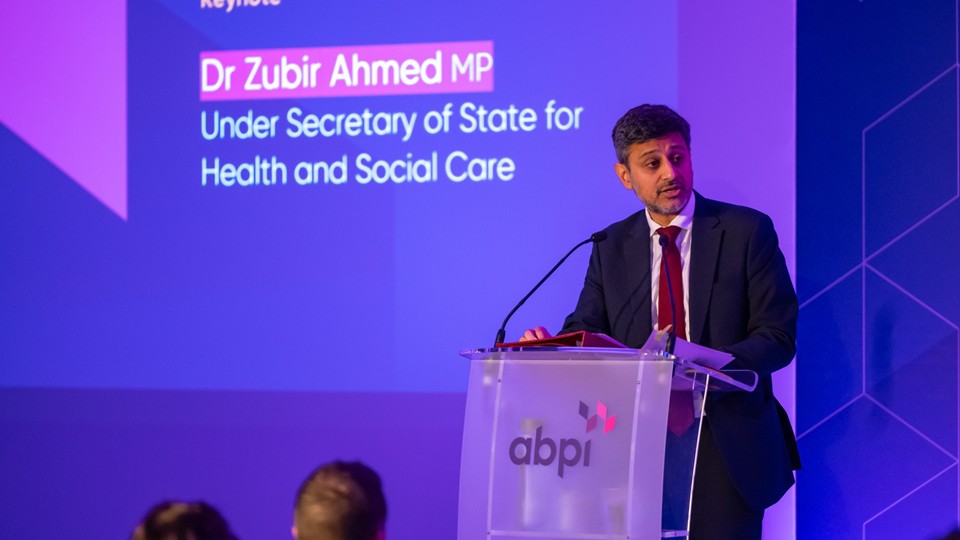
Dr Zubir Ahmed MP. Photo courtesy of the ABPI.
The health of the nation and its economy
Revealed on the day as the conference’s opening keynote speaker was Dr Zubir Ahmed MP, Under Secretary of State for Health and Social Care. Both his and Torbett’s statements provide an overview of the running themes of the conference as a whole.
Dr Amhed set out to highlight the progress that has been seen in the NHS since Labour came into power 20 months ago: from flashing red on every single indicator, at its worst crisis point in history, to this April, with almost three quarters of a million patients being seen on time, and with better outcomes for heart attack and stroke care, with waiting lists continuing to fall. Indeed, the NHS has seen a 6% increase in public satisfaction, the first rise since 2019, according to the latest findings from a NatCen survey of public attitudes to the NHS and social care, analysed by the Nuffield Trust and The King’s Fund.
Consistency, though, is the name of the game. The recent ‘North Stars’, the 10-Year Health Plan [10YHP] and Life Sciences Sector Plan [LSSP] must not present ‘hollow promises’: “There is no passing the buck under Wes Streeting’s leadership,” said Dr Ahmed. Streeting, of course, stood at the same lectern last year. So, although 2026 has been a “slightly rocky year,” nonetheless, the UK is home to four of the world’s top 10 universities; and the NHS health system has a data set ‘second to none’. Dr Amhed is also “proud of NICE as an institution, set up by [Health Secretary, Frank] Dobson, a giant of the Labour movement.”
“For the first time in over 20 years, NICE has been given a higher threshold for innovations,” he said. “An historic change that is already having fruits – two new cancer medicines, brain cancer patients as young as 12, and a rare gastric cancer. This government understands the indispensable contribution pharma makes to the health of the nation and its economy.”
Indeed, industry is decidedly contributing to the commercial landscape of the UK. Whether UCB’s capital boost from the Government’s Life Sciences Innovative Manufacturing Fund (LSIMF), to support its ongoing investment in R&D in the UK, or Boehringer Ingelheim’s expansion of its global Computational Innovation footprint with a new centre dedicated to AI and machine learning (ML) in King’s Cross, London, UK, part of the Knowledge Quarter ecosystem – “confidence is certainly back in the UK,” stated Dr Ahmed.
“The health of our nation and the health of our economy are now inextricably linked and the Joint Taskforce is an excellent chance to begin on a new and fresh footing – modernising the NHS is hard, I won’t lie, [but] industry, with its expertise, muscle, and innovation mindset is a core ingredient to help here,” he concluded.
Developments post-conference
Following the conference, on 27th April the Medicines and Healthcare products Regulatory Agency (MHRA) and Health Research Authority (HRA) introduced the largest package of reforms in over 20 years.
These include “faster assessment of first in human trials and the introduction of notifiable trials, a fast-track route to allow lower-risk trials to start sooner and modification to be approved quicker, whilst maintaining the highest safety standards.”
The news release quotes Dr Ahmed as calling this “a landmark moment for patients, researchers, and our thriving life sciences sector that will make a real, tangible difference for thousands of people waiting for new treatments.”
And on 28th April, the MHRA announced it will launch a new five-year strategy later this year, setting out how UK regulation will continue to evolve to support patient safety, NHS priorities, scientific innovation, and economic growth in the UK life sciences sector through to 2030. This will include strengthening the MHRA–National Institute for Health and Care Excellence’s (NICE) aligned pathway to accelerate patient access, a new UK–Singapore Innovation Corridor, inaugural membership of the HealthAI network, and collaboration with the US Food and Drug Administration (FDA) on medical device regulation as part of the wider US-UK pharmaceutical partnership.
Meanwhile, today - 29th April - AstraZeneca pledged to spend £300 million ($405 million) on investments in the UK. In a statement, Prime Minister Keir Starmer said the "significant investment" had been "made possible by the pharmaceutical arrangement we have struck with the US" and would "future-proof thousands of jobs in Macclesfield and in Cambridge."