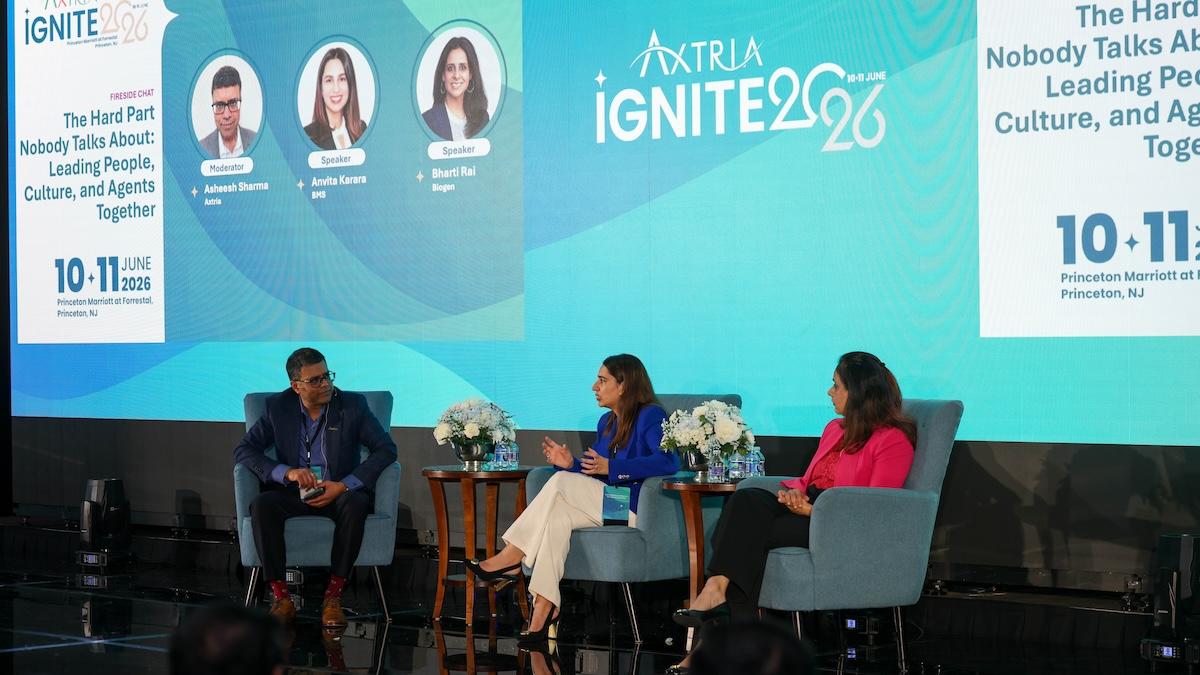
Axtria Ignite 2025: Building on GenAI’s foundation with agentic AI
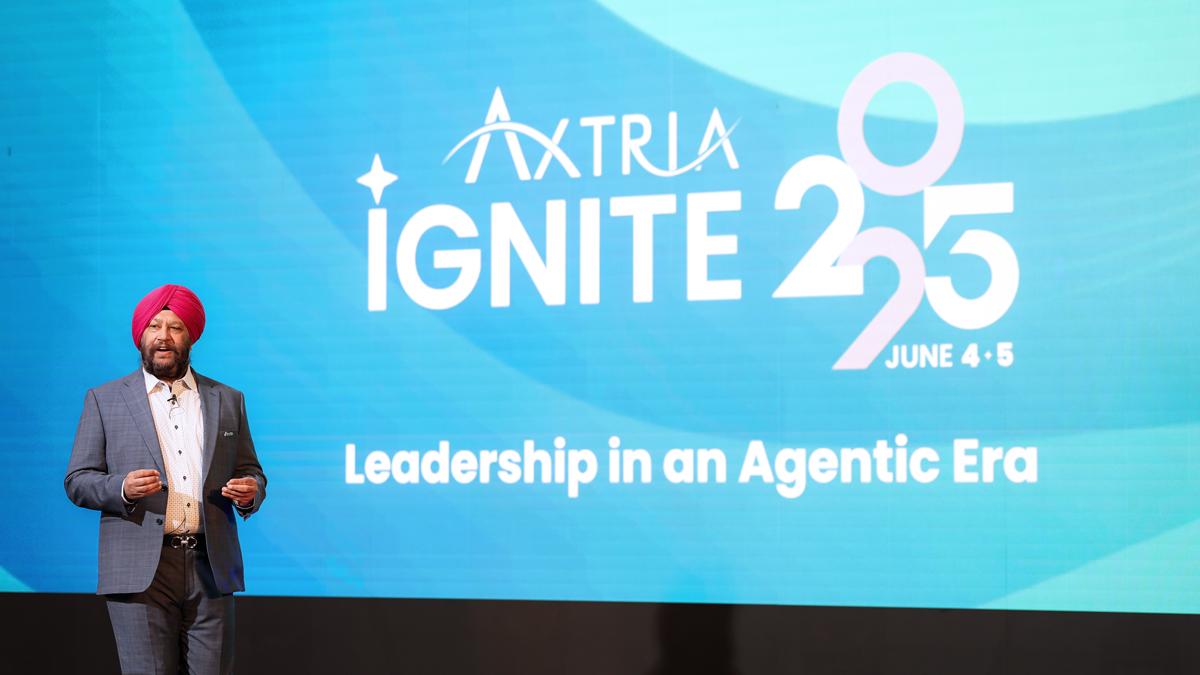
Hundreds of senior executives representing major pharma companies met last month at Axtria Ignite 2025 to discuss the future of agentic AI in the industry. Through panels, fireside chats, and many hands-on demos, the invite-only event revealed stories of what’s working and what isn’t when it comes to supercharging pharma operations with artificial intelligence.
Agentic AI takes centre stage
When it comes to the generative AI revolution of the last few years, a lack of enthusiasm has never been pharma’s problem. But, as one Axtria spokesperson said in an opening workshop at the event, GenAI often finds itself stuck in “pilot purgatory”, as the technology isn’t quite ready to deploy at scale.
Indeed, generic large language models do not work when stakes are high, cost is a factor, and data is as nuanced as it is in the life sciences. During a fireside chat on the main stage, a leading chief digital and technology officer told the audience that “90% of models fail.” And when it does work, it’s more like “we're kind of at the bottom of the first inning.” So, how can we get finally those big artificial intelligence wins in pharma? That’s where agentic AI comes in.
Agentic AI refers to AI systems that add layers of reason and autonomy. They act as largely independent agents that are specialised to perform particular functions, not waiting for prompts; rather, once they know the goal, they go after it. With each outcome, each feedback, they’re continually improving.

Off-the-shelf AI won’t cut it anymore
Agentic AI, like generative AI, makes calls to large language models (LLMs), but these LLMs are a compliance nightmare; they still have a tendency to hallucinate. And the more calls a system makes to the LLMs, the more opportunities for a hallucination to compromise the reliability of the system.
What’s the solution? Domain-trained, privately tuned LLMs, such as Axtria builds, which are pharma and business optimised. Because they use a more bespoke data set, they’re much less prone to hallucination. And because the company owns the model, instead of renting it, it ends up costing less as well.
What’s more: you don’t need to overload the training with extraneous information, as might be seen with standard, off-the-shelf public models. Highly-specialised agents know only their role, so they perform that task better. As one commercial insights executive director said during an Ignite panel, “In analytics, particularly with agentic AI, what we can do with data exploration, what we can do with pattern recognition, what we can do with physician augmentation, high-purpose analytics, is immense.”
An agentic AI in action
A demo is worth a thousand words, and throughout the event there were plenty of opportunities to see how these agents work in a real context.
One example is Axtria’s SalesIQ system. It leverages agents that take a variety of factors like incentive payouts, performance standing, and crediting logic into account to make complicated recommendations and enable changes to the map.
For instance, if a user, say an area general manager, asks the agent to help workload balance in an overloaded territory, the agent will determine the best ZIP codes to move out of those territories and the best territories to move them to. During an Ignite panel, the US alignment lead for a top-ten pharma company said, “One of the things that we are constantly being asked is can we merge these two territories, can we dissolve a territory, what will that look like? Having an agent that can do that complex analysis, that would really help.”
Solving implementation challenges
However, all the great technology in the world won’t help a company that isn’t able to train its teams and build cultures that facilitate rapid and effective adoption. This is a theme that came up many times over the two days of the conference.
From a culture perspective, it’s about clearly demonstrating the value of this technology to a few champions, and then encouraging the fire to spread from there. As the VP of commercial data science at a top pharma told attendees, “How do we get folks excited and want to do it? And then, over time, they become your change agent network.”
One great way to get folks excited is to just make the tools easy to use, said a VP and head of digital health at a leading pharma firm. “Making things simple and accessible for everyday tasks creates a better level of adoption,” she said – as well as having honest conversations reframing employee fears around AI replacing their jobs into excitement for AI making their jobs easier.
Building trusted systems
Several Ignite panellists noted how important it is to design AI use cases in a way that users can really trust them – not just the tools, but the process by which they’re developed.
Here, governance is key. And here, too, agentic AI can assist. As one pharma’s senior director of decision science and AI noted, “Before, we used to have inventories making sure that our ML models were doing what they were supposed to do. Now, because of the democratisation of GenAI and all the AI agents, companies have had governance as their main focus. So, that’s the evolution.”
AI agents aren’t always going to slot seamlessly into existing systems, said another firm’s director of data analytics and solutions for human health. That’s like “building a self-driving car and asking it to follow a horse-drawn cart’s rules.” Instead, we have to think carefully about designing systems where agents’ value can be maximised.
This might include systems where agents talk to other agents, but it will be important to make sure humans are in the loop somewhere in those systems, making sure the AI doesn’t run off the rails and impede data quality – as another top firm’s senior director of global decision sciences and insights noted.
Several panellists agreed: emphasise starting small with high-impact pilots and engage compliance teams early to scale agentic AI and AI-based omnichannel initiatives effectively.
Our agentic future
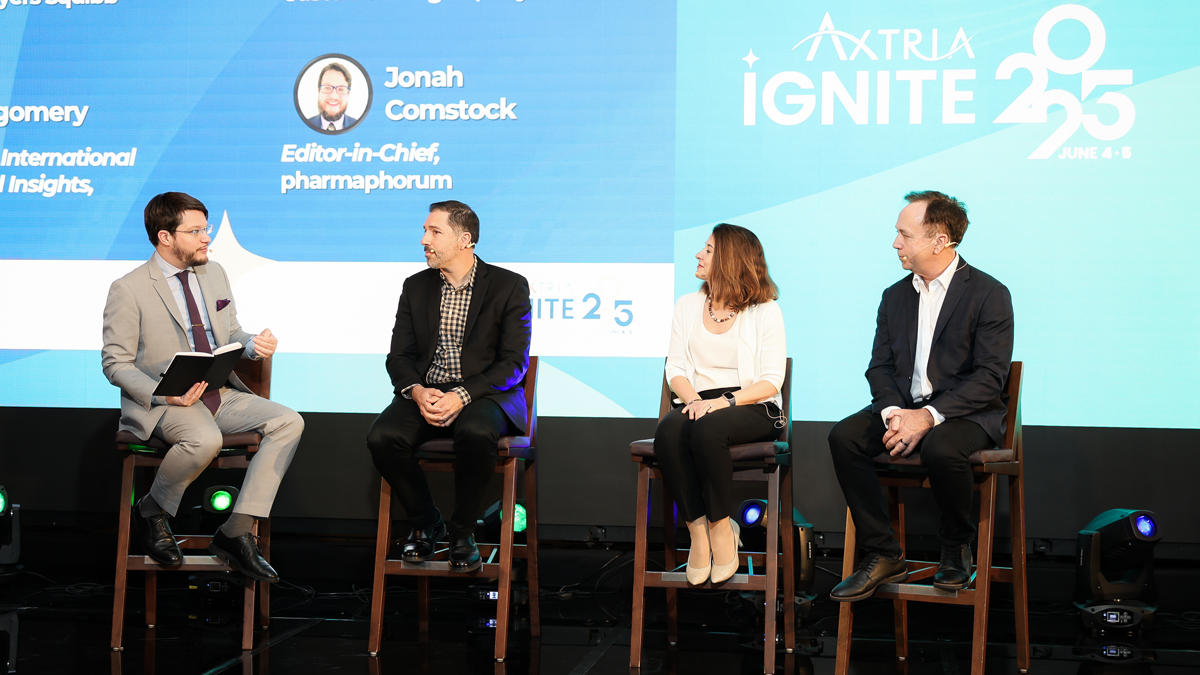
More than 45 speakers from a number of big pharma companies participated in the Ignite conference, including from the top five pharmaceutical firms. And they noted how agentic AI will ultimately revolutionise research, certainly in the number of experiments being done. But validation will continue to be a necessity.
“I think you're going to see a huge compression in a number of experiments,” said one chief digital and technology officer. “I think you're still for the foreseeable future going to have to experimentally validate, but the number of experiments you need to do to get to a validated target is going to be dropping significantly.”
Additionally, agentic AI will dramatically reduce the paperwork burden of clinical trials, with such options as touchless submission becoming a possibility and agents from life sciences companies communicating with agents from regulators – saving the considerable burden of the traditional human figure ploughing through 75,000 pages of documentation. No small gain.
Agentic AI could also help solve the problem of information overload for physicians. To enable this, pharma companies will need to embrace digital health to build the complex treatment information into the drugs themselves.
One speaker described the landscape in two decades being one requiring “a digital wrapper that elucidates why the molecule works in which patient population, how to monitor for safety events, how to monitor for the therapeutic effectiveness.” Those who wait, until it’s an insurer who reveals the drug’s successful patient population, will fall behind.
All of these possible futures explored at Axtria Ignite 2025 are enabled by moving from the imprecise, unreliable LLMs based on public data sets to domain-specific, purpose-built AI agents working in concert with each other – and with humans.
About Axtria

Axtria helps life sciences companies harness the potential of data science and software to improve patient outcomes by connecting the right therapies to the right patients at the right time. The company is a leading global provider of award-winning cloud software and data analytics to the life sciences industry. We’re proud to deliver proven solutions that help pharmaceutical, medical device, and diagnostics companies complete their journey from data to insights to action, enabling them to earn superior returns on their investments. As a participant in the United Nations Global Compact, Axtria is committed to aligning strategies and operations with universal principles on human rights, labor, environment, and anti-corruption, and taking actions that advance societal goals. For more information, please visit www.axtria.com.