JPM: The calm before the storm for radiotherapeutics
Radioligand therapies, which deliver small amounts of radioactive isotopes directly to cancer cells, are still waiting for their breakthrough moment. The technology has tremendous potential to deliver effective cancer treatment with negligible toxicity – but there are substantial scientific and logistic challenges that still need to be addressed before that potential is realised.
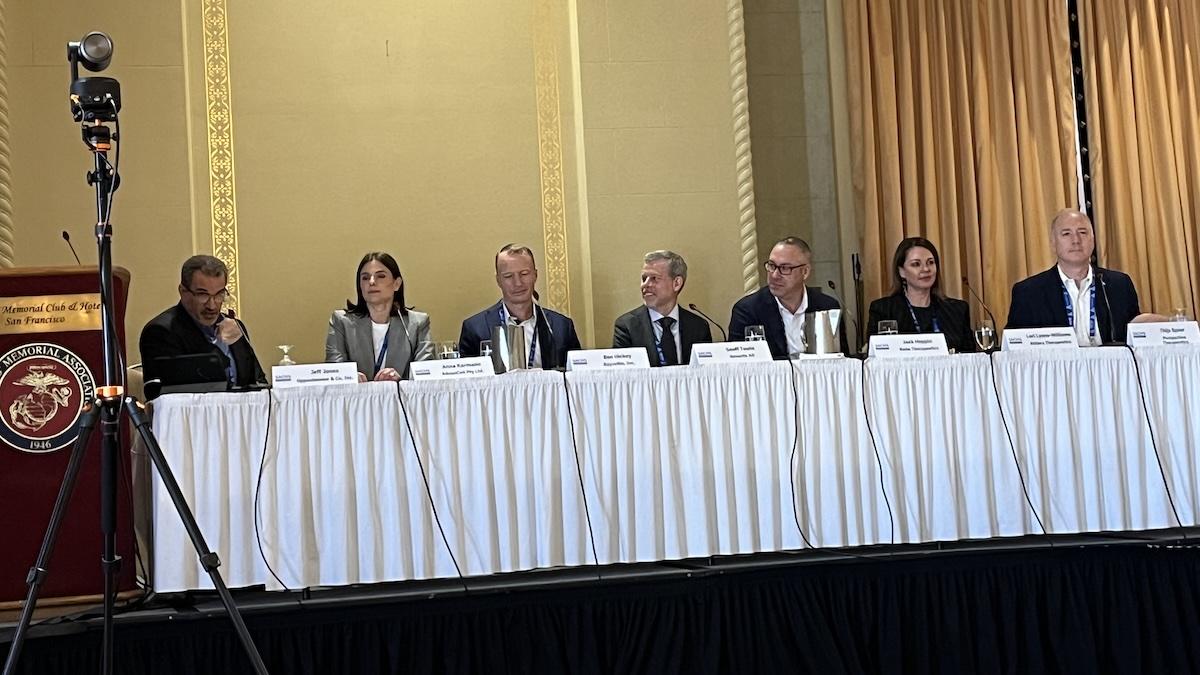
At the Sachs Oncology Forum this weekend, in the lead up to the JP Morgan Healthcare Conference, a panel of radiopharma innovators gathered to discuss the present - and future - of the space. The group included Geoff Towle, who heads up the RLT business at Novartis, the only company with approved therapies already in the market.
A $10 billion+ market
“I believe my CEO has been on the record to say that he expects us to be at least $10 billion business as a market for Novartis alone,” Towle said. “And that's certainly part of our ambition. And most importantly, of course, is how that translates into patient impact.”
Ben Hickey, President of RayzeBio, a recent Bristol Myers Squibb acquisition, agrees.
“It may not be the size of the I/O market, but there's no reason to believe that this can't be in the tens of billions of dollars,” he said. “So, that's one of the reasons that the Bristol acquired RayzeBio was to add on another modality to the modalities we had around target therapy, oncology, cell therapy, and so on.”
The current state of radiotherapeutics is “the isotope wars”, according to Jack Hoppin, CEO of Boston’s Ratio Therapeutics. The various companies, most pre-clinical, are experimenting to find the most effective and safe isotopes to use. But once these companies lock in, he predicts a rapid expansion into many indications and targets.
The coming inflection point
One reason for that rapid expansion is that radiotherapeutics have a strong and rapid efficacy signal in PET imaging.
“You can see in advance what will happen,” said Perspective Therapeutics CEO Thijs Spoor. “It's like seeing the question and the answer to the exam before you take it. For drug development, it's a massive de-risk.”
Another contributing factor is that radiotherapeutics can use some of the same targets as existing antibody drug conjugates, meaning the target is de-risked ahead of time. This is also true of targets that were studied and abandoned in ADCs because of toxicity.
“There're some inherent benefits to the delivery of radiation therapy,” said Lori Lyons-Williams, CEO of Abdera Therapeutics. “You don't need to worry about some of the toxicities you have to think about with some of the payloads on the ADC front. So, I think they can nicely be de-risked by other modalities, but there's still a really nice opportunity to differentiate with their radioligand therapy.”
From a dealmaking perspective, RLTs seem to be in a bit of a lull. As Lyon-Williams pointed out, there was a flurry of activity, but it has been quiet the last few years. Towle says this is just a timing quirk.
“Right now, there are a lot of fantastic assets. They're still in pre-clinical stages or maybe you’re clinical, but we're still waiting on some of the data,” he said. “I don't think the interest is waning at all. It's more of looking at the maturity of this space. And there's not a tonne of mid- to late-stage radiopharmaceuticals out there right now. Most of the lines that do exist are, at least from our perspective, similar to things we're already doing. And thus, that keeps us on the sidelines, but it's still a very high area of interest for our organisation and you'll continue to see us do deals in this space.”
“Over the last five years, with so much capital being in this market, the elevation of the business and the industry into this space is palpable,” Hoppin said. “You're going to see just much better drugs.”
Logistics challenges
But if there is to be a radiotherapeutics explosion in the next five years, the industry will need to overcome some infrastructure and supply chain challenges. The radioactive materials needed for these therapies may not be readily available at the scale needed for mass production.
“But it's more than just the supply,” Towle said. “Ultimately, part of the challenge is also in getting these to customers. Actinium has a relatively short half-life. And so, part of the incremental challenge is the infrastructure and investments needed to ensure that we can actually reliably get these to customers in a way that patients are able to show up to the office and actually receive them.”
There are also potential bottlenecks in the imaging piece.
“The ability to provide the imaging, the PET scan capacity, these are real things,” said Hoppin. “Personnel. There were 3.2 million PET procedures in 2025 in the United States of America. That's going to go to 6 million in four or five years.”
All that said, panellists were bullish that the breakthrough moment for radiotherapeutics is coming soon.
“As we project forward the next five to 10 years, that's where you're really able to see a massive inflection point for RLT,” said Lyons-Williams. “Obviously, Novartis and soon to be groups like the BMS will be commercialising these assets in ways that is, of course, contributing to the inflection point. But the big opportunity is getting into these larger markets, getting into other targets, getting into earlier lines of therapy. And that's what will really be the fuel [and] that, I think, will just put RLT into a different level, a different stratosphere, for how we see it as a modality in cancer.”