ESMO 2025 commences: ADCs, AI, and Asia
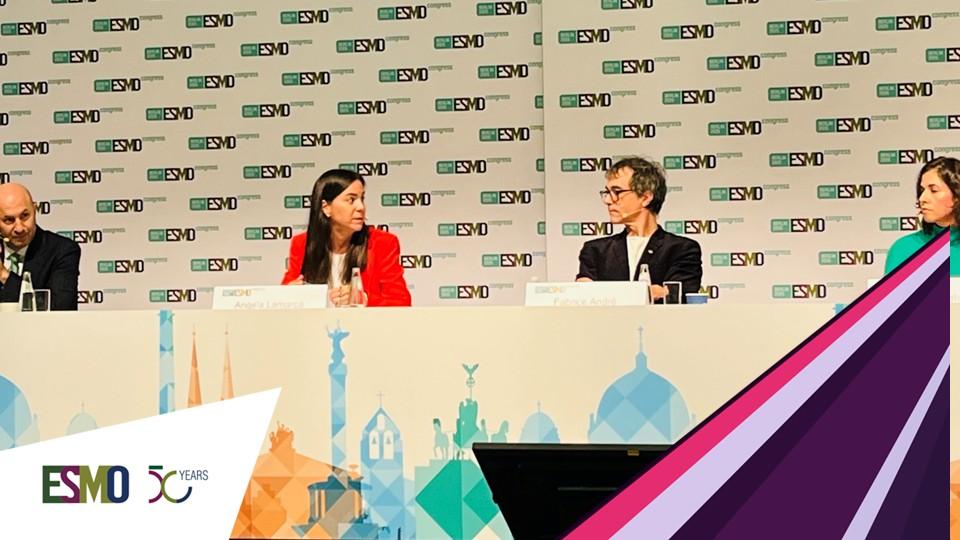
On Friday 17th October, the European Society for Medical Oncology’s Annual Meeting 2025 kicked off, with the opening press conference delivered by Fabrice André, ESMO president, and ESMO Congress 2025 scientific co-chairs Myriam Chalabi and Toni K. Choueiri. The session was moderated by Angela Lamarca, ESMO Press Officer.
This year marks not only the Congress' 50th year, but one for “breaking records,” commented Lamarca. And indeed, André noted that more than 35,000 attendees from all over the world are at the Congress, held at Messe Berlin, Germany. In terms of the “big trials,” it is a clear milestone in the history of oncology, the ESMO president said, that a new generation of ADCs is being shown to have an impact on patients who present in early stage cancer.
Additionally, of course, there will be discussions around artificial intelligence (AI) and ‘digital oncology’, while partnerships being built with Asian colleagues, oncologists from there, have led to presidential sessions featuring scientists, data, from Japan and China – demonstrating that it is “many countries” in the world which contribute to the advance of oncological medicine.
Antibody-drug conjugates, new discoveries
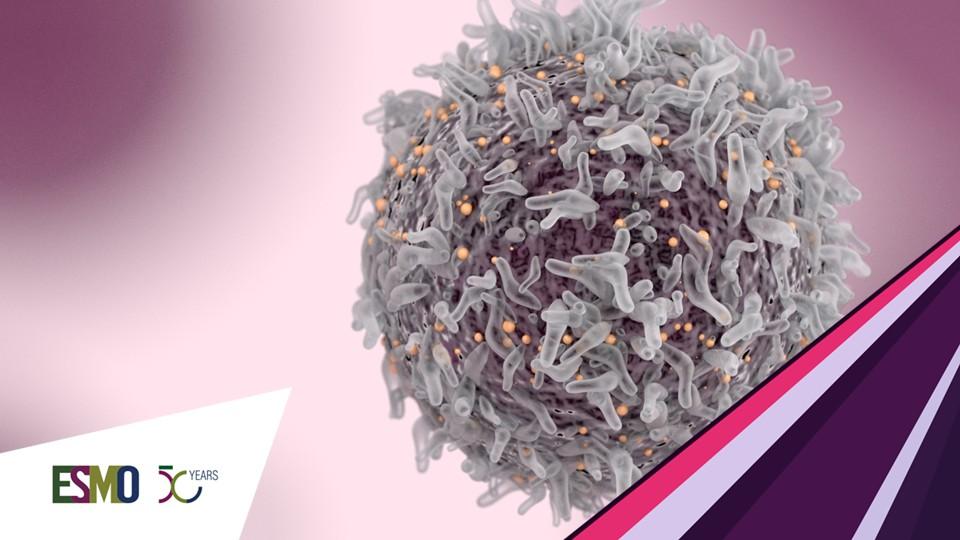
Asked to make clear exactly what it is antibody-drug conjugates (ADCs) have the potential to offer, André explained that the antibody binds to the target, generally a cancer cell, and, linked to the payload – normally a cytotoxic agent – delivers a high dose to the cancer cell. It is a new way of increasing the amount of chemotherapy the cancer cell is receiving whilst thereby sparing the normal, healthy tissue surrounding. This new class has a known impact in metastatic cancer, but now it is being argued that it might very well have an impact in early cancer, also. Tomorrow will reveal more.
In the vein of new discoveries, Chalabi noted that we sometimes forget that oncological developments start with basic science. Translational research sessions at ESMO will shed light on several topics, including that women who breast feed have a lower risk of developing breast cancer, that vaccines against COVID might impact results around checkpoint inhibitors – in short, the Congress promises some “very interesting data.” There is in all this a lot to be learned from basic science and translational data, she reiterated.
In terms of new treatments, Choueiri mentioned that ESMO 2025 might have the highest attendance and highest number of abstracts – but it also has a number of new modalities. For instance, radioligands in early setting of disease, and checkpoint inhibitors now in almost a prevention setting.
Need it be said, ESMO cares about all cancers. And Lamarca emphasised this point. It is not just about common cancers, but rare cancers too, and addressing those requires a sustainable healthcare system, inclusive of optimised treatment.
Chalabi added that treatment optimisation can include de-escalation and patient selection – ctDNA for example, and lowering doses, but maintaining efficacy. Furthermore, when it comes to low- and middle-income countries (LMICs), it is about addressing access issues and ameliorating the standard of care in those countries also.
On de-escalation, Chalabi explained that this means less drugs, which is more cost effective, and means lower toxicity. If it can be shown to result in the same outcome and improve quality of life – then that is what is wanted for all patients. The trials have to be very well designed, she caveated, and they need to show without any doubt de-escalation is not inferior treatment. Nonetheless, André’s perspective was to be more dose-centric: finding the optimal dose with the optimal duration. If you need two cycles of a drug to cure a patient, he said, you don’t need two or three years. In some countries where it is not possible to pay for two or three years of a drug, that optimal dosing can make drugs accessible to many more patients.
New drugs, and AI in the clinical setting
Choueiri admitted he had thought it was impossible to come up with new drugs, given we have so many. A tumour agnostic approach, though? One that stops treating per organ? The past 50 years were learning about cancer, classifying it by organ, said Choueiri, but a kidney cancer and a lung cancer can actually have more in common sometimes than lung and lung, or kidney and kidney. He mentioned that Chalabi herself had previously presented “stunning research” in this area.
Of course, AI now “touches everything.” Biomarkers can be facilitated. And when it comes to clinical trials – notoriously expensive and lengthy – AI can be used instead, perhaps, as well as in the personalisation of screening for every patient.
André agreed, noting that AI is “transforming oncology.” Indeed, some doctors are using ChatGPT in clinics – something that the conference will be focusing on, with release of a framework on use of LLMs in clinical practice; one of the first in clinical oncology, and a first step towards oncology assisted by AI. Additionally, he reminded us that ESMO is not only a conference: it is a scientific society, one consisting of colleagues working together to develop the right framework and classification for oncology moving forwards.
Questions for ESMO 2025 and beyond
Andrew Joseph from STAT enquired further into the praise for ADCs moving into early settings, stating that’s what eventually happens anyway, but also asked how that affects change in clinical care, in adaptation of physician practice.
André agreed that it is the normal history of treatment modality to move from advanced cancer to earlier. However, importantly, it is patient expectations which differ: a patient with metastatic disease is very hard to cure, whereas the expectation of patients in early stage is cure. This is why it is so important, he said. Those with early stage cancer have low toxicity, no long term sickness, and it opens the conversation on “how to train doctors in new modalities.”
Anette Breindl from BioWorld commented on the recent standard language used in abstracts and press releases – such as ‘statistically significant’ and ‘clinically meaningful’, seemingly always now included in the wording of these. What does it take, she asked, to be specifically ‘clinically meaningful’, especially if patients haven’t been asked?
Choueiri admitted it is “in the eye of the beholder.” A high bar in GU cancer, for example, is clinically meaningful for him, but you have to “ask a patient directly.” He is a practicing clinician – for some patients, he said, two months’ survival benefit is perfect, allowing them to make a holiday or a baptism, etc. For other patients, however, they want a cure. And ESMO has done a good job integrating patients and patient advocates.
The importance of the question was noted by ESMO president André: as a scientific organisation, ESMO has developed a framework to avoid biased interpretation – the ESMO-Magnitude of Clinical Benefit Scale (ESMO-MCBS) is designed to provide a structured and validated approach to assess the therapeutic impact of anticancer treatments. “There is no room for personal interpretation,” he asserted, and ESMO now has an involved group of patient advocates, aiming to eventually humanise scientific reports, putting humanity into the reportage of science.
Connected to this are, of course, Quality of Life questionnaires, said Lamarca. Which questions, commented Chalabi, share commonalities: earlier intervention, clinically meaningful data, selecting patients better. It is, she said, all coming together.
Broadening out from Europe: Oncology in the Far East
A pertinent online question from the French Press Medical Agency sought panellist opinions on the new drugs being developed in Asia and in study of Asian populations, as regards their suitability for patients in Europe.
André made clear that it is “very good news for everyone that China, Japan, all colleagues from Asia are inventing and manufacturing new drugs and undertaking clinical trials.” Indeed, 2024 marked the inaugural year of ESMO Asia. On the generalisability of that data and those drugs, though, he admitted he doesn’t yet have the answer. To this point, already methodologists have been set the task of addressing this unknown, to see whether additional trials are needed, but it will not be a case of repetition of a large Phase 3, say; for André, for patients, that just wouldn’t make sense.