After 'Year of Harvest', Bayer looks to diversify modalities
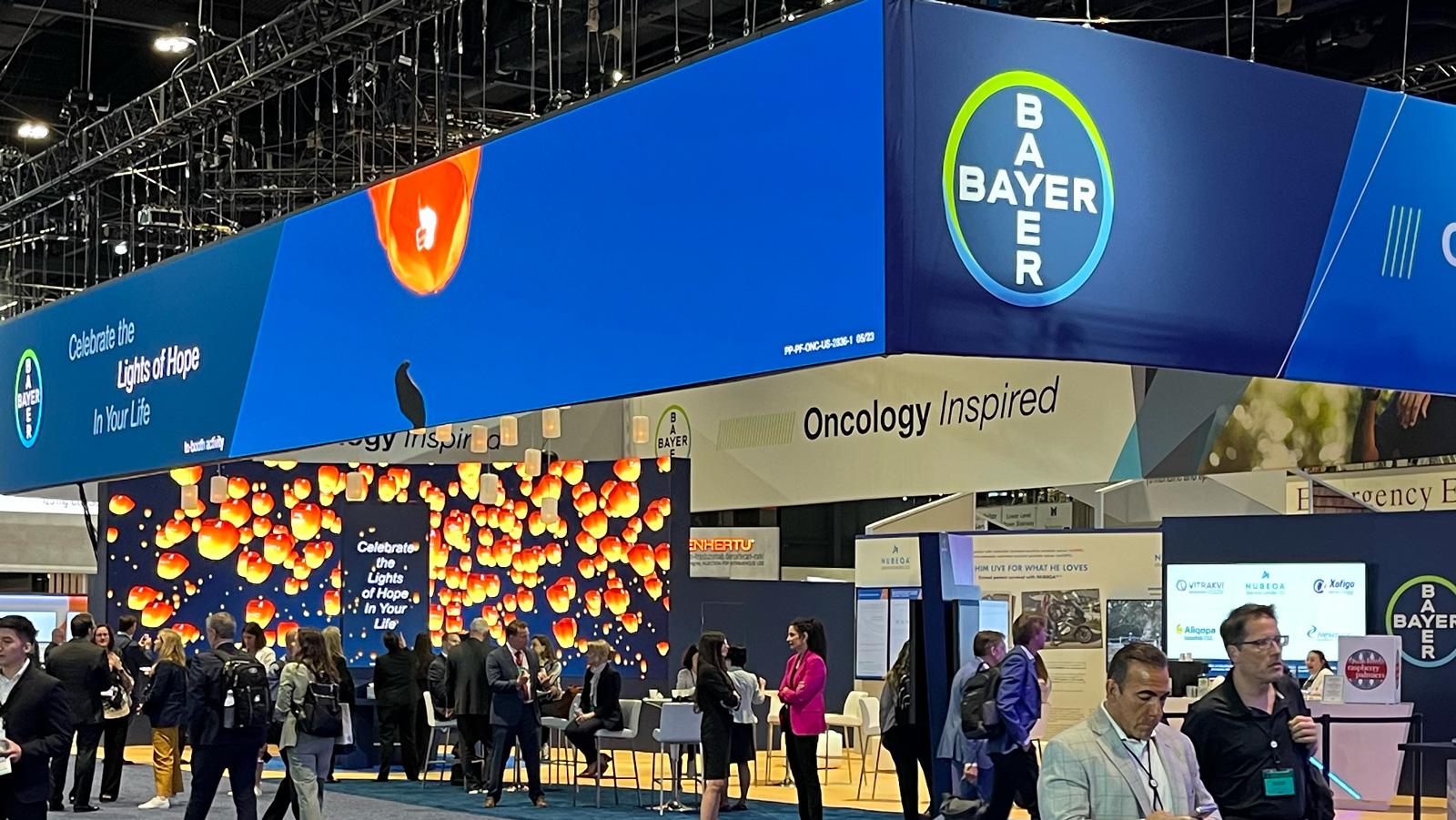
Bayer Oncology at ASCO 2024.
For the last three years, Bayer has been implementing a new strategy for its oncology development, a strategy that led to multiple approvals, as well as a number of promising new programmes added to its pipeline, in 2025. Now the company is tweaking that approach in the name of building a more diverse portfolio in terms of modality.
“We basically ended up with a portfolio that is very rich in small molecules, chemical matter, and radioligand therapy,” Bayer Head of Research and Early Development for Oncology Dominik Ruettinger told pharmaphorum in an interview on the sidelines of JPM last month. “It's not as diverse as we had thought it would be. Now we're actively intervening a little bit and saying, ‘Hey, we do want an antibody drug conjugate, for example, in our portfolio?’ We are [also] interested in an immune cell engager approach and a bispecific approach. You have to actively steer such a strategy a little bit to diversify.”
The strategy that’s led Bayer into its current position is called “precision drug development” and it is proudly modality agnostic.
“It's not rocket science. It's a mixture of a search grid of what good looks like and an unbiasing instrument,” Ruettinger explained. Biases are natural for researchers, but they can lead to missed opportunities, he said. “You recruit a wonderful rock star in oncology development, and he's been working on one certain modality for his entire life, and guess what?”
Up until now the strategy has had Bayer Oncology looking for three criteria: programmes with a clearly defined target-disease link; a strong predictive biomarker; and clear value differentiation from other competing programmes. Those criteria are then applied across four search areas: acquisitions, academic alliances, internal innovation, and Bayer’s platform companies – fully owned but operationally independent subsidiaries Vividion, Blue Rock, and AskBio.
A range of recent investments
As noted, Bayer brought in a number of new programmes last year using this strategy.
One, a PRMT-5 inhibitor from Puhe BioPharma, represents the firm’s first deal with a fully Chinese biotech. It targets MTAP-deleted tumours in cancers such as pancreatic cancer and glioblastoma. Another was a K-Ras G12D inhibitor from San Diego’s Kumquat Biosciences, targeting a mutation found in pancreatic, colorectal, and lung cancer.
And, on the academic side, the company secured an accelerated approval in second-line non-small cell lung cancer with the HER2 mutation that came out of work from the Broad Institute at MIT and Harvard. They’re expecting first-line approval on that drug, sevabertinib, in 2026.
The company is also working with its subsidiary Vividion to leverage Vividion’s chemoproteomics platform in pursuit of previously undruggable targets.
Finally, Bayer is anticipating a 2027 readout from the ARASTEP study of the company’s successful drug Nubeqa (darolutamide) in prostate cancer.
“That is our prime example of what improved tolerability of a molecule can do and how important that could be for patients,” Ruettinger said. “That's a programme that became a blockbuster drug much faster than we had anticipated. And we've seen real-world data on the compliance of patients being much higher than with any other AR inhibitor.”
Jockeying for a radiotherapeutics leadership position
As the radioligand therapy space heats up, much of the innovation is coming from small biotechs. But big pharmas have strong footholds in the space already, with Bayer and Novartis notable for having three already FDA-approved drugs between them. In Bayer’s case, that’s Xofigo (Radium 223 dichloride).
“This is probably the most fascinating mode of action that's out there,” Ruettinger said. “Alpha particles can kill every cancer cell regardless of mutational status, regardless of pre-treatment […] From a mode of action perspective, if you can get this stuff safely into the tumour, I don't think there's anything better than that.”
Unlike Novartis’s drugs Pluvicto and Lutathera, Xofigo is alpha-emission, which Ruettinger believes holds significant advantages.
“Higher linear energy transfer, shorter penetration, which means less damage to healthy tissue,” he said. “I, as an MD, I want to say there are probably other advantages that are much more relevant, such as no shielding needed, additional radiation safety measures. That means a relative can pick up the patient and drive in the same car, which you cannot do with a beta-emitter. You can sleep in the same bed and things like that. That is significant from a handling and convenience perspective.”
Ruettinger acknowledged that the radiotherapeutics space has inherent logistical challenges.
“Actinium has a half-life of about 10 days,” he said. “So basically, you're making the drug and then the clock ticks. You know, euphemistically, these drugs are called just-in-time drugs, which means you better hurry up and get the stuff to the patient.”
However, the widespread interest in the space means that the cost of the required infrastructure is being spread out across multiple stakeholders, which makes it a manageable problem.
“I'm totally convinced that we're almost beyond the tipping point because investments have been made into infrastructure by hospitals as well as companies,” he said. “So once you're beyond that tipping point, you are using it. I'm pretty sure this is here to stay.”