NICE backs five AI tools for bowel cancer screening
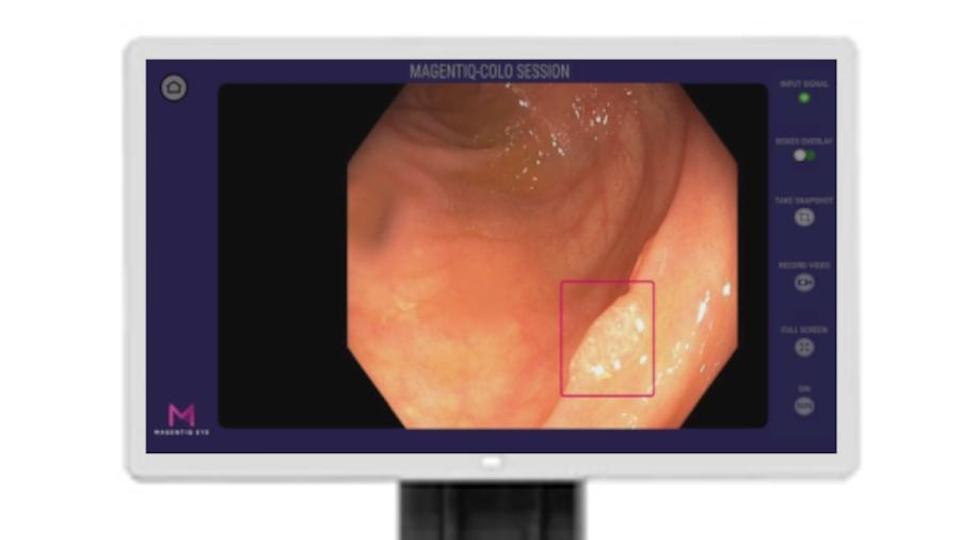
Magentiq's MAGENTIQ-COLO is one of the AIs recommended for use by the NHS.
Five AI-based technologies that can be used during a colonoscopy exam to help detect the early signs of bowel cancer have been backed for use by the NHS.
New guidance from reimbursement authority NICE has recommended that the five AIs – Fujifilm's CAD EYE, Olympus' ENDO-AID, Wision AI's EndoScreener, Medtronic's GI Genius, and Magentiq's MAGENTIQ-COLO – can be used to look for colorectal polyps that can become cancerous if not found and removed early.
They can be used in the NHS over the next four years while more evidence is collected on their benefits in spotting and characterising polyps, to gauge whether that translates to an improvement in colorectal cancer detection, and to determine their impact on costs and surveillance intervals.
Several other AIs can only be used for research purposes by the NHS for the time being, as evidence for their value remains premature, according to NICE's appraisal committee.
"These AI tools watch the live camera feed during a colonoscopy and have learned to spot polyps by studying thousands of images. When the software thinks it sees a polyp, it alerts the doctor to the area of concern. It's like having an extra pair of eyes looking out for anything that might be easy to miss," said NICE in a statement.
"The doctor stays in complete control and makes all the decisions – whether something really is a polyp, whether it needs removing, and what to do next," the agency added. "The whole process fits into the normal colonoscopy and usually adds just a minute or two to the appointment."
Bowel cancer is the UK's fourth most common cancer, affecting over 42,000 people each year, and patient advocacy organisation Bowel Cancer UK has called on improvements to be made to screening in the forthcoming National Cancer Plan to help avert what Cancer Research UK has predicted will be more than 600,000 new cases of the disease by 2040.
Last year, a study published in The Lancet Oncology confirmed that the rate of colorectal cancer is rising in younger adults around the world, with England among the countries seeing the highest increase.
Catching the disease early makes a huge difference, as nine out of 10 people survive for five years or more when it is identified at the earliest stage.
"We’re committed to bringing innovative technology into frontline care quickly and safely as part of the NHS’s move from analogue to digital, and this is a perfect example of that," said Prof Peter Johnson, national clinical director for cancer at NHS England.
"I am looking forward to seeing how this technology works in NHS services, alongside the appropriate clinical oversight, and the benefits it has for patients," he added.
The draft recommendation is now open for comments until Thursday, 11th December.