From roasts to billions: Navigating the biopharma investment landscape in 2025
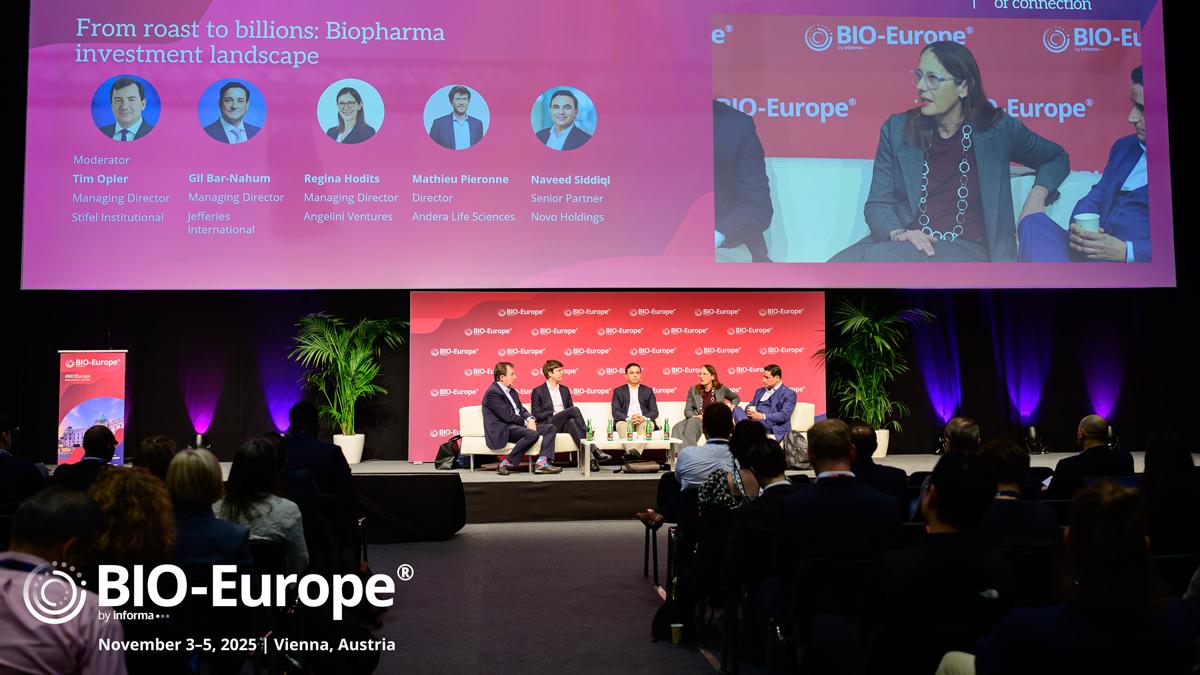
At the BIO-Europe congress in Vienna, the session titled “From Roasts to Billions: Biopharma Investment Landscape” brought together leading voices from investment banking and venture capital to dissect the state of biotech funding in 2025.
Moderated by Tim Opler (Stifel Institutional), the panel featured Gil Bar-Nahum (Jefferies International), Regina Hodits (Angelini Ventures), Naveed Siddiqi (Novo Holdings), and Mathieu Pieronne (Andera Life Sciences). Their discussion revealed a market in transition – shaped by macroeconomic shifts, evolving investor priorities, and the relentless pursuit of innovation.
Capital markets: A turning point
The conversation opened with a candid acknowledgment: the past few years have been challenging for biopharma financing. Pandemic aftershocks, geopolitical uncertainty, and tightening liquidity have created headwinds for early-stage ventures. Yet, optimism is returning, particularly in the US public markets.
Gil Bar-Nahum painted a vivid picture of resurgence: “October alone saw $40 billion returned to investors through M&A, and 35 follow-on transactions compared to none in April.” Mutual funds, flush with capital, are deploying aggressively, sometimes after mere minutes of diligence. The XBI biotech ETF has climbed 20% in recent weeks, signalling renewed confidence. IPO activity, while cautious, is stirring – Jefferies recently led a $250 million IPO for MapLight, with more deals queued.
This rebound matters beyond Wall Street. As Bar-Nahum explained, “Follow-ons need to work, IPOs need to work – then purse strings open for venture capital.” In short, public market liquidity is the tide that lifts all boats, eventually cascading into private funding and early-stage innovation.
Venture capital: Later-stage bias and frugality
On the venture side, the tone was pragmatic. Regina Hodits of Angelini Ventures emphasised a “product-first” mindset: “If the going gets tough, it’s the product, stupid.” Investors are gravitating toward later-stage assets with clear clinical validation and defined patient populations. Angelini’s recent bets – Munich-based Meridian Pharma and Paris ADC specialist Adceterix – reflect this trend.
Hodits also highlighted a cultural shift toward capital efficiency: “Our frugal approach is catching on with US friends.” Syndicates now span continents, prioritising milestone-driven spending and conservative burn rates. While Angelini supports venture studios and spin-outs, the bulk of capital flows to companies nearing or in clinical stages.
Novo Holdings echoes this stance. Siddiqi confirmed that, while evergreen capital allows Novo to stay active across cycles, “It’s been harder to invest very early.” Instead, Novo is backing large private rounds - $150 million to $300 million - positioning companies for eventual IPOs or strategic exits. “It’s a buyer’s market,” Siddiqi noted, citing Windward’s $200 million raise as an example of transcontinental deal-making.
Andera Life Sciences shares this later-stage bias, but remains opportunistic. “We cover every step – from preclinical to Phase III,” said Pieronne. Yet, he acknowledged the “winner-takes-all” dynamic: mega-rounds for clinical-stage assets dominate, while preclinical start-ups struggle for attention.
Europe vs US: Diverging dynamics
Historically, European biotechs have faced steeper hurdles than their US counterparts. However, recent PitchBook data shows Europe posting its strongest life sciences fundraising quarter ever – a trend driven by a handful of blockbuster rounds. Siddiqi cautioned against over-generalisation: “It’s a tale of haves and have-nots.” Later-stage European companies with robust data can attract global syndicates, but early-stage ventures remain in a funding drought.
Structural challenges persist. As Hodits observed, “Europe still hasn’t figured out how to get companies onto a stock market easily – they still have to go to Nasdaq.” This reliance on US listings underscores the need for deeper European capital markets and more streamlined IPO pathways.
M&A: The engine of liquidity
If public markets are the tide, M&A is the current propelling momentum. Bar-Nahum forecast sustained deal-making, driven by big pharma’s looming patent cliffs: “$90 billion of revenue is disappearing into thin air.” To fill the gap, pharma must secure assets with $2–$3 billion peak sales potential – whether through late-stage acquisitions or upstream bets on earlier portfolios.
Recent European deals illustrate this trend. Ipsen’s acquisition of ImCheck and Taiho’s purchase of Auraris reflect growing appetite for targeted innovation. Even early-stage players – such as in vivo CAR-T companies – are finding buyers, offering VCs alternative paths to liquidity.
China: Catalyst or competitor?
A striking theme was China’s rising influence. Regulatory reforms enabling rapid first-in-human trials, coupled with cost efficiencies, have made China a magnet for development. “If you have a bispecific agent and publish the sequence, assume someone in China will be in 300 patients within days,” said Bar-Nahum.
Rather than viewing this as a threat, panellists saw opportunity – particularly for Europe. Hodits argued that, “this could be Europe’s moment if we pair our deep biological expertise with China’s execution speed.” Collaborative models, not extractive ones, could unlock value, provided geopolitical and regulatory complexities are navigated.
Advice for entrepreneurs: Clarity, commercial vision, and credibility
The session closed with practical guidance for founders seeking capital:
- Define the problem first. “It’s amazing how often people skip this,” said Siddiqi. Context matters – investors need to know why your science exists.
- Articulate clinical translation. Strong preclinical data is not enough; explain how it becomes a differentiated product.
- Show a credible path to market. Hodits stressed mapping the commercial case early: “If you can model a $1 billion opportunity for a defined patient population, you’re good.”
- Know your audience. Pieronne advised researching fund portfolios: “If they’ve done three T-cell engager deals, don’t pitch another.”
- Build for independence. Bar-Nahum warned against over-reliance on M&A: “Expect to become Pfizer – that’s the quickest way to be acquired.”
And common mistakes? Overhyping science without market context, ignoring biomarker strategy, and failing to demonstrate why investors should “own this stock today.”
The road ahead
The biopharma investment landscape in 2025 is a study in contrasts: frothy US capital markets versus cautious European venture; mega-rounds for clinical assets versus early-stage scarcity; and a global chessboard where China’s speed meets Europe’s science. Yet, amid uncertainty, one constant remains – the imperative to deliver innovation that matters to patients.
For entrepreneurs, the message is clear: sharpen your story, validate your science, and align with investors’ evolving priorities. For investors, opportunity abounds – but so does competition. As Bar-Nahum put it: “The music is playing loudly, but when it stops, it stops abruptly.” In this high-stakes symphony, timing, strategy, and execution will determine who dances and who’s left standing.