Biotech leaders: ‘They're shoving this industry into the arms of China’
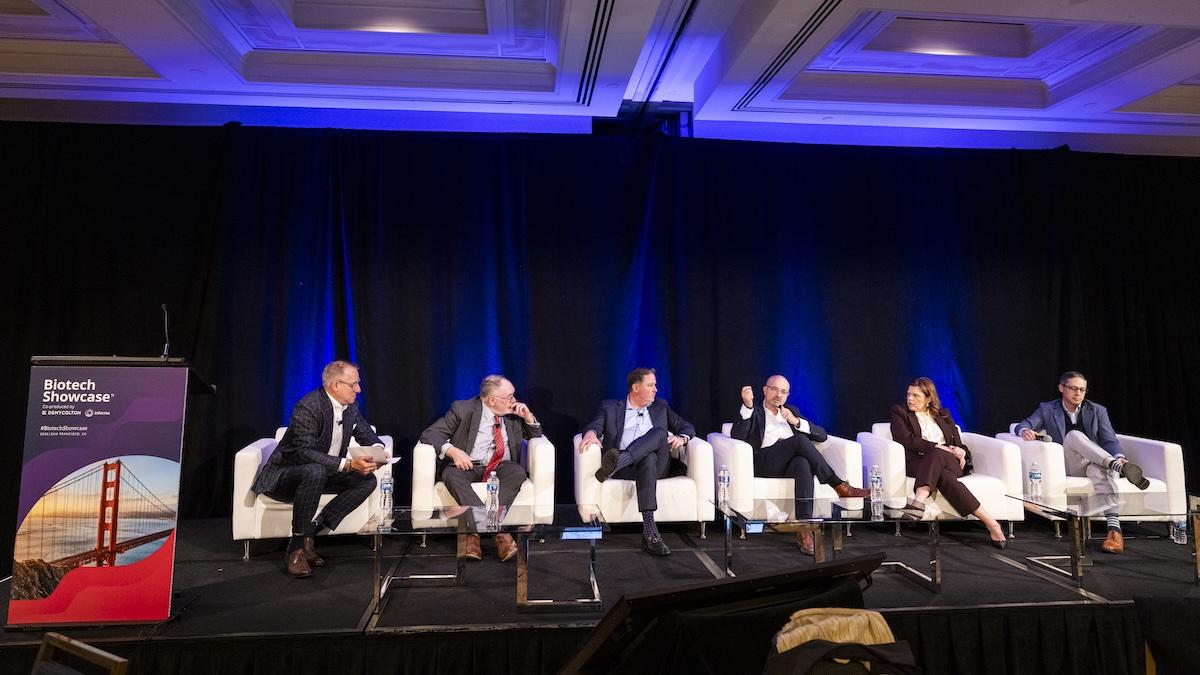
At the Demy-Colton/Informa Biotech Showcase, a US policy discussion with (L to R) Oppenheimer & Co's Michael Margolis, Foley Hoag's Thomas Barker, BIO Board Chair and Genentech SVP Fritz Bittenbender, Ovid Therapeutics Chair Jeremy Levin, PhRMA COO Lori Reilly, and Google Head of Healthcare and Life Science VC Joe Shonkwiler.
The confluence of China’s rapidly rising biotech prowess and US policy decisions that hamper the industry is a cause for rising concern among US pharma and biotech leaders, who see the country’s hard-won dominance in this space slipping away.
That was the prevailing narrative at the US Policy Perspectives panel at the Demy-Colton/Informa Biotech Showcase in San Franscisco last month, which featured top voices from pharma industry groups PhRMA and BIO as well as investors, experts, and biotech executives.
“We talk as a country about energy dominance. Why on earth are we not talking about wanting to retain our biotech, biopharma dominance?” said Lori Reilly, COO at PhRMA. “We took this industry, candidly, over the last four to five decades from Europe to the US through a combination of smart policies. … And China has had this multi-decade plan that they are now going to be dominant. They are doing everything they can to take that away from the US and we are playing into that, in my opinion, by pushing policies that send industry into a different direction.”
Reilly and other panellists mentioned a number of administrative decisions that make it harder for US biotech to compete, including funding cuts to the NIH, FDA, and CDC; government price controls around IRA and MFN; and immigration policies that limit the ability of universities and businesses to attract top talent.
“Business requires stability at the FDA, at the CDC, it requires we bring in the best talent to devote themselves to finding new medicines, which requires immigration and it requires a sentiment of 'We can do this and we are with you,’” said Jeremy Levin, chair of Ovid Therapeutics. “That's not happening.”
Those factors, along with the general instability and uncertainty that are hallmarks of the current administration, are also affecting the industry’s appetite for deals, Levin said.
“No large company in their right mind should be doing large M&A right now because if they are they cannot possibly predict what's going to be happening the next day,” he said.
China’s increasing dominance in biotech is not an accident. The country is in the midst of a 40-year strategic plan which has seen them rapidly stand up a biotech industry that’s moved from me-too drugs to producing real innovation – and producing it faster than other countries. As a result VCs from all over the world, including the US, are increasingly putting their money into Chinese companies, which are also increasingly attractive partners and M&A opportunities for global pharma companies.
“We're making it harder, not easier,” Reilly said. “The fact is that a Phase 1 clinical trial takes half the amount of time in China at 40% less cost. We need to do things here to make clinical trials more efficient, we need to rely on technology like AI in terms of reviews. We need to make sure that if we build a manufacturing base here that it's built to be efficient, because China's not just at our heels. Within the next decade they're set to surpass us.”
Panellists agreed that the strategy for reclaiming US biotech dominance has to involve the US coming up with its own plan.
“What China has that we don't have is that strategic plan,” said BIO Chair and Genentech SVP Fritz Bittenbender. “They've said in 40 years they're going to be the global leader in healthcare and life sciences. And that's exactly what we have to do in the US. And that includes thinking about regulatory, that includes thinking about policy changes, that includes thinking about manufacturing. And the response cannot be 'We're going to stop anyone from China from doing business in the United States.' Their technology is too good. The response has to be 'Yes, we're going to manufacture in the United States too and do clinical trials in the United States too'. It can't be just no to China, we have to compete and win against China in terms of innovation.”
Joe Shonkwiler, head of healthcare and life science VC at Google, was a little more optimistic about the US in biotech vs China, stating that the US is better positioned to take advantage of the AI revolution. Levin added that the US should lean on its longer history of medical research.
“It's critical for us to take advantage of the fact that we have an enormous repository of medical knowledge in the United States and if we use AI that will allow us to build better clinical trials, better selection of patients, better endpoints,” he said. “And because of the 40 years of record-keeping, which is something China does not have, we have a huge advantage in this country.”
But before anything else, panellists said, the US government needs to acknowledge the problem and stop making it worse.
“Whether it's for national security reasons or just because we want a healthy population, we should want to retain this industry,” said Reilly. “And to me going backwards for funding things like the NIH, changes to intellectual property laws, changes to our reimbursement policies, those are not things that drive and advance our industry. They put us further behind. They're shoving this industry into the arms of China.”